
Canadian tech teams are under pressure to move faster, spend less, and make better decisions with AI. That creates a clear challenge for leaders across the GTA and beyond: which tools actually improve workflows, and which ones are just noise?
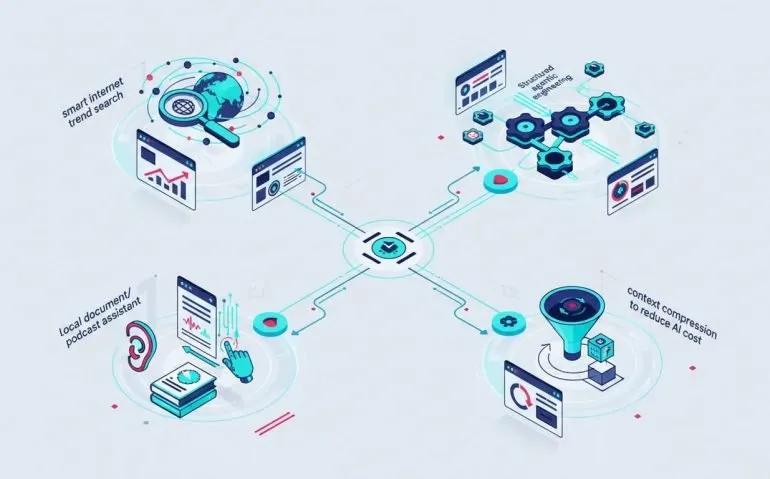
Four open source projects stand out for a simple reason. They solve real problems that business and technical teams face every day. One turns internet activity into a smarter trend search engine. Another creates a local alternative to NotebookLM for document analysis and podcast generation. A third imposes structure on agentic engineering. The last one attacks one of the most painful cost issues in AI by compressing context before it hits the model.
For organizations tracking the next wave of Canadian tech productivity, these projects are more than interesting GitHub experiments. They point toward a broader shift in business technology: AI tools are becoming cheaper, more customizable, and increasingly practical for everyday use.
This guide breaks down what each project does, why it matters, and how it could fit into modern Canadian tech operations.
Why these open source AI tools deserve serious attention
Open source AI is no longer just a sandbox for hobbyists. It is becoming a meaningful part of enterprise and startup workflows. For Canadian tech companies managing budgets carefully, that matters.
Free tools lower the barrier to experimentation. Local deployment offers more control over privacy and data handling. Skills and wrappers for coding agents reduce friction for development teams. And context compression can materially reduce AI operating costs.
These four projects map directly to four high-value business outcomes:
- Better intelligence gathering through trend-based search
- More useful knowledge extraction from long documents and files
- More disciplined engineering execution through structured agent workflows
- Lower AI spending through token savings and context optimization
Each tool addresses a different bottleneck, but together they reveal where AI infrastructure is heading.
1. Last30Days: A new kind of search engine built on human signals
The first project, Last30Days, is a skill that behaves less like a traditional search engine and more like a real-time intelligence layer. Instead of relying primarily on static indexed pages, it searches across platforms such as Reddit, Hacker News, GitHub, X, YouTube, TikTok, and Polymarket, then uses human engagement as the core ranking signal.
That distinction is important. Standard search often returns a mix of SEO-optimized pages, old articles, and paid placements. Last30Days aims to surface what people are actually discussing, sharing, funding, or voting up now.
How Last30Days works
The project aggregates signals from several places where technical communities and internet culture move quickly:
- Reddit upvotes
- Hacker News activity
- GitHub project momentum
- X engagement
- YouTube content signals
- TikTok engagement
- Polymarket odds backed by financial positions
It searches these sources in parallel, scores them based on real engagement, and then uses an AI judging layer to synthesize the results into a concise brief.
The result is not just a list of links. It is a compact explanation of what is trending, why people care, what the key arguments are, and where the supporting discussions are happening.
Why this is useful for Canadian tech leaders
For anyone operating in Canadian tech, trend detection is becoming a competitive function. Product teams need to identify emerging techniques. Investors and founders need to detect momentum before it becomes obvious. IT and engineering leaders need to understand which patterns are durable and which are simply hype.
Last30Days can help in several scenarios:
- Competitive research on fast-rising AI concepts
- Market scanning for startup opportunity areas
- Internal briefings for leadership teams
- Technical trend analysis for engineering managers
One of the strongest use cases is identifying language shifts. In the example shown, the project was used to research “loop engineering,” a term that had only recently begun circulating. The tool not only summarized the concept but also surfaced key patterns and the source communities driving the conversation.
Shareable HTML summaries make it practical
A particularly useful feature is its ability to generate a clean HTML brief. That turns a search result into a shareable artifact for teams. Instead of forwarding a collection of links, a user can distribute a formatted summary with the main findings and source references already assembled.
For Canadian tech companies that need lightweight executive memos on fast-moving topics, this is a simple but valuable capability.
What makes Last30Days different
The project’s strongest idea is that attention itself is a dataset. People signal importance with upvotes, likes, reposts, comments, code stars, and sometimes even money. Last30Days treats those signals as a useful filter for relevance.
That does not make it perfect. Human attention can be noisy and reactive. But for identifying what is newly important across developer and internet-native communities, it can be remarkably effective.
2. Open Notebook: A local NotebookLM alternative for documents, Q&A, and AI podcasts
The second project, Open Notebook, targets another major need in Canadian tech: turning long documents into usable knowledge.
NotebookLM-style workflows have become popular because they let users upload PDFs and other material, ask questions about them, and generate audio discussions based on the content. Open Notebook brings that model into an open source environment and can be run locally if desired.
What Open Notebook can do
At a basic level, Open Notebook ingests documents and allows conversational interaction with them. But it goes beyond simple chat with files. It also supports audio generation and multiple document transformations.
Key capabilities include:
- Question answering over uploaded documents
- Insight extraction from essays, reports, and PDFs
- Podcast generation based on source materials
- Dense summaries and simplified summaries
- Reflection questions for learning or review
- Table of contents generation
- Paper analysis for more academic or technical material
In the demonstrated use case, a single article was loaded through a link, then analyzed for tone and perspective. The system identified that the author’s stance was supportive of AI, but in a nuanced way rather than a simplistic “machines replace people” framing. It also pointed back to the relevant reference location inside the document.
Why local matters
For many B2B and enterprise teams in Canadian tech, local deployment is not a niche feature. It is a strategic requirement.
Documents often contain:
- Internal process details
- Client information
- Draft strategy documents
- Regulatory material
- Technical architecture plans
Being able to run a document intelligence system with local models or a controlled stack can make adoption easier for security-conscious organizations. Open Notebook supports hosted models, but it also allows local models for language, voice, and related tasks. That flexibility is one of its biggest strengths.
Podcast generation is more than a novelty
One feature stands out because it sounds playful but carries real business value: automated podcast creation from documents.
For busy professionals in Canadian tech, not every report gets read. But a synthesized audio discussion of a report, policy paper, research note, or internal memo can dramatically increase consumption. Audio versions of dense materials can support:
- Leadership briefings
- Sales enablement
- Analyst note summaries
- Research digest formats
- Internal training materials
Open Notebook also appears to offer substantial control over podcast tone, host setup, and script behavior. That matters because enterprise audio content needs more than generic text-to-speech. It needs structure and credibility.
Where ElevenLabs fits in
The workflow also highlighted ElevenLabs as an option for more natural voice output. For organizations building customer-facing conversational systems, support tools, or audio-driven products, realistic voice quality can have a meaningful impact on adoption and trust.
That makes Open Notebook relevant beyond personal productivity. It can become part of a broader Canadian tech stack for knowledge delivery and conversational interfaces.
What this means for Canadian businesses
Document overload is a universal problem. Across legal, consulting, software, public sector, and financial services organizations in Canada, teams sit on large volumes of information that are difficult to operationalize.
Open Notebook suggests a practical path forward:
- Upload or link internal materials
- Turn them into searchable intelligence
- Create summaries for different stakeholders
- Produce audio versions for broader adoption
That is exactly the kind of business technology transformation many Canadian tech leaders are seeking.
3. Agent Skills: Structured workflows for agentic engineering
The third project, Agent Skills, is especially relevant for engineering teams trying to get consistent output from AI coding agents. It provides seven slash commands that map to seven stages of engineering work:
- Spec
- Plan
- Build
- Test
- Review
- Code simplify
- Ship
This is a deceptively important idea. Many teams using AI agents for software development struggle because they jump straight into prompting for implementation. They skip definition, constraints, milestones, and refinement. The result is often noisy output, weak architecture, and rework.
Agent Skills addresses that by embedding a disciplined workflow into the development process.
Why agentic engineering needs structure
As AI coding tools proliferate, the bottleneck is shifting. It is not just about generating code quickly. It is about orchestrating work clearly enough that the agent can contribute meaningfully.
That is where many Canadian tech teams can gain an advantage. The companies that win with AI-assisted engineering are unlikely to be those that merely use agents. They will be the ones that impose strong systems around them.
Agent Skills appears designed for exactly that. It makes the engineering workflow explicit instead of leaving everything to ad hoc prompting.
The “interview me” workflow is especially useful
One highlighted feature is a guided interview command. It asks step-by-step questions to clarify what the user is trying to build, what type of problem it is, and what edge cases or goals matter.
That conversational intake then gets structured into a markdown artifact that can feed the rest of the workflow.
This matters because project failure often begins at the definition stage. A badly scoped feature request leads to vague plans, weak execution, and avoidable bugs. By forcing a clarification process early, the skill can improve the quality of everything that follows.
Strong fit for product and engineering teams
Agent Skills is not only for individual developers. It is relevant for:
- Product managers refining feature concepts
- Engineering leaders standardizing AI-assisted workflows
- Startup founders translating ideas into build plans
- Technical consultants creating repeatable development processes
The example used in the workflow focused on building a library of agentic loop ideas for engineers. The tool responded by forming a hypothesis around the concept, identifying likely patterns, and continuing to probe toward a more complete spec.
That kind of iterative clarification is exactly what many teams need when experimenting with AI-driven product development.
Additional capabilities extend beyond coding
The project also includes areas such as security hardening, code simplification, and performance optimization. This broadens its value. Instead of functioning as a one-time planning assistant, it can support quality throughout the lifecycle.
For Canadian tech organizations where lean teams need to maximize every engineering cycle, that can be highly attractive.
Bottom line: Agent Skills turns “prompt and hope” into a clearer engineering system.
4. Headroom: The open source cost saver that could reshape AI economics
The fourth project, Headroom, may be the most commercially significant of the group.
Its purpose is straightforward: compress the information sent to a large language model before the model processes it. That includes tool outputs, logs, retrieval chunks, files, and conversation history. The promise is the same result quality with far fewer tokens.
For anyone managing AI costs, this is a massive idea.
Why token efficiency is now a strategic issue
As Canadian tech companies adopt more AI tooling, token spend becomes a real operating expense. Even where usage is tied to quotas rather than direct invoices, teams still run into practical limits. Long conversations, large codebase exploration, debug sessions, and retrieval-heavy workflows can burn through context windows and budgets quickly.
Headroom attacks that problem at the infrastructure layer.
Rather than asking teams to simply use cheaper models or shorten prompts manually, it compresses the incoming material before it reaches the model. That can preserve utility while reducing cost.
The savings are dramatic
The reported examples are striking:
- Code search with 100 results: from 17,000 tokens to 1,400, about 92 percent savings
- SRE incident debugging: from 65,000 to 5,000, again about 92 percent savings
- GitHub issue tracking: from 54,000 to 14,000, about 73 percent savings
- Codebase exploration: from 78,000 to 41,000, about 47 percent savings
Even if real-world outcomes vary by use case, those figures are impossible to ignore. For engineering-heavy AI workflows, the economics could change substantially.
Why this matters for Canadian tech budgets
Budget discipline is a defining feature of many Canadian tech organizations. Capital is tighter than it was in the peak easy-money years. Teams are under pressure to justify software spend and demonstrate measurable ROI from AI initiatives.
Headroom aligns directly with that environment. It offers a path to:
- Lower API costs
- Longer use of quota-based coding agents
- More efficient debugging sessions
- Better scalability for AI-assisted workflows
This is not a shiny front-end feature. It is plumbing. But in enterprise software, plumbing often creates the biggest financial impact.
Accuracy preservation is critical
Compression only matters if quality holds up. The project claims strong benchmark preservation across several evaluation sets, suggesting that the reduction in tokens does not significantly degrade answer quality.
That is the core make-or-break issue. If context compression simply strips useful information, it creates hidden costs in the form of errors and retries. If it truly maintains output quality, then it becomes a powerful optimization layer.
Headroom also learns from failures
One of its most interesting features is a learning command that analyzes failed sessions and writes suggested corrections to agent instruction files such as claude.md and agents.md.
That means the system is not just optimizing token flow. It is also mining history for process improvement opportunities. In the example shown, it examined session logs, identified patterns, and suggested changes that could save thousands of tokens in future interactions.
For Canadian tech teams building internal agent workflows, this creates a feedback loop between usage and improvement.
Important setup caveats
There were also two practical notes worth highlighting:
- The installation process may include an additional component called Serena unless a no-Serena flag is used
- Telemetry is enabled by default, so teams concerned about privacy should review and disable it if needed
That is a reminder that open source adoption still requires due diligence. Technical leaders should inspect install defaults, dependencies, and data behavior before deploying tools broadly.
What these four projects reveal about the direction of AI
Taken together, these repositories show a larger pattern that should matter to every serious participant in Canadian tech.
1. AI is moving from novelty to workflow infrastructure
These are not merely chat demos. They touch search, knowledge management, software delivery, and cost optimization. That means AI is embedding itself into operational systems, not just experimental side projects.
2. Human signals are becoming a powerful intelligence source
Last30Days points toward a broader search shift. Relevance is increasingly being measured by engagement and momentum, not just web indexing. That has implications for product research, market sensing, and strategic planning.
3. Local and customizable tools are gaining ground
Open Notebook demonstrates the demand for more controllable AI stacks. Especially in privacy-conscious or regulated environments, local options matter.
4. Process beats prompting
Agent Skills makes a compelling case that structure is the missing ingredient in agentic engineering. Better results come from better systems, not just more elaborate prompts.
5. Cost optimization will separate scalable AI programs from expensive experiments
Headroom may be the clearest example of this. In the next phase of enterprise AI, spending efficiency will be just as important as model capability.
How Canadian tech teams can evaluate these tools responsibly
Before rolling any of these into production, teams should run a disciplined evaluation process.
- Define the problem first. Choose one workflow bottleneck such as trend research, document analysis, engineering planning, or AI spend.
- Test with realistic inputs. Use actual internal scenarios rather than toy examples.
- Measure business outcomes. Track time saved, token savings, answer quality, and workflow adoption.
- Review privacy and telemetry. Especially for local or open source deployments, verify defaults and data paths.
- Create internal playbooks. If a tool works, standardize how teams should use it.
That evaluation mindset is essential if Canadian tech companies want to move beyond experimentation and into durable advantage.
The bigger opportunity for Canadian tech
Canada has strong technical talent, active startup ecosystems, and a growing appetite for AI-enabled productivity. But success will not come from chasing every flashy tool. It will come from identifying the tools that improve decision-making, cut waste, and strengthen execution.
These four projects are compelling because they do exactly that.
- Last30Days improves signal detection
- Open Notebook turns documents into usable knowledge
- Agent Skills brings order to agentic engineering
- Headroom attacks runaway AI costs
That combination speaks directly to the needs of modern Canadian tech organizations trying to do more with less while staying at the leading edge.
The future of AI adoption will belong to teams that combine speed with discipline. These open source projects offer a glimpse of what that looks like in practice. Better trend intelligence. Smarter document workflows. More structured engineering. Lower model costs.
For decision-makers across Canadian tech, that is the real story. The most valuable AI tools are not always the loudest ones. Often, they are the practical systems that quietly remove friction from work and make the economics of AI far more sustainable.
Which of these tools could have the biggest impact on a business right now: trend search, local document intelligence, structured agent workflows, or token compression?
Frequently Asked Questions
What is the most useful project for reducing AI costs?
Headroom is the clearest cost-saving tool of the four. It compresses context before it reaches the language model, which can significantly reduce token use in workflows such as code search, debugging, issue tracking, and codebase exploration.
Which tool is best for researching fast-moving AI trends?
Last30Days is designed for that purpose. It aggregates engagement signals from platforms such as Reddit, Hacker News, GitHub, X, YouTube, TikTok, and Polymarket to produce concise summaries of what is gaining traction.
Can Open Notebook run without relying entirely on hosted AI services?
Yes. Open Notebook can be powered by hosted models, but it also supports fully local configurations using local language and voice models. That makes it attractive for privacy-sensitive environments.
Why is Agent Skills important for engineering teams?
Agent Skills adds process structure to AI-assisted software development. It maps key engineering stages such as planning, building, testing, reviewing, and shipping into a repeatable workflow, which can improve consistency and reduce poorly scoped work.
Are these tools relevant to Canadian tech businesses, or mainly individual developers?
They are relevant to both. Individual developers can adopt them quickly, but the broader value for Canadian tech businesses lies in workflow improvement, cost management, internal knowledge handling, and more disciplined AI operations.