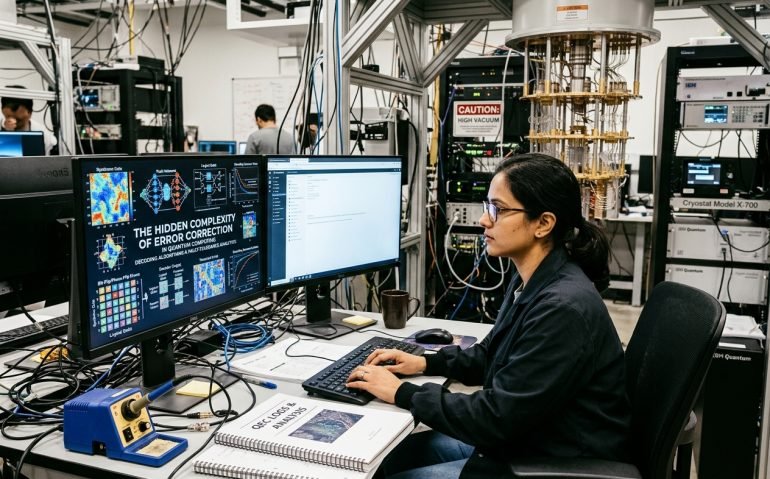
Quantum computers promise to solve certain problems exponentially faster than classical machines, but they are acutely vulnerable to noise. Correcting that noise—so-called quantum error correction (QEC)—is usually presented as a technical hurdle with a known solution. Recent theoretical and experimental work, however, shows that the landscape of quantum errors is richer and more problematic than many early models assumed, implying that practical fault-tolerant quantum computation could prove harder than expected.
Why Quantum Computers Need Error Correction
Unlike classical bits, which are either 0 or 1, qubits can occupy superpositions and become entangled with one another. Any interaction with the environment—thermal fluctuations, stray electromagnetic fields, cosmic rays—can randomly disturb the amplitude or phase of a qubit’s wavefunction. If these disturbances are not caught and corrected, the fragile quantum information unravels long before an algorithm finishes.
Standard Error-Correction Assumptions
Most QEC protocols are built on two simplifying premises:
- Locality of errors: Each physical qubit fails independently of all others (the “independent noise” model).
- Markovianity: Noise has no memory; the probability of an error is the same at every moment and uncorrelated in time.
Under these assumptions, researchers derived fault-tolerance thresholds: if the physical error rate can be pushed below roughly 10−3–10−2 per gate, logical errors can, in principle, be suppressed arbitrarily by adding more qubits and layers of encoding.
Emerging Evidence: Errors Are Often Correlated
New experiments with superconducting and trapped-ion qubits reveal that reality deviates from the tidy picture above. In particular, correlated errors—errors that strike multiple qubits simultaneously or linger over time—appear more common than previously assumed.
Spatial Correlations
Cross-talk between control lines, shared resonators, and phonon-mediated interactions can induce bursts of errors across neighboring qubits. When an energetic cosmic ray or background radiation event dumps energy into a chip, it can simultaneously flip or dephase dozens of qubits, overwhelming codes designed for isolated single-qubit failures.
Temporal (Time-Correlated) Noise
Noise with memory—sometimes called 1/f or “pink” noise—causes error rates to drift slowly. If the environment stays slightly out of equilibrium over milliseconds, consecutive error-correction cycles see highly correlated syndromes, violating the Markovian assumption that makes standard decoders effective.
Leakage Errors
Many physical qubits are multi-level systems. If a qubit is accidentally promoted to a non-computational level, it “leaks” out of the code space. Leakage errors are particularly pernicious because they do not map neatly onto the bit-flip or phase-flip categories that QEC codes expect.
Implications for Error-Correcting Codes
Correlated noise lowers the effective threshold and increases the overhead—sometimes dramatically. A surface code that needs ≈1,000 physical qubits per logical qubit under independent noise could require an order of magnitude more under realistic correlated noise scenarios.
Decoding algorithms also become more complex. Belief-propagation and minimum-weight perfect-matching decoders assume independent error probabilities; feeding them correlated syndromes can lead to mis-diagnosis and uncorrected logical flips.
Potential Mitigation Strategies
- Hardware improvements: Better shielding, materials with lower cosmic-ray cross-sections, and chip layouts that reduce cross-talk can suppress correlated events at the source.
- Noise tailoring: Techniques such as dynamical decoupling or randomized compiling can dilute temporal correlations, turning “sticky” noise into more tractable white noise.
- Correlation-aware codes: Topological subsystem codes, low-density parity-check (LDPC) codes, and bosonic codes are being re-evaluated for their resilience against multi-qubit or leakage errors.
- Adaptive decoders: Machine-learning-based decoders can ingest syndrome histories and learn the correlation structure on the fly, outperforming static analytic decoders in non-Markovian environments.
- Leakage-reduction units (LRUs): Special gate sequences periodically pull leaked population back into the computational subspace before standard QEC cycles resume.
The Road Ahead
The discovery that error mechanisms are more intertwined than once believed does not spell doom for quantum computing, but it raises the bar for engineering truly fault-tolerant machines. Every layer—from chip fabrication and control electronics to code design and decoding algorithms—must be re-examined with these richer noise models in mind. The payoff is still enormous: a scalable, error-corrected quantum computer could tackle chemistry, cryptography, and optimization problems out of reach for classical technology. Yet the journey may demand more qubits, smarter codes, and deeper insight into the quantum-hardware environment than the community originally anticipated.