Artificial intelligence has spent much of its recent public life on screens: drafting text, answering questions, and generating images or code. Physical AI describes a broader ambition: systems that perceive a changing environment and act within it through a robot, vehicle, machine, or other device. The shift from digital output to physical action is significant because the world is unpredictable, and a wrong answer on a screen is different from a robot that drops a load or moves into someone’s path.
What makes AI “physical”
A physical AI system brings together several parts. Sensors collect information about surroundings, such as camera images, distance, pressure, or motion. Software interprets those signals, estimates what is happening, and selects an action. Motors, grippers, wheels, or other actuators carry out that action. The system then observes the result and adjusts. In research, this loop is often described as perception, reasoning, and action.
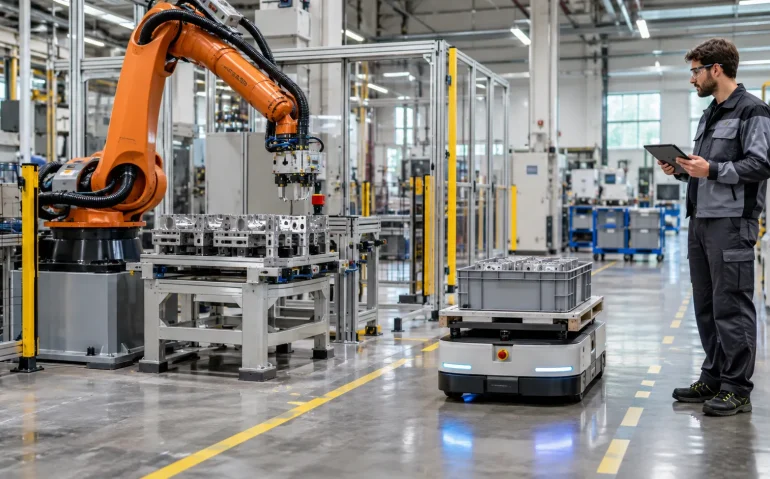
Traditional industrial robots have performed physical tasks for decades, but they are usually programmed for structured environments and repeated movements. A robot on a factory line can be extremely capable when the parts, lighting, and workflow are predictable. A more general physical AI system aims to cope with variation: an object arrives at a different angle, a shelf is rearranged, or a route is partly blocked. That flexibility is the promise, but it is also the hard engineering problem.
Why language models are only one piece
Large models can help a machine interpret instructions and connect visual information with an intended task. A person might say, “Move the blue container to the empty table,” and the system must identify the container, locate the table, plan a safe path, and check that the placement succeeded. Understanding the sentence is not enough. The system needs a reliable link between the words, the objects in its field of view, and the robot’s physical capabilities.
Robots must also act under timing constraints. A model that takes too long to respond may be unsuitable for a moving vehicle or a manipulator near a person. Systems often divide work between fast, local control loops and slower planning models. The local controller handles balance, speed, or collision avoidance; the higher-level model can plan a sequence or interpret an unusual instruction. The division must be designed carefully so that a slower component cannot override a safety-critical limit.
The gap between a demonstration and deployment
A polished demonstration shows that a system can complete a task in one setting. Deployment asks harder questions: How often does it succeed across different sites? What happens when a sensor is dirty or a camera is blocked? Can the machine recognize that it is uncertain? Who is responsible when it cannot complete the task safely? Stanford’s 2026 AI Index discussion of robotics emphasizes that real-world benchmarks remain difficult because physical environments change and mistakes have consequences.
Training data is another constraint. Digital systems can learn from large collections of text or images available online. Robotics data is more expensive to gather because it often requires sensors, hardware, and physical demonstrations. Simulators can help generate varied experience, but the simulated world does not perfectly reproduce friction, lighting, wear, or unexpected human behavior. A system trained in simulation must still be evaluated on the actual equipment and worksite.
Hardware introduces practical limits that software alone cannot fix. Batteries constrain operating time. A gripper may not handle every object. A robot may need reliable connectivity, maintenance, and space to move. The cost of the full deployment includes integration with existing systems, safety review, monitoring, and staff training—not just the purchase price of a machine or model.
Where adoption may make sense first
Physical AI is most plausible where a task is repetitive enough to measure, costly or difficult for people, and bounded enough to supervise. Warehouses may use machines to move goods or assist with picking. Manufacturers can apply machine vision to inspection or adapt robotic work cells to modest variation. Agriculture and field services may benefit from equipment that can navigate changing outdoor conditions. In hospitals and homes, the needs are different: reliability, accessibility, privacy, and safe interaction become central.
Each use case needs its own business case. A machine that reduces one manual step may still create extra work if employees must constantly reset it. Buyers should track uptime, task completion, error recovery, maintenance, and the level of human intervention required. A pilot is valuable when it tests those operational facts rather than only showing that a robot can perform a carefully staged task.
Human oversight should be designed in
Human supervision is not a temporary patch for immature technology. It can be a deliberate part of the system. Workers may handle exceptions, approve actions with safety or financial consequences, and stop the machine when conditions change. Clear controls, status indicators, and a reliable stop mechanism matter as much as the model’s reasoning ability. People need to know what the machine is doing and how to intervene.
Organizations should define limits before deployment. Which areas may the robot enter? What objects may it handle? What is it allowed to do without an operator? How will it respond when it detects an obstacle, a person, or an unfamiliar object? Monitoring should capture enough information to investigate failures while respecting privacy and minimizing unnecessary collection.
Measuring progress beyond spectacle
News coverage often focuses on a machine’s most surprising action. Businesses need more ordinary measurements. A deployment should be compared with the task it replaces or supports, including safety, quality, throughput, energy use, downtime, and total operating cost. Teams should also test for edge cases and account for the cost of maintaining equipment over its useful life.
Standards and safety practices become important as machines move beyond isolated research labs. A system that shares space with people must be assessed as a complete product, including its sensors, control software, network connections, and failure modes. An AI model’s confidence score cannot substitute for physical safety engineering or a well-defined operating procedure.
Physical AI is entering the real world through a combination of more capable models, better sensors, and machines that can adjust to changing conditions. Its progress will depend less on impressive one-off demos than on dependable behavior over thousands of ordinary tasks. Companies should begin with bounded applications, measure results in the workplace, and build human oversight and safety into the design. Intelligent machines can extend what people do, but they must earn trust through predictable performance.