
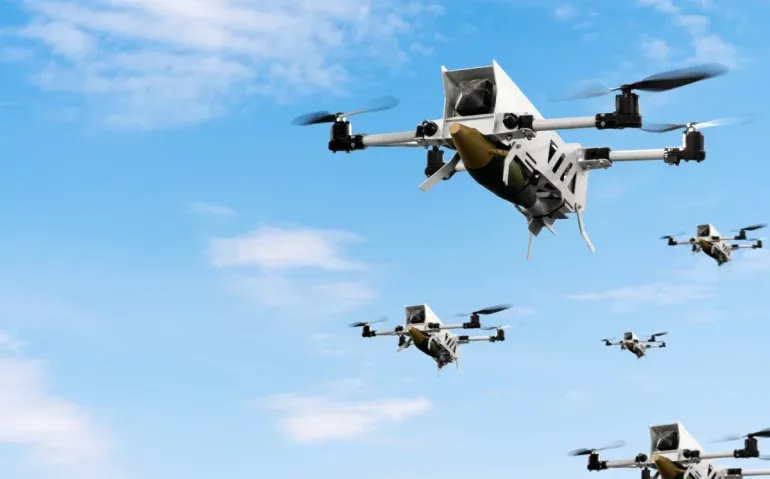
News has surfaced that two years ago, on a Ukrainian test range, fully autonomous drones were ordered to eliminate everything inside a predefined kill-box—and human soldiers died. The event, confirmed to New Scientist by a high-ranking source in Ukraine’s defence industry, marks the first known instance of lethal force being applied by machines that selected and engaged human targets without direct human command. Below, we explore what reportedly happened, how the technology works, and the strategic, legal and ethical shockwaves now rippling through the global security community.
What Reportedly Happened
• Around mid-2022 a Ukrainian weapons laboratory conducted a field test of an experimental loitering munition swarm.
• Operators uploaded GPS coordinates and an “engagement envelope” rather than specific targets.
• Once launched, the drones used onboard machine-vision and sensor fusion to differentiate vehicles, uniforms and heat signatures, attacking anything deemed hostile within the designated area.
• After the mission a Ukrainian after-action review confirmed multiple human fatalities, making this the first documented instance of fully autonomous lethal engagement.
From Semi-Autonomous to Fully Autonomous
Most armed drones worldwide—such as the Turkish Bayraktar TB2 or U.S. MQ-9 Reaper—are remotely piloted; a human operator designates each target. Recent advances in edge AI, however, have enabled level-5 autonomy: navigation, identification and lethal decision-making all happen on board, in real time, without a data link. The technology stack typically includes:
• Computer vision trained on thousands of military and civilian objects.
• Sensor fusion combining electro-optical, infrared and acoustic signatures.
• Swarm coordination algorithms that allow dozens of drones to de-conflict flight paths and divide targets.
• On-chip neural accelerators that bypass the need for cloud connectivity—crucial when radio-frequency jamming is rampant on modern battlefields.
Why Ukraine—and Why Now?
Ukraine has become a de facto “Silicon Valley of war” where rapid prototyping is followed by immediate front-line feedback. Faced with a much larger adversary, Kyiv’s defence sector prizes speed over bureaucracy, making it fertile ground for boundary-pushing tests. Western export restrictions on long-range missiles also incentivise indigenous solutions such as kamikaze drone swarms.
Regulatory Vacuum
The international community has yet to agree on a binding treaty covering lethal autonomous weapon systems (LAWS). The UN Convention on Certain Conventional Weapons (CCW) holds yearly meetings, but progress is stalled by geopolitical friction. Ukraine’s test occurred in this grey zone, technically legal under existing law but morally fraught.
Implications for the Laws of Armed Conflict
Traditional International Humanitarian Law hinges on distinction (discriminating between combatants and civilians) and proportionality (avoiding excessive civilian harm relative to military gain). Critics argue that delegating life-and-death decisions to algorithms erodes accountability:
• Attribution gap: If a drone malfunctions, is the programmer, commander or manufacturer liable?
• Data-set bias: Training data rarely reflects every conceivable environment, raising false-positive risks.
• De-escalation: Unlike humans, machines lack contextual judgment or the capacity for surrender acceptance.
The Technology Race Accelerates
Multiple nations are now sprinting to perfect similar systems:
• Turkey’s STM Kargu-2 reportedly carried out autonomous strikes in Libya (unconfirmed casualty data).
• Russia’s Lancet drone line is being retrofitted with onboard target recognition to reduce bandwidth reliance.
• The U.S. Air Force is field-testing the Golden Horde collaborative cruise missile program.
• China demonstrated an AI-controlled truck-launched swarm of 48 loitering munitions in 2021.
Countermeasures and Tactical Shifts
As autonomous lethality spreads, so do defences:
• Radio-frequency jammers are less effective, because autonomy reduces link dependence.
• Directed-energy weapons (high-powered microwaves, lasers) provide instantaneous kill options.
• Decoys and signature management are becoming standard: deployable heat-bags, reflective Mylar strips and even battlefield smoke tuned to block specific IR wavelengths.
• “Anti-AI camouflage”—patterns specifically designed to confuse computer vision—has emerged as a new military art form.
The Ethical Debate Intensifies
Proponents claim autonomous drones reduce friendly casualties and reaction time, operating where GPS is jammed and comms are severed. Opponents warn that lowering the cost of pulling the trigger could make war more likely and atrocities easier to perpetrate. Human Rights Watch and the Campaign to Stop Killer Robots are urging a pre-emptive global ban.
What Happens Next?
• Expect fresh UN motions as evidence of the Ukrainian incident circulates.
• Insurance firms, not just governments, may start pressuring manufacturers via liability exclusions.
• Battlefield norms could evolve, with commanders obliged to keep a “human-in-the-loop” for high-value target approval—though enforcing that norm will be challenging.
• Tech-sector whistle-blowers, akin to those at Google’s Project Maven in 2018, may increase internal pressure on companies supplying dual-use AI modules.
The death of soldiers at the hands of autonomous drones is no longer hypothetical. It is a milestone that compresses decades of ethical debate into an urgent policy dilemma. Whether humanity can craft robust guardrails before the technology proliferates further remains uncertain—but the clock is now ticking audibly on battlefields worldwide.