Canadian tech culture thrives on practical invention. Not every breakthrough begins in a lab or a venture-backed startup. Sometimes it starts at home, with a child who loves a gadget and a parent who decides to build a better version. That is exactly what makes this small hardware project so compelling. A modern digital pet, inspired by the classic Tamagotchi formula and recreated on a Raspberry Pi Pico development kit, shows how accessible Canadian tech style experimentation has become.
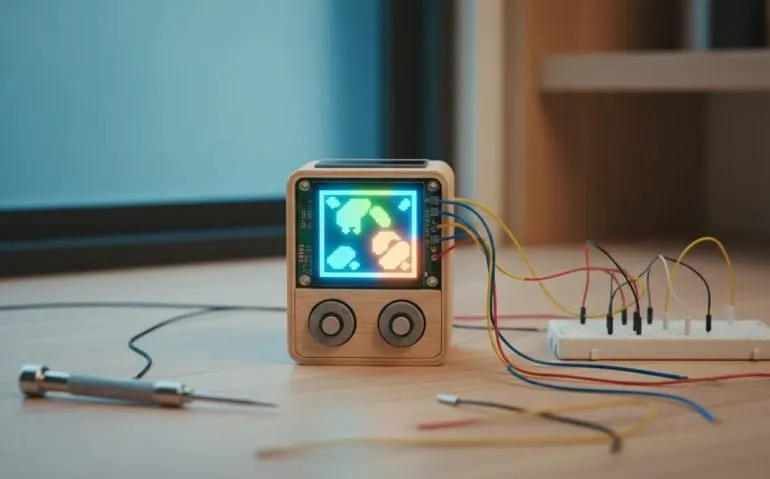
The project is simple on the surface. A son loves tiny virtual pet toys. The commercial versions are expensive at around $40 each. Instead of buying a collection of them, a custom version was built from scratch using a Raspberry Pi Pico, a touchscreen, physical controls, and AI-assisted coding. The result is more than a fun family project. It is a sharp example of where Canadian tech, maker culture, low-cost hardware, and AI development tools are heading right now.
For business leaders, educators, parents, and product innovators, there is a larger lesson here. The barriers to hardware prototyping are falling fast. Consumer electronics ideas that once required specialized engineering teams can now begin with off-the-shelf development boards, natural language prompts, and rapid iteration. In the Canadian tech ecosystem, where cost efficiency and practical innovation matter, that shift is significant.
The Big Idea Behind This DIY Digital Pet
The inspiration came from a familiar category of toy. Digital pets have been around for decades, and their appeal remains remarkably strong. They combine nurturing, routine, game mechanics, and a sense of progression. Feed the creature, play with it, care for it, and help it grow. That loop is simple, but it creates attachment.
In this case, the toy that sparked the project was a modern version of that concept, referred to as a Bitsy. The child involved was deeply interested in collecting them, but the price made that difficult to justify at scale. Rather than continuing to buy a product line, the decision was made to build a personalized alternative.
That moment captures a familiar Canadian tech instinct. Instead of accepting a high-cost consumer option, the builder looked for a way to create something better suited to the real need. It was not just about saving money. It was also about customization, creativity, and learning by doing.
Why This Matters Beyond a Toy
It is easy to dismiss a digital pet as a small novelty project, but that would miss the larger trend. This build sits at the intersection of several powerful forces:
- Affordable hardware platforms that reduce prototyping costs
- AI-assisted software development that lowers coding friction
- No-solder modular design that opens hardware to beginners
- Personalized product design shaped by direct user feedback
- Fast iteration that mirrors modern startup product cycles
Those are not toy-only ideas. They are core patterns in Canadian tech and global product development. What appears to be a household build is really a miniature case study in agile design.
The Hardware Choice: Raspberry Pi Pico as an Entry Point
The foundation of the project was a Pico development kit built around the Raspberry Pi ecosystem. That choice is important. Raspberry Pi boards have become a gateway into electronics, embedded systems, and rapid hardware experimentation because they balance capability, affordability, and community support.
In this project, the board included the essential interactive components needed for a digital pet:
- A touchscreen for visual interaction
- Buttons for menu navigation or actions
- A joystick for playful input and movement
That combination makes the board ideal for a compact game-like experience. A digital pet needs a display, some user controls, and enough computing power to manage states such as hunger, growth, and play. A Pico-based kit can handle that effectively without becoming expensive or overly complex.
For the Canadian tech community, this is a strong reminder that prototyping hardware does not always require a custom PCB or a deep electrical engineering background at the earliest stages. Off-the-shelf kits can get a concept moving quickly.
No Soldering Required: Why Accessibility Is the Real Breakthrough
One of the most notable details in the build is what it did not require. There was no need for soldering. The add-on hardware could be plugged into the Pico development kit directly, making setup far less intimidating.
That matters because hardware projects often lose newcomers at the first technical hurdle. Soldering is not impossible, but it creates hesitation for beginners, parents, students, and business professionals who are curious but not yet comfortable with electronics assembly.
By using a board that snaps together cleanly, the project becomes much more approachable. That approach aligns closely with a broader Canadian tech reality. Many people interested in innovation are not embedded engineers. They may be product managers, startup founders, educators, or executives exploring proof-of-concept ideas. Lowering the mechanical barrier to entry expands the pool of people who can participate.
In practical terms, no-solder prototyping delivers several advantages:
- Faster setup and testing
- Lower risk of assembly errors
- Greater confidence for beginners
- Shorter time from idea to working prototype
That is exactly the kind of acceleration Canadian tech teams need when moving from concept to demonstration.
AI-Assisted Development Changes the Game
Perhaps the most striking part of the build is how the software was started. After plugging the device into a computer, the builder opened Codex and prompted it to create the digital pet. That detail signals a major shift in how software for hardware projects can now be developed.
Instead of manually writing every line from scratch, the process began with a natural language request. The first version was basic, which is typical for AI-generated starting points. But it was functional enough to establish a foundation. From there, multiple rounds of refinement improved the project.
This is where Canadian tech leaders should pay close attention. AI coding tools are not just productivity enhancers for enterprise software teams. They are becoming accelerators for embedded systems, interactive products, and hobbyist hardware builds as well.
For someone building a digital pet, AI can help generate:
- Basic game state logic
- User input handling for buttons and joystick
- Display rendering routines
- Simple animation structures
- Feeding and growth mechanics
- Iteration ideas for added features
The first output may not be polished, but it shortens the path to experimentation. That is one of the most exciting developments in Canadian tech right now. AI is compressing the distance between imagination and implementation.
From Rough Prototype to Personalized Product
The initial version of the digital pet was intentionally simple. That is how most good product development starts. Rather than aiming for perfection on day one, the builder focused on creating a working base. Then came iteration.
That iterative process was not done in isolation. It happened together with the child who would use the device. As features evolved, the toy was shaped around exactly what he wanted. This is user-centered design in its most direct form.
In larger Canadian tech companies, teams run interviews, usability tests, and product workshops to achieve a similar effect. Here, the same principle played out at a much smaller scale. Build something minimal. Put it in front of the user. Learn what matters. Improve it. Repeat.
That workflow is extremely valuable because it avoids one of the biggest traps in product development: building based on assumptions. A personalized digital pet works best when the creature, interactions, and progression system match the interests of the person using it.
Even a family build can demonstrate these core product lessons:
- Start with the smallest functional version.
- Gather direct feedback early.
- Prioritize features based on actual enjoyment.
- Refine the experience through short iteration cycles.
- Separate function from finish until the concept works.
That process is deeply relevant to Canadian tech startups and internal innovation teams alike.
The Real Value of Customization
Commercial digital pets come with predefined characters, mechanics, and limitations. A homemade version offers something far more interesting: control over the experience.
Customization can affect nearly every layer of the product:
- The look of the pet
- Its growth stages
- The kinds of activities available
- How often it needs care
- The visual layout of the interface
- The external physical design of the device
This matters because personalization is one of the most powerful drivers in modern product strategy. Canadian tech companies across SaaS, fintech, health tech, and education technology are all competing on their ability to tailor experiences. A digital pet may be playful, but the principle is serious. People care more when a product feels made for them.
Cost Efficiency and Why It Resonates in Canadian Tech
The original motivation was straightforward. Buying multiple commercial toys at roughly $40 each adds up quickly. Building a custom alternative can reduce recurring purchase costs while also creating something reusable and expandable.
In a Canadian tech context, cost discipline is more than a household concern. It is a strategic priority. Whether in Toronto, Vancouver, Montreal, Calgary, or emerging regional hubs, teams are under pressure to move fast without overspending. Prototyping with inexpensive boards and AI-assisted development tools fits that environment perfectly.
A low-cost build strategy creates room for experimentation. If a first attempt fails, the financial downside is manageable. If the project succeeds, the team gains both a functional prototype and valuable learning at a modest cost.
That is one reason this kind of maker project deserves attention from a business audience. It reflects a lean innovation mindset that Canadian tech organizations increasingly need.
Industrial Design Comes Next: The 3D-Printed Housing
Although the digital pet was operational, the project was not considered finished because the physical appearance still needed work. The next step was to create a 3D-printed enclosure, described as a house for the Bitsy.
This is a crucial stage. Many prototypes function well but feel incomplete until the physical form catches up with the software. A clean enclosure changes the experience dramatically. It turns exposed development hardware into something that feels intentional, durable, and gift-worthy.
For Canadian tech product teams, this highlights the difference between a demo and a product. The internal logic may be working, but usability and presentation matter. A housing can improve:
- Durability and portability
- Safety for younger users
- Aesthetic appeal
- Brand identity
- Perceived product quality
3D printing is particularly useful at this stage because it allows rapid experimentation with form factors. Buttons can be repositioned, grips can be improved, and the device can be designed around exactly how it is meant to be held and used.
What Canadian Businesses Can Learn From This Small Build
This project may be personal and compact, but the lessons scale remarkably well. Canadian tech companies and business leaders can extract several strategic insights from it.
1. AI lowers the threshold for experimentation
When natural language can kickstart working code, more people inside an organization can participate in prototyping. That does not eliminate the need for developers, but it does increase speed and widen access.
2. Modular hardware reduces time to proof of concept
Using accessible hardware kits allows teams to test ideas before committing to custom engineering. For Canadian tech startups, that can preserve capital while validating demand.
3. User-driven iteration beats assumption-driven design
The product improved because it was built alongside the intended user. The same principle applies whether the customer is a child with a toy or an enterprise team with a dashboard.
4. Finish matters after function
A prototype can prove the concept, but industrial design and polish are what convert curiosity into adoption.
5. Small projects reveal larger opportunities
A custom digital pet is also an exercise in interactive software, embedded hardware, interface design, and consumer product thinking. Those are transferable skills with commercial relevance.
Why This Project Fits the Current Canadian Tech Moment
Canadian tech is in a period where practical AI use cases matter more than hype alone. Organizations want proof that modern tools can produce real outcomes, save money, or unlock creativity. This build delivers that kind of example in a compact, tangible way.
It shows AI not as an abstract concept, but as a working assistant in the making of a physical product. It shows hardware not as a specialized domain limited to elite engineers, but as something more approachable through better kits. And it shows innovation not as a giant corporate initiative, but as something that can start with one real problem and one motivated builder.
That mindset is highly relevant across the Canadian tech landscape, including:
- Edtech programs introducing students to coding and electronics
- Startup incubators developing early physical prototypes
- Retail innovation teams exploring smart products
- Makerspaces supporting local entrepreneurship
- Internal enterprise labs testing IoT concepts
In every case, the combination of accessible hardware and AI-assisted development can accelerate output.
The Hidden Educational Power of a DIY Digital Pet
There is also a strong educational dimension to this kind of build. A digital pet is a playful interface to several core concepts in technology and product development.
Even in a simple implementation, it can teach:
- State management, such as hunger, mood, and growth
- Input systems through buttons, touch, and joystick control
- Basic graphics and interface logic
- Feedback loops that shape user engagement
- Hardware and software integration
- The relationship between design choices and user enjoyment
That makes it a powerful format for learning. In Canadian tech education, project-based work often produces deeper understanding than abstract exercises. Building a digital pet can turn coding and electronics into something concrete, emotional, and memorable.
A New Model for Family Innovation
One of the most refreshing elements of this story is that it was collaborative. The project was built with the child, not merely for the child. That shifts the dynamic from consumption to co-creation.
There is a subtle but important Canadian tech message in that approach. Innovation is not only about delivering products to users. It is also about involving people in the creation process where possible. Co-design builds stronger engagement, better feedback, and deeper ownership.
For businesses, that principle can influence everything from customer advisory programs to pilot deployments. For families and educators, it can transform technology from passive entertainment into active making.
What the Final Product Still Needs
Even after multiple iterations, the build was still considered unfinished because appearance matters. That acknowledgment is useful. Too many prototype stories focus only on what works technically and skip the gap between functional and delightful.
To reach a more complete product state, the remaining priorities are clear:
- A polished physical enclosure
- A more refined visual identity
- Potentially smoother user interface elements
- Additional game and care mechanics if desired
- A tighter integration between hardware design and software flow
These are the same final-mile challenges many Canadian tech teams face. The prototype proves possibility. The final polish determines whether the product feels complete.
The Broader Signal for Canadian Tech Builders
This project sends a clear message. The gap between idea and implementation is shrinking. A consumer-inspired concept can now be translated into a custom working device with accessible hardware and AI support. That is not science fiction. It is current reality.
For anyone in Canadian tech, from startup founders in the GTA to innovation leads inside larger enterprises, the takeaway is urgent. The old excuses are disappearing. It is cheaper to prototype. Easier to code. Faster to iterate. Simpler to personalize. More realistic to bring niche ideas to life.
That does not guarantee success, of course. Good products still require judgment, taste, persistence, and user insight. But the tools have improved enough that more people can now get to a first version. In many cases, that first version is all that is needed to unlock momentum.
Conclusion
A custom digital pet built on a Raspberry Pi Pico might look like a small personal project, but it captures some of the most important forces shaping Canadian tech today. Low-cost prototyping, AI-assisted development, modular hardware, rapid iteration, and personalized design are no longer abstract trends. They are practical tools available right now.
What began as an effort to avoid buying multiple expensive toys became something much more instructive. It demonstrated how a clear problem, a flexible device, and a willingness to iterate can produce a tailored product with real emotional value. It also showed that innovation often starts with usefulness, not scale.
For the Canadian tech community, that is the real headline. The future does not always arrive through massive product launches. Sometimes it shows up in the form of a homemade digital pet, a plugged-in dev board, and a prompt that turns an idea into software.
Is Canadian tech ready to embrace more of this hands-on, AI-powered building culture?
FAQ
What is the main hardware used in this digital pet project?
The project uses a Raspberry Pi Pico development kit that includes interactive components such as a touchscreen, buttons, and a joystick. This setup provides a strong base for building a simple handheld digital pet.
Why is this project relevant to Canadian tech?
It highlights several trends shaping Canadian tech, including affordable prototyping, AI-assisted coding, modular hardware, and user-centered product design. These are highly relevant for startups, educators, and innovation teams across Canada.
Did the build require soldering?
No. The hardware was designed to plug directly into the Pico development kit, making it much more accessible for beginners and faster to assemble.
How was AI used in the project?
Codex was used to generate the initial version of the software after the device was connected to a computer. From there, the project was improved through multiple rounds of iteration and customization.
What features does a DIY digital pet like this typically include?
A digital pet generally includes care mechanics such as feeding, playing, and growth over time. With a touchscreen and physical controls, the device can support menus, interactions, and simple visual feedback.
What was the next step after building the working prototype?
The next planned stage was to create a 3D-printed enclosure, or house, for the device. This would improve the look and feel of the project and move it closer to a finished product.