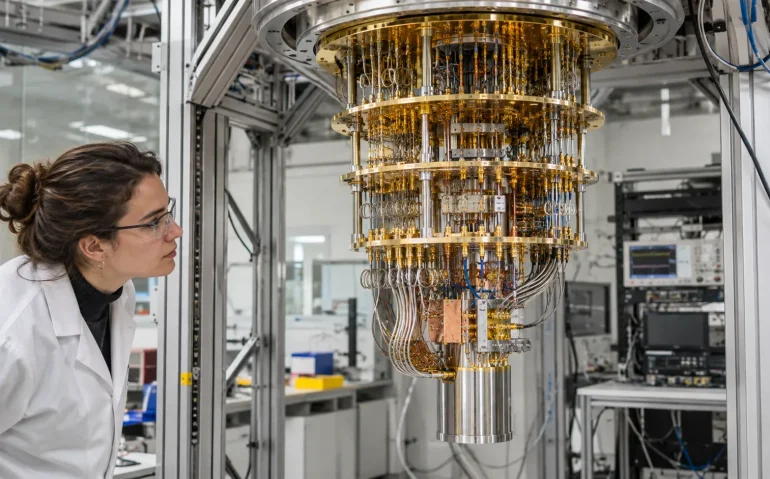
Quantum computing has reached a stage where laboratory demonstrations are increasingly ambitious, yet practical business use remains a difficult engineering goal. The next challenge is not simply building a processor with more physical qubits. It is producing reliable, error-corrected computations that solve a valuable problem better than the classical tools already available. That gap between a technical milestone and a useful product will define the field’s next phase.
Why today’s quantum processors are fragile
Quantum computers encode information in qubits, which can represent states that have no direct equivalent in ordinary bits. The same physical properties that make qubits useful also make them sensitive to noise from their environment and control hardware. Operations can fail, measurements can be imperfect, and errors can accumulate as a computation gets longer.
Adding more physical qubits does not automatically solve this problem. Fault-tolerant computing requires many physical qubits to work together to protect a smaller number of logical qubits. Error-correction routines detect and correct faults while preserving the information needed for a calculation. The overhead can be substantial, so progress depends on improving qubit quality, control electronics, error-correction methods, and system architecture at the same time.
From impressive demonstrations to useful computation
Researchers have shown that quantum processors can perform specialized experiments and generate results that are difficult to reproduce with straightforward classical approaches. Such demonstrations can test hardware and algorithms, but they do not necessarily establish a commercial advantage. A useful application must deliver a result that matters, be repeatable, and justify the cost and complexity of the machine.
Candidate areas include chemistry, materials research, optimization, and certain scientific simulations. Each requires close collaboration between quantum engineers and domain experts. The business problem must be translated into a form the hardware can handle, and the output must be validated against known results or practical experiments. A quantum result that cannot be trusted or connected to a real decision has limited operational value.
Hybrid systems may provide a bridge. A classical computer can manage data, prepare a problem, and handle steps that are not suited to quantum hardware. The quantum processor can be used for a specific subroutine, with classical tools checking the result. This approach does not guarantee a speedup, but it reflects how quantum technology is likely to integrate with existing high-performance computing systems.
Roadmaps are milestones, not guarantees
Governments and research organizations are building roadmaps toward error-corrected systems and practical applications. The U.S. Department of Energy announced a milestone-driven effort aimed at demonstrating a scientifically relevant, fault-tolerant quantum computer by 2028, while also developing application challenges and a user facility. The roadmap is an ambitious policy target, not evidence that a fault-tolerant system will automatically arrive on schedule.
National strategies also recognize that useful algorithms are limited. Canada’s quantum computing roadmap notes that only a small number of algorithms currently have practical utility. That makes application research just as important as hardware progress. Scientists need to identify cases where quantum methods could offer a meaningful advantage and develop benchmarks that show whether that advantage survives realistic constraints.
Business value requires a clear baseline
Companies considering quantum computing should begin with the problem, not the machine. They can ask whether the organization faces a calculation that is too slow or too costly on classical systems, and whether a quantum approach has a plausible path to improve it. The comparison should include data preparation, hardware access, error correction, classical preprocessing, and engineering effort.
Cloud access makes it easier to experiment without buying a processor, but an experiment still needs knowledgeable staff and a way to evaluate results. A short proof of concept can be useful if it tests a specific hypothesis. It is less useful when success is defined vaguely as “exploring quantum.” Procurement and research teams should document what was tested, what resources were used, and what would count as a meaningful outcome.
Security planning is already relevant
Quantum computers capable of breaking widely used public-key cryptography are not available today, but organizations should not wait for a machine to begin planning for post-quantum security. Sensitive information may need to remain confidential for many years, and encrypted data collected now could be targeted later if future capabilities change. The U.S. Government Accountability Office has identified preparation for quantum-related cyber threats as an area requiring federal action.
Businesses can inventory where public-key cryptography is used, understand which vendors control those systems, and follow standards bodies’ transition guidance. This is a long migration involving software, devices, certificates, and supply chains. It is separate from buying a quantum computer, but it is one of the most concrete ways that quantum progress affects organizations today.
How to separate progress from hype
Useful reporting should distinguish between physical and logical qubits, describe the task performed, and explain how errors were measured. It should state whether a result was peer-reviewed, independently replicated, or reported by the company that built the system. Comparisons should identify the classical baseline and include the resources needed on both sides.
Progress can still be important even when it is not immediately commercial. Better error correction, control systems, and materials can build knowledge needed for later machines. But research milestones should not be confused with a near-term productivity tool. Most organizations should maintain awareness, support relevant research where it aligns with their strategy, and avoid relying on speculative timelines for core business planning.
Quantum computing’s next challenge is turning laboratory breakthroughs into reliable, error-corrected operations that address real problems. That will require progress in hardware, software, algorithms, integration, and measurement—not just bigger qubit counts. Businesses can prepare by asking precise questions, tracking credible roadmaps, and beginning cryptographic inventory work. Practical quantum use will arrive through evidence and engineering, one well-defined application at a time.