If you have been trying to use Manus AI for real business work, you probably already know the catch. It can handle autonomous research, but it can also burn through credits fast, take a long time on a single task, and start from zero every time you need something done.
That is not how work actually happens in a business. Work is ongoing. You need context. You need files, repeatable processes, recurring reports, and a system that remembers what happened last week without forcing you to explain the entire project again.
OtterMind AI is built around that idea. It is an AI-powered workspace where autonomous AI agents can plan work, execute it, save context, use files, create deliverables, and run recurring automations. Instead of sending a prompt and receiving a one-off answer, the workflow becomes input, planning, execution, and deliverable.
That difference is huge if you want to automate tasks with AI, create repeatable business workflows, or build something that feels closer to an AI employee than another chat tool.
Why One-Off AI Tasks Are Not Enough
Manus AI does some things well, especially autonomous research. You can ask it to investigate a topic, synthesize findings, and produce a document or presentation. That is useful.
The issue is that a research task is rarely the end of the job. Once the first draft is done, you may need to update it, reuse the data, answer follow-up questions, create a report next week, turn it into a briefing, or route the findings into another workflow.
When every request begins with no memory of the previous one, the process becomes expensive and repetitive. You are not building a system. You are just running isolated prompts.
That is the core limitation of a credit-heavy, single-task approach:
- Every task can consume a meaningful number of credits.
- The cost may not be clear before the task begins.
- Unused credits may not carry over.
- Project context does not naturally compound over time.
- There is no real workspace where files, tasks, skills, and automations live together.
- Longer tasks can leave you waiting before you can move to the next step.
In one comparison, a request to research the top 20 companies in the world in 1990, 2000, 2010, and today, then turn the findings into a PowerPoint, used nearly 400 Manus credits. The output was solid from a research perspective, but it still required slide adjustments because some text was not positioned cleanly on the page.
The presentation was useful. The model did the research and assembled the material. But for a task that might be considered relatively lightweight, using nearly 400 credits makes you think carefully about how many times you can run that kind of workflow.
What Makes OtterMind AI Different?
OtterMind sits in the broader category of autonomous AI agent platforms alongside tools such as Manus, Genspark, Perplexity Labs, OpenClaw, and Hermes Agent. The important distinction is that OtterMind is designed as an ongoing AI workspace, not simply a place to run one task at a time.
It combines several pieces that normally live in separate tools:
- AI chat for giving instructions and following up on work
- Task execution for research, analysis, creation, and delivery
- Persistent memory for retaining project context
- A file workspace for documents and data used across tasks
- Reusable agent skills for saving processes you use repeatedly
- Workflow automations for recurring tasks and scheduled reports
- Cross-device context so the workspace remains consistent across desktop, mobile, and tablet
This is what makes the difference between asking AI to perform a task and actually creating an AI-driven operating system for your work.
Rather than saying, “Here is a prompt, now give me an answer,” you can give OtterMind a goal, files, a desired format, and a repeatable process. It can then work through the task and hand back a finished deliverable that can be edited, downloaded, reused, or automated.
Testing OtterMind AI Against the Same Research Task
To make a fair comparison, the same company-research prompt was used in OtterMind:
Research the top 20 companies in the world in 1990, 2000, 2010, and today, then create a PowerPoint showing how the rankings changed.
OtterMind approached this by using multiple skills to complete the research and presentation work. The final result included both a main PowerPoint file and an editable OtterMind version.
The editable format matters more than it might sound. Once the agent has assembled the work, you can change the text, adjust element sizes, duplicate slides, delete items, and make quick edits directly in the workspace. You are not stuck with a static output that needs to be rebuilt somewhere else.
The resulting deck used a polished consulting-style aesthetic similar to the visual language associated with firms such as McKinsey, BCG, or Bain. It included charts, country flags, graphics, structured slides, and an overall professional layout. The output could then be downloaded as a PowerPoint.
Even more interesting, the OtterMind task used fewer than 80 credits in the test. Compared with the nearly 400 credits used for the Manus version of the same request, that is roughly one-fourth of the consumption while producing a more editable and polished presentation workflow.
Credit use can vary by task, but the point is clear: if you are doing research, reports, presentations, and recurring analysis every week, efficient execution matters.
Files Turn an AI Agent Into a Real Business Tool
A major strength of OtterMind is that it can use your files as task context. The workspace supports PDFs, Word documents, Excel files, CSV files, and images.
This is where AI automation becomes much more useful for actual operators. Your business data does not exist in one neat paragraph. It lives in exports, reports, customer files, spreadsheets, decks, notes, and documents. An agent that can work directly with those materials can do far more than give general advice.
Inside the OtterMind Drive, you can organize and access:
- Uploaded source files
- Completed tasks
- Recently used items
- Starred files and projects
- Generated deliverables
That workspace becomes increasingly valuable because the agent retains the materials and project context for future work. You do not need to repeat the same background every time you run a report.
Workflow #1: Turn Customer Data Into an Executive Presentation
One of the best recurring uses for OtterMind AI is analyzing customer data and converting it into an executive-ready deck.
The instruction can be straightforward:
Read these files, pull key insights, supporting data, and recommendations, then build an eight-slide executive presentation.
With customer data uploaded into the workspace, the agent can review the files, identify the relevant information, analyze trends, create a coherent story, and assemble a polished presentation. The process is not limited to generating a few bullet points. It creates an actual deliverable.
For a business owner, this can be incredibly useful for tracking:
- Customer retention
- Churn and cancellation patterns
- Revenue concentration
- Refund rates
- Dispute rates
- Data-quality gaps
- Customer segments with higher spending
- Operational bottlenecks and recommended next actions
In the customer-data example, the analysis surfaced details that might have been missed in a manual review, including customers paying more than $100, points where the business was getting stuck, the fact that most revenue was coming from the United States, and missing country data that needed attention.
It also created a 90-day plan to help optimize the business. That is the value of asking an AI agent not just to summarize information, but to connect the data to recommendations and an execution plan.
The real win is the compounding context. When the next week’s data arrives, you can keep using the same workspace, files, deck rules, and business history. The agent already understands the project instead of requiring a full rebrief.
Workflow #2: Automate a Weekly AI Agent News Briefing
The second workflow is a recurring automation. This is where AI agents start saving serious time.
A useful automation might be:
Every Monday at 9 a.m., research the top AI agent news and trends from the previous week, then deliver a clear briefing.
In OtterMind, you can create an automation, choose the agent, set the execution environment, add the prompt, and define whether the workflow runs once or on a recurring schedule. A recurring automation can be set weekly, assigned to Monday, started immediately, and configured to continue indefinitely, end after a chosen number of runs, or stop on a certain date.
That turns a task that once took significant time into a reliable process that arrives automatically.
A solid AI agent briefing can include:
- Top takeaways from the week
- Major announcements and notable changes
- A trend map
- Implications for builders, operators, enterprise teams, and investors
- Topics and developments worth monitoring next
- Follow-up answers if more detail is needed
One briefing identified themes such as coding agents remaining an important frontier, open-source agent tooling becoming more productized, evaluation moving beyond basic task completion toward goal completion, enterprise agent platforms converging around governance, and agent protocols increasingly acting as infrastructure.
That is already useful. But the workflow can go further. You can extend the automation to generate a content brief for your team, draft a community update, prepare internal notes, or turn the weekly research into a starting point for content creation.
The key is pairing reusable skills with automations. Save the process once, then have it run repeatedly without rebuilding the same workflow every time.
Build Specialized AI Agents With Skills and Integrations
OtterMind also allows you to create agents for distinct roles. When setting up a new agent, you can define its name, description, model, role, and available skills.
Skills can be explored through a marketplace or added from another source, including uploaded files or a URL. Available examples include self-improvement capabilities, GitHub access, and other specialized functions.
This creates a practical structure for building AI employees around the jobs your business repeatedly performs. One agent can focus on research. Another can create presentations. Another can analyze data. Another can create briefs from recurring news or business inputs.
OtterMind also includes integrations with tools such as Make, Stripe, Notion, Lark, Monday.com, Slack, Supabase, Telegram, and more. These integrations matter because work rarely begins and ends inside one AI tool. The more naturally an agent fits into the systems your team already uses, the more useful it becomes.
You can also configure language, appearance, personalization settings, and email notifications for completed work.
OtterMind AI vs Manus AI: The Bottom Line
Manus can be useful when you want an autonomous research task handled in a single run. It is capable of producing research-based outputs, including presentations.
But if you are tired of managing credit consumption, waiting on isolated tasks, and starting from scratch every time, OtterMind presents a different model.
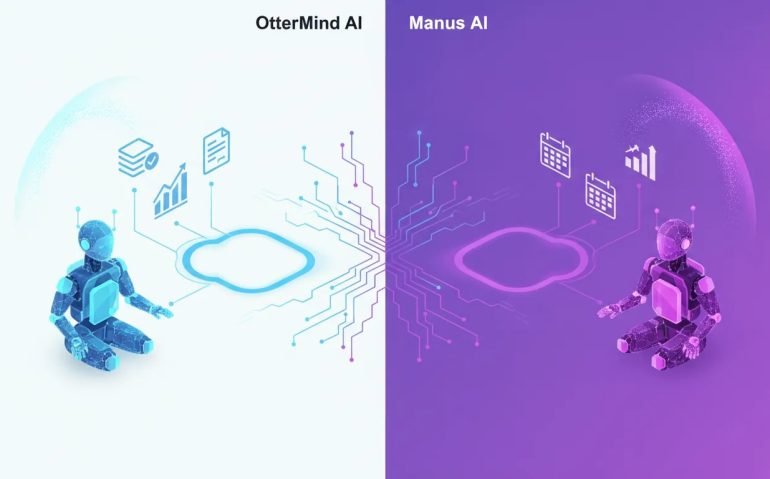
Manus is built around individual tasks. OtterMind is built around ongoing work.
OtterMind combines memory, files, reusable skills, editable deliverables, specialized agents, and automations in one workspace. That means your research can become a report, your report can become a weekly automation, and your automation can become a repeatable business process.
If you want an AI agent that helps you build systems instead of just generating one-off outputs, try OtterMind AI for free and test it with a workflow you already do every week.

Frequently Asked Questions
What is OtterMind AI?
OtterMind AI is an AI-powered workspace built around autonomous AI agents. It combines chat, task execution, file context, persistent memory, reusable skills, editable deliverables, and recurring automations.
How is OtterMind AI different from Manus AI?
Manus is useful for one-off autonomous research tasks, while OtterMind is designed for ongoing work. OtterMind keeps project context, works with uploaded files, supports reusable skills, creates editable outputs, and can automate recurring workflows.
Can OtterMind AI create PowerPoint presentations?
Yes. OtterMind can research a topic, create a professional presentation, provide an editable workspace version, and allow the finished deck to be downloaded as a PowerPoint file.
What files can OtterMind AI use for analysis?
OtterMind can use PDFs, Word documents, Excel spreadsheets, CSV files, and images as context for tasks, reports, research, and business analysis.
Can OtterMind AI run recurring automations?
Yes. You can create one-time or recurring automations, choose a schedule, set timing and frequency, define an end condition, and update the prompt or cadence later when your needs change.
What are practical OtterMind AI workflows for a business?
Useful workflows include turning customer data into executive presentations, tracking retention and churn, producing 90-day business recommendations, creating weekly AI news briefings, drafting team content briefs, and publishing community updates from recurring research.
Keep Building Your AI Operating System
The biggest opportunity with AI agents is not using them for a random task once in a while. It is identifying the work that repeats, building the process properly, and putting it on autopilot.
Start with one workflow that drains time every week. Give the agent the right files, define the expected output, save the process as a reusable skill, and automate it. Then build from there.