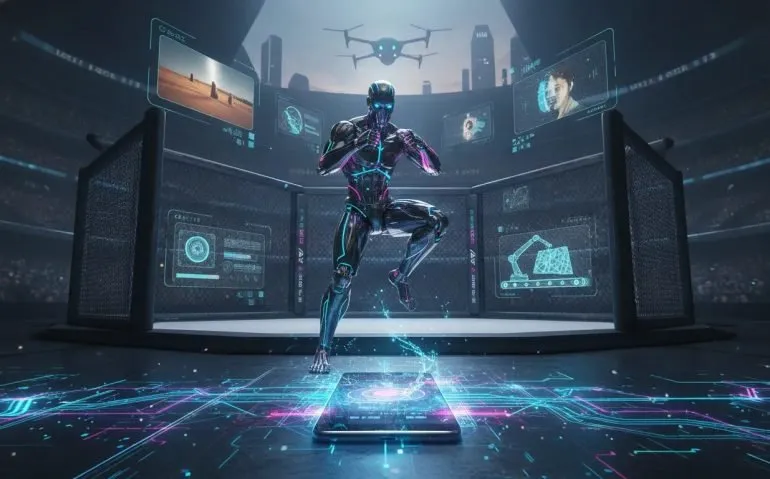
AI never sleeps, and this week’s releases make that painfully obvious. Open models are closing the gap with frontier systems. Video generation is moving from expensive GPU servers to smartphones. Robots are entering MMA cages, flying on eVTOL-style platforms, folding laundry, and taking on industrial work with entirely new body designs.
This is not just a collection of fun demos. It is a signal that the economics of AI are changing fast. For Canadian businesses, from fast-growing Toronto startups to enterprise teams across the GTA, Montreal, Waterloo, Calgary and Vancouver, the key development is accessibility. Powerful models and creative tools are increasingly becoming local, open and cheaper to deploy.
That matters because the next competitive edge may not come from having access to a closed AI platform. It may come from knowing how to combine open models, local hardware, secure workflows and specialized automation before everyone else does.
Ardy
NVIDIA has released Ardy, an AI system that generates realistic 3D human motion in real time. A user can provide a text instruction, a desired movement, or more precise controls such as paths, waypoints, key poses and joint locations. Ardy then creates continuous animation that can keep running until it is stopped.
The important technical idea is its two-stage planning system. First, it determines how the character should move through the space. Then it adds detailed body movement, including the arms, legs and torso. That separation makes a lot of sense. You plan where a person is going before deciding exactly how every body part should move.
Ardy is useful for games, virtual characters, animation pipelines and robotics research. It can also be used to control a humanoid robot in simulation, including Unitree’s G1. For Canadian firms working in industrial automation, simulation, digital twins or immersive training, that is a big deal. Natural human motion data has traditionally been difficult and expensive to create.
Even better, NVIDIA has released the code and models. Individual models are roughly 765 MB, making this a relatively approachable local AI project compared with giant video-generation systems.
MobileWan
Generating AI video locally on a phone sounds ridiculous, but MobileWan makes it possible. Built to run Alibaba’s Wan video model directly on a mobile device, it can generate a five-second clip at 480p and 16 frames per second from a text prompt in roughly 20 seconds.
That is not cinema-grade production, but it is a massive technical step. Video generation normally requires a serious NVIDIA CUDA GPU. MobileWan gets around that requirement through aggressive optimization:
- It generates video in small chunks instead of processing every frame together.
- It removes less useful attention heads through model pruning.
- It cuts generation down to three steps rather than the more common 20 to 30 steps.
- It uses a memory-efficient video decoder.
The full package is about 9.9 GB. That is still substantial for a phone, but the broader story is enormous. Local mobile video generation means more privacy, more portability and less dependence on cloud inference. Marketing teams, field teams and creators may eventually be able to prototype visual content directly on-device without uploading sensitive material to external servers.
PiD v1.5
NVIDIA’s PiD v1.5 pushes open-source image upscaling further. Compared with the earlier PiD release, version 1.5 delivers improved fine detail, sharper output and better colour fidelity.
Upscaling may sound mundane beside robots and frontier language models, but it is one of the most immediately useful AI capabilities for businesses. Teams routinely need to adapt lower-resolution assets for presentations, e-commerce listings, social content, product pages and print materials. PiD can turn a 512 by 512 latent image into a 2K image in seconds on a consumer GPU.
It also works with multiple image-generation ecosystems, including Qwen Image, Flux and Z Image. That flexibility matters in an increasingly fragmented creative AI market. Rather than locking into a single image model, teams can build a modular workflow where generation, upscaling, editing and background removal are separate best-in-class steps.
Audio to MIDI
Audio to MIDI from Mirelo is one of those tools that feels like reverse engineering a song. Upload an audio file with vocals and multiple instruments, and the system attempts to identify the components and create separate MIDI tracks for each.
MIDI is essentially a digital representation of musical notes and performance data. Instead of merely producing an audio recording, it gives music producers editable note sequences for instruments such as drums, synths, strings and voice. Those tracks can be imported into a digital audio workstation, then adjusted, replaced or rearranged.
The results are not flawless. A practical estimate is that the output is around 80 percent of the way there. It may fail to identify an instrument, such as bass, or make mistakes that need manual correction. But that is already extremely useful for analysis, learning, remix-oriented workflows and quickly creating a starting point for production.
The model is open source and comes in small, medium and large variants. Even the large model is 1.4 billion parameters and about 5.5 GB, making it manageable on many consumer GPUs. The small version may even run on a CPU. One major limitation is licensing: model weights are released under a Creative Commons Non-Commercial licence, so organizations need to be careful not to use it for commercial purposes without appropriate rights.
WanDancer
Alibaba’s Wan team has also released WanDancer, a model that can generate long, synchronized dance videos from an image and a piece of music. Unlike systems that copy movement from a reference performance, WanDancer uses the music itself to produce choreography.
That means a character can dance across different genres without anyone manually choreographing every move. The system is also designed to keep the character visually consistent over longer clips, a major pain point for AI animation where identity often drifts after only a few seconds.
Creators can add keyframes for more control, giving them a way to steer the dance instead of accepting entirely random motion. The business potential is obvious for virtual performers, music content, branded characters and social campaigns. However, the hardware requirement is serious. The full release totals around 85 GB and needs a high-end GPU.
Still, open releases have a habit of getting smaller. Quantized versions and alternative formats may eventually make this more accessible on consumer hardware.
GNM
Google’s GNM, short for Generative Anthropometric Model and Ecosystem, is all about precise head and face control. Rather than vaguely prompting for a person with a certain look, users can manipulate identity, facial expression, head rotation, eye direction and positioning through adjustable parameters.
The output is a dense 3D head mesh, with remarkably granular control over internal elements such as eyes, teeth, gums and tongue. GNM reportedly includes 253 identity controls, about 170 head controls and 80 controls for teeth components. Its expression system contains 383 controls, including detailed controls for both eyes, the lower face and the tongue.
This addresses a familiar issue in AI image generation: many generated people can feel oddly similar. For companies building digital humans, games, education tools, avatars or virtual product ambassadors, specificity matters. A character needs to remain recognizable, distinct and controllable across different assets.
GNM is released under the Apache 2.0 licence, which permits commercial use. That makes it especially interesting for Canadian product teams that need more flexibility than a non-commercial research licence can provide.
Lucida
Background removal is another category that sounds simple until the image gets difficult. Glass, hair, shadows, camouflage, glow effects and text are where many tools fall apart. Lucida is an open-source model designed to handle exactly those cases.
It can isolate a subject while preserving subtle transparency in objects such as water and glass. It can separate text from its shadow. It can also extract fine hair details that simpler segmentation tools often leave behind. This is the kind of unglamorous capability that can dramatically improve a creative workflow.
For e-commerce teams, agencies and in-house marketing departments, clean background removal is a daily requirement. A model that understands transparent edges and tricky foreground-background overlap can save substantial manual editing time.
Lucida is under the MIT licence, offers training and dataset information, and is less than 900 MB. It can run on most consumer GPUs and has a free online demo. In one example, background removal completed in about six seconds while preserving the correct transparency in glass and water.
Motion4motion
Motion4motion transfers movement from one video to another without relying on matched skeletons, ControlNet or conventional character rigs. A source clip can drive motion in a completely different target character, even when proportions are radically different.
A fox’s movement, for example, can be mapped onto a giraffe. That is difficult because the bodies do not share the same structure or proportions. Motion4motion handles this by tracking points through the source clip to build a motion-flow map, matching those points to the target and injecting the new positions into a video model.
The research has only been released as a technical paper so far. There is no usable public code at this stage. But it points to an important trend: control of generative video is moving beyond prompts. Businesses will increasingly want systems that can preserve a desired action, brand character or performance pattern while changing the environment, visual style or subject.
Higgsfield MCP
AI agents can now become a complete creative production team, and Higgsfield MCP is built around that idea. It connects systems such as Claude, ChatGPT and OpenClaw to Higgsfield’s creative tools, allowing an agent to develop concepts, create briefs, generate images and videos, build landing pages and coordinate campaign workflows.
The strength of this setup is that frontier language models are often better at interpreting a messy idea and refining it into a detailed creative direction than people expect. Instead of endlessly rewriting prompts and switching between tools, the language model can work as a creative director while Higgsfield handles media generation.
Inside environments such as Codex or Claude Code, an AI can generate assets and save finished files directly into a project folder. That reduces the friction of moving between tabs, downloading files and manually transferring content across platforms.
For Canadian marketing leaders, this is the more immediate business story behind agentic AI: not simply replacing one task, but connecting ideation, production and asset management into one streamlined process. Higgsfield’s tools include Seed Dance, Cinema Studio and Marketing Studio for different creative workflows.
Bonsai 27B
Bonsai 27B demonstrates how quickly local language models are becoming practical. It is based on Alibaba’s Qwen 3.6 27B, a capable open model that would normally require much more storage and compute than a phone can offer.
The full Qwen model is roughly 56 GB. Even a 4-bit version is around 18 GB, still too big for most mobile devices. Bonsai compresses it into two variants:
- Ternary Bonsai 27B: approximately 5.9 GB.
- One-bit Bonsai 27B: approximately 3.9 GB.
Ternary weights simplify each model value to minus one, zero or plus one. Instead of preserving a precise decimal value for every neural-network connection, the model only stores whether a connection lowers a signal, does nothing or raises it. This radically reduces storage and operating costs.
Normally, such severe compression would come with a major quality drop. Bonsai reports that its ternary model retains 95 percent of the full-precision baseline, while the one-bit version retains 90 percent. Across cited benchmarks, Qwen 3.6 scored 85 percent on average, compared with 80.5 percent for Ternary Bonsai.
That is an insane trade-off for local deployment. A medium-sized 27-billion-parameter model can potentially operate offline on a phone or laptop. For organizations with privacy requirements, unreliable connectivity or a need to keep data on-device, this direction is hugely important.
Kimi K3
Kimi K3 is making the strongest possible case that open-weight AI has caught up to frontier systems in several high-value areas. It performs at or above leading proprietary models on a range of benchmarks, though the exact ranking changes by task.
On a multi-turn debate leaderboard, Kimi K3 placed second, narrowly behind Claude Fable 5 while beating GPT 5.6 and Claude Opus 4.8. This type of test measures broad knowledge, factual accuracy and the ability to remain coherent and defensible across several rounds.
It also performed extremely well on KernelBench, a challenging evaluation of low-level GPU kernel optimization. This is specialized code that determines how efficiently GPUs perform calculations. Kimi K3 even outperformed Claude Opus 4.8 in a KernelBench CUDA evaluation.
Perhaps the wildest demonstration was a 48-hour autonomous chip-design proof of concept. Kimi K3 designed a small chip to serve a model based on its own architecture, optimizing for speed and size in simulation. The chip included hardware intended for low-precision calculations.
Its DeepSWE score reached 69 percent, slightly above the Kimi team’s original report, placing it among the best systems for long-horizon software engineering tasks. Confidence intervals across top models overlap, suggesting that there may not be a meaningful difference between Kimi K3, GPT 5.6 and Claude Fable on that benchmark.
It is not dominant everywhere. On LiveBench, it ranks below some rivals in areas such as agentic coding, mathematics and data analysis. That nuance matters. There is no universal best model. Canadian technology leaders should evaluate models against their specific workloads, not just a single leaderboard.
Robot MMA
Real Steel is no longer just a movie concept. Shenzhen hosted what was described as the first humanoid robot MMA event, featuring Engine AI’s full-sized T-800 humanoid robots trading punches and flying kicks inside a cage.
The robots were tele-operated, and the fight was understandably messy. Punches and kicks frequently missed. One robot’s head became loose, and it eventually lost balance and fell. It is comical right now, but this is also the worst the technology will ever be.
Robotics is improving rapidly in perception, balance, responsiveness and motion control. The immediate lesson is not that autonomous robot fighting is around the corner. The lesson is that highly dynamic full-body humanoid movement is becoming an increasingly active development area.
That raises serious questions. If machines are trained to perform complex attacks, how are safety boundaries set? Who controls the systems? How is misuse prevented? As Canada develops its robotics and AI governance approaches, these are not hypothetical issues to leave until the technology is mature.
Coolfly eVTOL
The robot MMA event had another bizarre twist: the robots were reportedly flown to the arena using a hoverboard-style device from Coolfly. The Coolfly Urban is designed as an eVTOL, or electric vertical takeoff and landing aircraft, capable of transporting a robot and potentially a person.
The promise is obvious. Urban travel is clogged, particularly during rush hour in major regions such as the GTA. A personal or commercial eVTOL could theoretically bypass surface congestion. But this remains an early concept, not a practical replacement for commuting. Safety, regulation, noise, infrastructure and airspace management would all need to be solved first.
Robot centaur
Run Robotics has unveiled a robot that rejects the assumption that useful robots need two legs. Its hybrid “centaur” design combines a humanoid upper body with four wheeled legs and is intended for difficult industrial settings such as nuclear plants, steel mills, oil fields and mining operations.
The robot reportedly carries up to 210 kilograms, a heavier load than many leading humanoid designs. Its form factor is fascinating because it borrows the parts of human anatomy that are useful, particularly arms and an upright upper body, while replacing inefficient bipedal walking with a more stable mobility platform.
Four wheeled legs could enable rolling, better balance, step climbing and movement across uneven terrain. The upper platform could potentially act like the bed of a pickup truck for heavy materials. For resource and industrial sectors that matter deeply to the Canadian economy, robots designed for harsh worksites may be more relevant than general-purpose household humanoids.
Act 2
Sunday Robotics has introduced the Act 2 Preview Robotics model, described as the brain controlling a household robot. It runs offline and is designed to perform tasks in homes it has never encountered before.
The headline metric is a reported 99.1 percent success rate in laundry folding. For shorts, tops and polos, it reportedly achieved a 100 percent success rate. The model can handle clothes found on the ground and garments ranging from baby-sized items to 8XL shirts.
Folding is only one part of the ambition. The same model is learning tasks including vacuuming, organizing, turning clothing inside out and zipping garments. Household robotics remains brutally difficult because homes are unstructured, cluttered and full of varied objects. Even so, a high success rate on flexible materials such as clothing is a notable result.
GenCeption
Google DeepMind’s GenCeption reframes video models as more than clip generators. It transforms a standard video model into a unified visual-understanding system that can perform many perception tasks from a single input video.
Rather than building individual specialist systems for depth, object tracking, camera motion and segmentation, GenCeption can predict normals, depth, camera pose, segmentation, dense pose and 3D key points. These outputs can then be combined to reconstruct a 4D scene and identify objects within it.
This is a crucial direction for robotics, autonomous systems, manufacturing inspection and spatial computing. Generative video technology may become a foundation for machines that understand the world, not merely create aesthetically impressive clips. Code is expected but has not yet been released.
GPT Red
OpenAI’s internal GPT Red model is designed to attack other AI systems. It is an automated safety red teamer that searches for vulnerabilities, particularly prompt injection weaknesses.
Prompt injection occurs when malicious instructions are hidden inside content that an AI agent reads, such as a webpage, email or attachment. If an agent has permission to access files, browse the web, read messages or change settings, a malicious prompt could trick it into leaking data or taking harmful actions.
GPT Red automates the work of generating attacks, observing how a target model responds and adapting its strategy until it finds a successful exploit. It was trained through self-play, with GPT Red attacking models that simultaneously learn to resist it. As defenders become stronger, the attacker must invent more sophisticated methods.
With additional compute, GPT Red reportedly attacked target models successfully around 84 percent of the time, compared with a 13 percent human baseline. OpenAI then used the discovered attacks to train GPT 5.6, resulting in six times fewer failures than GPT 5.5.
GPT Red will remain internal for obvious reasons. But its existence is a major signal for enterprises. As Canadian businesses roll out AI agents, safety testing cannot be treated as an afterthought. Agents need tight permissions, careful isolation, monitoring and rigorous adversarial testing.
Wan Streamer v0.3
Wan Streamer v0.3 expands real-time AI character interaction beyond a portrait that simply talks. Earlier versions already supported synchronized speech, lip movement, eye contact, nodding and facial expressions. Version 0.3 allows characters to interact more freely with their surroundings and respond to commands such as making gestures, adjusting hair or changing where they look.
Its architecture separates the video into two layers. The “world” contains stable elements such as the character’s appearance, room, background and visual style. The “event stream” contains changing elements such as speech, body movement, camera movement and input from a person’s microphone, camera or text.
This separation is a clever solution to the consistency problem in live generative video. It allows a world to remain stable while events evolve in real time. The work is currently presented as a technical paper, with no open-source release yet.
Inkling
Thinking Machines, founded by former OpenAI CTO Mira Murati, has released an open-weight model called Inkling. It is a mixture-of-experts model with almost one trillion total parameters, though only 41 billion are active during use.
Inkling supports a context window of up to one million tokens and was pre-trained on 45 trillion tokens spanning text, images, audio and video. Its native multimodal reasoning is its most interesting feature. It can reason across text, images and audio, an area where several prominent models are weaker.
There is also Inkling Small, with 276 billion parameters and 12 billion active parameters. It is faster and requires less memory, although agentic coding performance takes a hit.
Independent rankings paint a more mixed picture. Inkling trails leading open-weight models such as GLM 5.2 and Kimi K3 on one leaderboard and is slower than models including MiniMax M3 and GLM 5.2. The full model is also massive at 1.9 TB. Even an NVFP4 version is 592 GB, while a highly quantized one-bit version is around 270 GB with significant quality compromises.
Inkling is not the easiest local model to deploy, but its audio and vision capabilities show why multimodal AI is becoming strategically important.
Nemotron Embed
NVIDIA’s Nemotron 3 Embed models are not chatbots. They are embedding models, which means they convert text, code, documents and search queries into numerical representations that help AI systems find related information.
This is foundational technology for search engines, retrieval-augmented generation systems, coding agents and enterprise knowledge tools. If a business wants an AI assistant to accurately locate information across policies, technical documents, support materials and internal code, retrieval quality is critical.
NVIDIA has released an 8-billion-parameter model and a smaller 1-billion-parameter variant. Across cited retrieval benchmarks, the models outperform similarly sized options such as Qwen3 and Gemma. They are also positioned as highly cost-efficient, combining strong retrieval accuracy with relatively low inference cost.
The 8B model is about 16 GB, while the 1B model is just 2.3 GB. Both support multiple languages. For Canadian organizations operating in bilingual or multilingual environments, multilingual retrieval is especially relevant. A strong embedding model may be less glamorous than an AI video generator, but it is often closer to the core of a useful enterprise AI system.
What this AI wave means for Canadian business
The biggest takeaway is not a single model or robot. It is the accelerating convergence of local AI, open-source development, multimodal systems and physical automation.
Canadian business leaders should be paying attention to three immediate opportunities:
- Local deployment: Tools such as MobileWan, Bonsai 27B, Lucida and smaller embedding models show that valuable AI can increasingly run outside a major cloud environment.
- Creative automation: Video, motion, image processing, music analysis and agentic production tools can reduce the time between concept and usable asset.
- AI security: As agents receive access to documents, email, browsing and operational workflows, prompt injection and permission control become board-level concerns.
The opportunity is huge, but this is not a moment for blind hype. Test tools against real workflows. Verify licences before commercial use. Understand the hardware requirement. Build governance before granting AI agents access to sensitive systems. The organizations that move fast with discipline will have the advantage.
FAQ
Can AI video generation now run on a smartphone?
Yes. MobileWan can generate a five-second, 480p video at 16 frames per second from a text prompt directly on a mobile device. It achieves this through heavy compression, pruning and a reduced number of generation steps.
What makes Kimi K3 important?
Kimi K3 is an open-weight AI model that performs competitively with leading proprietary systems across several benchmarks, including debate, low-level GPU code optimization and long-horizon software engineering. Its performance demonstrates how quickly open models are approaching frontier capabilities.
Is GPT Red available for businesses to use?
No. GPT Red is an internal OpenAI safety model designed to discover and test vulnerabilities in AI systems. It is not being publicly released because it is specifically built to identify ways to attack models.
Which of these tools are most practical for a business today?
Lucida for advanced background removal, PiD v1.5 for image upscaling, Nemotron 3 Embed for retrieval systems, and local language models such as Bonsai 27B may offer the clearest near-term value. The right choice depends on the organization’s workflow, data requirements, licensing needs and available hardware.
Are humanoid robots ready for widespread workplace deployment?
Not yet. Current demonstrations show rapid progress, but many robots remain tele-operated, specialized or early-stage. Designs such as Run Robotics’ centaur platform may be more practical for demanding industrial environments because they prioritize load capacity, stability and mobility over human-like form.
The AI race is no longer happening only inside giant cloud data centres. It is moving into phones, laptops, creative studios, industrial sites and everyday business operations. Is your organization preparing to build with this new generation of open, local and increasingly capable AI systems?