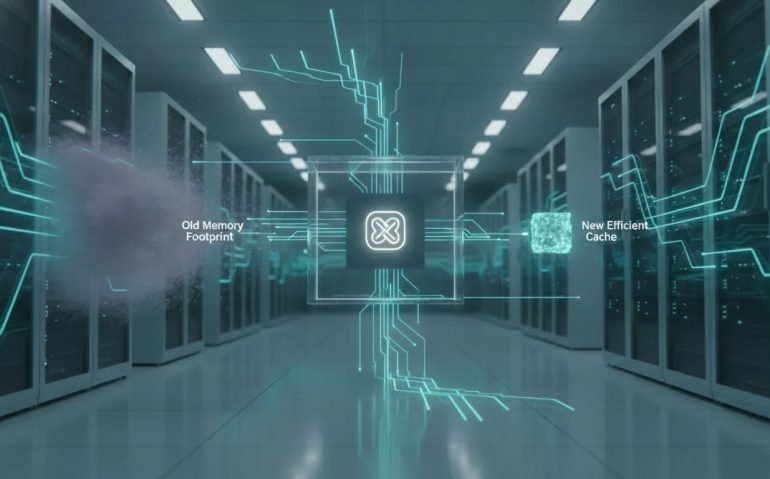
DeepSeek V4.1 Flash is a freak of AI engineering. It is positioned alongside frontier models on performance, yet it has been designed to be radically faster, cheaper, and more memory-efficient. The most jaw-dropping figure is its global KV cache footprint: just 890 bytes per token, compared with almost 390,000 bytes per token in DeepSeek V1. That is roughly a 437 times reduction.
This is not one flashy optimization. DeepSeek has rebuilt the way an LLM reads, remembers, retrieves context, and generates answers. The result is an architecture that attacks the biggest operational pain point in generative AI: the exploding cost of serving long-context workloads.
For Canadian enterprises, startups, and IT leaders, that matters right now. From Toronto financial institutions processing dense reports to Montreal AI firms building agents and Western Canadian energy companies searching technical documentation, long-context AI is becoming a serious business technology requirement. But it has been brutally expensive. DeepSeek’s latest design suggests that the economics may be changing much faster than expected.
Deepseek V4.1 intro
DeepSeek has once again released an open model accompanied by a deeply technical report, and the design choices are genuinely unexpected. At first glance, some of them look flat-out wrong. Why would an AI model deliberately skip computation? Why would it delete part of its own memory? Why would it recalculate information it could have saved?
Once the trade-offs become clear, the architecture starts to look brilliant.
DeepSeek V4.1 Flash is presented as a frontier-capable Flash model that is optimized for low latency, high throughput, and long context. Rather than relying on ever-larger GPU clusters and brute-force scaling, the team has focused on reducing unnecessary computation and minimizing expensive data movement.
That is the key theme running through every component: make the hardware work smarter, not harder.
The situation
DeepSeek operates under constraints that would normally put a lab at a major disadvantage. It is not described as having the funding scale of OpenAI, a massive data-centre footprint, or unrestricted access to the highest-end NVIDIA GPUs. Its team is also much smaller than those of the largest frontier AI labs.
Yet DeepSeek V4.1 Flash is reported to match frontier-level performance while being substantially faster and more efficient. That alone should have Canadian technology leaders paying attention.
The AI market has increasingly rewarded access to capital, chips, and electricity. That is especially relevant in Canada, where companies often face tighter budgets, data sovereignty requirements, and less appetite for endlessly escalating inference costs. A model that delivers strong reasoning and knowledge-work performance without demanding an enormous hardware footprint could be highly consequential.
DeepSeek’s approach is a reminder that competitive AI advantage will not come only from buying more compute. It can also come from architecture, systems design, and ruthless optimization.
Prefill vs decode
To understand why DeepSeek V4.1 Flash matters, it helps to understand the two stages of LLM inference: prefill and decode.
During prefill, the model reads the prompt, attached documents, prior messages, code, or other input context. Text is split into tokens and passed through the model’s layers. At each layer, the model creates numerical representations called keys and values. These are saved in a KV cache.
The KV cache is essentially the model’s notes. It lets the system retain information it has already processed instead of rereading every token from scratch for each new generated token.
Decode is the writing stage. The model generates an answer one token at a time. To decide what should come next, it needs access to the relevant context accumulated during prefill and during generation.
A simple analogy is a student taking notes during a long lecture. When asked a question afterward, the student does not need to replay the entire lecture. They consult their notes. KV cache performs a similar function for an LLM.
That sounds straightforward until the model is asked to process thousands of pages, a giant codebase, or a multi-day AI agent workflow. Then the notes become massive.
The problem
The AI industry is racing toward larger context windows and more autonomous agents. Organizations want models to reason over policies, contracts, financial disclosures, customer histories, engineering documents, and sprawling software repositories. They want agents to sustain tasks over hours or days.
That ambition creates two serious bottlenecks: compute and memory movement.
GPU high-bandwidth memory, often called HBM, is extremely fast because it is close to the processor. It is also limited and expensive. When a KV cache fits in HBM, the model can access its notes quickly. When the cache becomes too large, data must spill into slower storage, such as SSDs outside the GPU.
That is where performance falls off a cliff. Pulling data from an SSD into GPU memory requires moving it through a much slower path. The GPU can end up waiting for information to arrive instead of doing useful computation.
- Compute problem: the model must search and process too much context.
- Memory problem: the model’s cache grows beyond fast GPU memory.
- Latency problem: moving cache data between storage and the GPU slows generation dramatically.
For enterprise AI deployments, this is not a niche engineering issue. It determines operating costs, response times, infrastructure sizing, and whether a promising AI agent is commercially viable.
Causal encoder decoder
A conventional transformer processes layers in a broadly uniform way. Each layer creates its own KV cache, and those caches add up rapidly. DeepSeek V4.1 Flash takes a very different route: it divides the architecture into a causal encoder and a decoder.
During the prefill stage, the latter half of the model is effectively inactive. The encoder half handles the heavy lifting. It reads the provided context, constructs an understanding of the material, and creates a global KV cache.
During decoding, the decoder half generates the response. Rather than independently processing the entire prompt and producing a separate global cache for itself, it borrows the completed global KV cache produced at the end of the encoder block.
This is a highly unusual move because it means roughly half of the model does not perform the full global reading process. The obvious concern is that output quality could suffer. If the decoder did not fully absorb the source material itself, would it lose nuance and produce weaker answers?
DeepSeek’s engineering challenge was to preserve model quality while removing that duplicated work. The reported results suggest it has managed to strike that balance.
The direct payoff is enormous: the architecture can slash the compute required for global context processing by roughly half.
Global vs local cache
The model separates two types of context.
Global context includes the total body of material provided to the system: the prompt, documents, history, and all other available information. It is the complete set of notes from a long series of lectures.
Local context is the immediate material most relevant to generating the next token. It is the sentence, paragraph, or recent exchange that directly shapes the next word the model should produce.
The decoder does not abandon context. It avoids rebuilding the global cache, while continuing to work with the local information needed to write coherent, accurate output.
A business analogy makes this clearer. Junior analysts may read thousands of pages of financial material and produce a precise executive brief. Senior decision-makers rely on that comprehensive summary for overall direction, but when they approve a statement or recommendation, they closely examine the exact wording in front of them.
The encoder is doing the broad analysis. The decoder is using the resulting summary while concentrating hard on immediate execution.
Sliding window attention
DeepSeek uses sliding window attention to give the decoder highly focused local awareness. Instead of repeatedly attending to every token in an enormous context, the decoder pays close attention to the most recent tokens.
This is a major efficiency play. In many generation tasks, the most immediate context has an outsized influence on the next output token. By narrowing local attention to the relevant window, DeepSeek avoids making the decoder scan the full universe of previous information.
The global cache remains available as a source of broad understanding, while the sliding window handles the near-term linguistic and reasoning details of generation.
For organizations deploying AI copilots, this distinction is important. It shows how a model can maintain access to broad enterprise knowledge without paying the full computational price at every single token.
Luma
Efficient AI infrastructure is only part of the story. Organizations also need practical tools that turn model capabilities into useful workflows. Luma is positioned as a creative AI agent platform that combines access to image and video models with an agent-driven workspace.
Rather than treating each prompt as a one-off task, Luma is designed to support end-to-end creative processes. It can help develop concepts, generate visuals, refine assets iteratively, and organize work within one project environment.
Its reusable Skills feature is particularly relevant for marketing teams and creative operations. A team can establish a workflow once, then apply it repeatedly to different assets. Examples include creating influencer-style user-generated content from a product image or producing 360-degree product orbit visuals.
For Canadian brands competing in crowded digital markets, the business case is clear: repeatable creative workflows can reduce production friction while helping teams scale campaigns, product visuals, and social content.
Insane cache compression
The KV cache compression figures behind DeepSeek V4.1 Flash are almost absurd.
- DeepSeek V1 global KV cache: nearly 390,000 bytes per token.
- DeepSeek V4 Flash global KV cache: roughly 3,500 bytes per token.
- DeepSeek V4.1 Flash global KV cache: roughly 890 bytes per token.
That takes the cache footprint from the earliest DeepSeek generation down by approximately 437 times. Even against the previous V4 Flash generation, V4.1 Flash is nearly four times smaller.
Those numbers matter because context capacity is not free. A model may be advertised with a giant context window, but if every added token expands a costly cache, long-context inference becomes economically painful. DeepSeek’s approach tries to break that link.
The central question, of course, is whether a model can compress its notes this aggressively without losing meaning. DeepSeek’s answer is Compressed Sparse Attention 2, or CSA2.
CSA2
CSA2 targets the redundancy inherent in a standard multi-layer transformer. Normally, each layer generates its own KV cache. Since different layers may discover overlapping patterns or reference the same underlying material, this can create an enormous amount of duplicated storage.
DeepSeek introduces extreme sharing through three operating modes: full, reindex, and reuse.
Full mode
A layer in full mode does the complete job. It creates a new KV cache and also generates an index that later layers can use to search that cache efficiently. Think of the index as a table of contents for the notes.
Reindex mode
A layer in reindex mode reuses the KV cache produced by a full-mode layer. It does not create a separate set of notes. However, it builds a new index that highlights different relationships within the same underlying information.
For example, one index might organize world history chronologically, while another might organize the same material around themes, technologies, or political change. The notes remain the same, but the navigation path changes.
Reuse mode
Reuse mode is the maximum-efficiency option. The layer reuses both existing notes and existing indexes. It creates neither a new cache nor a new map for searching the cache.
This is an elegant way to reduce memory growth. Not every layer needs to rewrite information that already exists. Not every layer even needs to create a new perspective on it. CSA2 allows the model to reserve costly work for the layers where it adds real value.
Hierarchical sparse indexer
DeepSeek goes further with a hierarchical sparse indexer. At the beginning of the decoder stage, the first decoder layer acts as a gatekeeper. It reviews the available global cache and creates a candidate pool containing only the most relevant tokens.
Out of a context of one million tokens, the system selects roughly 16,000 candidate tokens. Subsequent decoder layers are restricted to this shortlist rather than being allowed to search the entire context.
That is an aggressive narrowing of the search space. It could easily fail if the system overlooked important evidence. A model that searches only a bad shortlist could miss critical facts, generate unsupported answers, or hallucinate.
The crucial engineering achievement is that the candidate selection process is trained to be accurate enough that the later layers can operate effectively without needing the remaining context.
This principle has direct business relevance. Enterprise AI is not useful merely because it can ingest a million tokens. It must retrieve the right information from that million-token environment quickly, reliably, and at a cost that makes deployment practical.
Local memory problem
Sliding window attention creates a fresh systems challenge. In a multi-turn conversation, the model must preserve local context from prior exchanges. If every short-term cache is saved to SSD storage, the system can end up clogging drives with temporary memory.
This creates the same old data-movement problem. Saving local context externally may seem sensible because the model can retrieve it later, but fetching it back into the GPU introduces latency. The model spends time moving information rather than reasoning.
DeepSeek’s response is counterintuitive: do not persist that local memory at all.
SWA bounded replay
DeepSeek calls this mechanism SWA bounded replay. Once the model has completed a response, it deletes the short-term sliding-window cache rather than storing it on an SSD.
At first, that sounds ridiculous. Why discard the most recent context when the system will likely need it in the next conversational turn?
Because, under this design, recalculating the latest 128 tokens is faster than reading and transferring them from external storage.
Instead of saving, locating, transferring, and loading local cache data, the GPU simply regenerates the most recent local notes when needed. Processing 128 tokens is described as a microsecond-scale operation for a modern GPU. By comparison, moving data over slower storage pathways carries far more overhead.
DeepSeek’s most important insight may be brutally simple: when storage traffic is slower than computation, recomputation is the efficient choice.
This is a masterclass in understanding bottlenecks. Traditional intuition says saving a result should always be more efficient than recomputing it. In modern AI systems, that assumption can fail because memory movement has become such a dominant cost.
For CIOs and infrastructure teams, the lesson extends well beyond this model. AI performance is not only about FLOPS. It is about where data lives, how often it moves, and whether an apparently wasteful calculation is actually cheaper than a storage operation.
Single pass mHC
DeepSeek also adds a component called single pass mHC. The objective is to reduce memory traffic inside the GPU itself.
Running an AI model involves more than performing arithmetic. One operation produces intermediate values that the next operation needs. In a conventional flow, those values may be written to memory and then loaded again for a subsequent calculation. Individually, each movement is tiny. Across billions of operations, the accumulated latency becomes substantial.
Single pass mHC mathematically aligns multiple operations so they can be combined rather than executed as isolated sequential steps. This reduces unnecessary trips to memory and helps keep the processing pipeline moving.
It is another example of the same design philosophy: remove friction everywhere. A few saved movements may seem trivial, but at AI scale they can materially improve throughput.
Engram
The Engram component acts as a separate memory module containing 168 billion parameters. Rather than occupying costly GPU memory, it is designed to live in standard server RAM.
Its purpose is to hold static factual knowledge, such as historical dates, capital cities, and other fixed information. The model can retrieve those facts when needed, but the GPU is not constantly burdened by them.
This separation makes conceptual sense. GPU memory is premium real estate, especially in long-context inference. It should be dedicated to active reasoning and immediate computation wherever possible. Static facts can sit in less expensive memory until required.
Think of a senior lawyer handling a complex case. Their highest value is strategic reasoning, synthesis, and judgement. They do not need to spend their mental energy recalling every exact clause or date. An assistant can retrieve those specific details on demand.
Engram gives the model that kind of assistant, freeing its core reasoning pathway to focus on the difficult part of the task.
DSpark
DeepSeek’s DSpark component tackles another stubborn limitation of autoregressive AI: output generation speed.
Most LLMs generate text one token at a time. Each token depends on what came before it, which creates a sequential process. Even when the model is powerful, this can make output feel slow, particularly for lengthy tasks.
DSpark is designed to enable generation of multiple tokens at once. The objective is straightforward: increase output speed by reducing the strict one-step-at-a-time nature of decoding.
Combined with the memory and cache optimizations elsewhere in DeepSeek V4.1 Flash, DSpark helps create a system geared toward high-throughput inference rather than only benchmark performance.
For Canadian organizations building customer service systems, coding assistants, document intelligence platforms, or internal productivity tools, speed has a direct operational impact. Faster output can improve user experience, support higher concurrent usage, and lower the infrastructure required per task.
They flattened the curve
The most remarkable reported result appears in the relationship between context length and decode computation.
Normally, when a model’s context window grows, its computational requirements grow too. More context means more material to search, evaluate, and use while generating each response token. This is one reason enormous context windows have historically been so expensive.
DeepSeek V4.1 Flash reportedly keeps its decode FLOPS curve nearly flat as context scales from about 4,000 tokens to one million tokens. One million tokens is described as roughly 700,000 words or the scale of a medium-sized codebase.
In practical terms, the model is designed to spend roughly the same amount of energy per output token whether it is working from a one-page document or a vast corpus of information.
That is the headline. DeepSeek appears to have flattened the cost curve for long-context decoding.
If this holds up under enterprise workloads, it could change how Canadian businesses plan AI adoption. Projects that previously looked too expensive, such as deep codebase analysis, large-scale contract review, persistent knowledge agents, or long-document research, may become more commercially realistic.
Frontier performance
Efficiency would not matter much if the model’s quality collapsed. The reported benchmark position is why DeepSeek V4.1 Flash is attracting attention.
DeepSeek V4.1 Flash is described as performing on par with frontier models and leading open-model rankings. On DeepSu 1.1, it reportedly scores 74.2, placing it near GPT6 Astra at 74. It is also presented as highly competitive on CyberGym and Automation Bench, including results that surpass GPT6 Astro Max in some comparisons.
LiveBench reportedly ranks the model as the number-one open model. VAL’s index, which measures performance across knowledge-work tasks, also places DeepSeek V4.1 Flash first.
The cost comparison is perhaps even more disruptive. Models in second and third place are described as costing more than 20 times as much. Through the API, DeepSeek V4.1 Flash reportedly exceeds 200 tokens per second, about four times the output speed attributed to GPT6, while also delivering industry-leading time to first response.
This is the combination that can shake up the market: frontier-like capability, open availability, low cost, and high speed.
Summary
DeepSeek V4.1 Flash is not the product of one magic trick. It is a stack of interlocking decisions that collectively make the model an absolute Frankenstein of efficiency.
- It separates global reading and local generation through a causal encoder-decoder design.
- It reduces decoder workload with sliding window attention.
- It shrinks KV cache requirements using CSA2 and extreme sharing across layers.
- It uses a hierarchical sparse indexer to select a focused candidate pool from huge contexts.
- It deletes short-term cache and uses SWA bounded replay to recompute the latest 128 tokens when that is faster than storage retrieval.
- It reduces internal GPU memory movement with single pass mHC.
- It moves static factual memory to an external Engram module in standard RAM.
- It accelerates generation through DSpark’s multi-token output approach.
The bigger message for the Canadian tech sector is urgent. AI leadership is not solely a contest to build the largest model or acquire the most GPUs. It is increasingly a competition to create the most efficient intelligence system possible.
That matters in a country where enterprises need to balance innovation with cost discipline, governance, and infrastructure realities. It matters for startups in the GTA trying to deliver AI products without burning capital on inference. And it matters for every business leader who has recognized that AI agents will eventually need to operate across enormous volumes of company knowledge.
DeepSeek V4.1 Flash suggests that long-context AI does not have to become exponentially more expensive just because the workload gets bigger. The curve can be challenged. The architecture can be rethought. And the future of enterprise AI may belong to the teams that are willing to make the most counterintuitive engineering decisions.
Is your organization preparing for an AI landscape where performance, cost, and context capacity no longer move in lockstep?