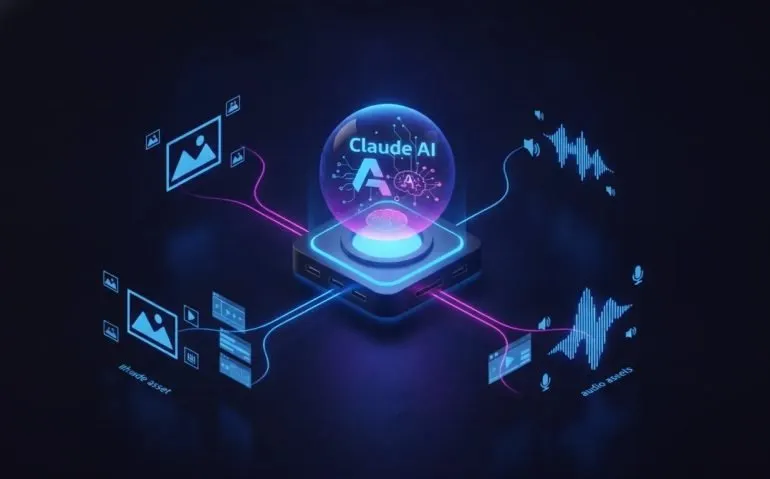
Claude AI can become a full creative studio when you connect it to Hedra through MCP. Instead of stopping at research, outlines, prompts, and plans, Claude can help take an idea through to a finished image, video, or audio asset without forcing you to jump between a stack of separate tools.
That is the part that makes this so powerful. Most AI agents are great at thinking. They can research a topic, organize information, write a script, and tell you what to make. Then you are left doing the actual production work yourself. With Hedra MCP connected to Claude, the workflow changes. Claude can research, create a plan, choose from available creative models, and generate the asset directly in the same conversation.
Whether you need a YouTube thumbnail, a short avatar video, an AI voiceover, or a quick news-style audio update, this connection closes a major gap between an idea and a finished piece of content.
What Is Hedra MCP for Claude?
Hedra is not simply an image generator or a video generator. It is a research and production agent that can work across images, videos, and audio. It can also determine which available model is best suited to a particular creative task.
MCP, short for Model Context Protocol, is the connection layer that lets an AI platform use outside tools. Once Hedra’s MCP server is connected to Claude, Claude gains access to Hedra’s creative capabilities. That means Claude is no longer limited to writing instructions for content. It can initiate the production process itself.
The practical result is simple: you can describe what you want in plain language and have Claude coordinate the work.
For example, you can ask Claude to research what makes an effective thumbnail around AI voice agents for small businesses, develop the concept, and generate the actual thumbnail. Or you can ask for a short script about an AI news update, then have that script turned into a finished avatar video with voice and lip sync.
This is especially useful for creators, marketers, founders, agencies, and anyone who has plenty of ideas but wants to reduce the friction between planning and publishing.
How to Connect Hedra MCP to Claude
The setup is incredibly quick. You need a Hedra account and the Hedra MCP server URL, then you connect it through Claude’s connector settings.
- Go to Hedra and locate the MCP server connection URL.
- Copy the MCP URL.
- Open Claude and select Customize.
- Open the Connectors section.
- Select Add and enter Hedra as the connector name.
- Paste the Hedra MCP URL and continue.
- Complete the authentication process by signing in to your Hedra account.
- Allow Claude to access your account, then enable the available permissions and tools.
Once the connection is complete, Claude can access Hedra’s image, video, and audio capabilities from inside your chat. You can inspect the permissions and available tools before enabling them, which is important because those permissions are what allow Claude to actually carry out creative tasks instead of merely describing them.
Hedra MCP can also be used in other environments that support MCP connections, including tools such as Cursor and ChatGPT. The core idea remains the same: connect the production layer to the AI assistant you already use for research, writing, and planning.
Why This Is Different From a Typical AI Agent
A lot of AI workflows currently look like this:
- You ask for research.
- The AI gives you a plan.
- The AI writes prompts or a script.
- You open several other tools.
- You manually generate visuals, voiceovers, clips, and edits.
That can still work, but it creates a ton of friction. The plan is not the finished deliverable.
Hedra changes that by combining research and creative production. Claude can use your request, its available context, and Hedra’s tools to move from concept to generated output. You can still guide every part of the process, but you are no longer responsible for manually handing off every step between disconnected platforms.
Claude becomes the creative command centre. Hedra becomes the layer that can produce the image, video, or audio needed to execute the idea.
Use Case #1: Generate Better YouTube Thumbnails
One of the strongest use cases is YouTube thumbnail creation. Great thumbnails have to communicate a clear story immediately. They need readable text, contrast, a strong focal point, and a visual that matches the promise of the title.
Rather than prompting an image model blindly, you can ask Claude to research what would make a compelling thumbnail for your topic. In the example workflow, the topic was AI voice agents for small businesses. Claude was asked to research successful thumbnail approaches, create a concept, and generate the image through Hedra.
That request can be as direct as:
Using Hedra’s MCP, research what would make a good thumbnail for a video about AI voice agents for small businesses, then generate the image.
Claude can assess available creative tools, use relevant context, develop a thumbnail direction, and produce a visual. The resulting concept used bold, text-heavy messaging around the idea of AI answering calls, making the benefit obvious before someone even reads the full title.
Use Quality Levels Strategically
Image generation can involve a tradeoff between speed and quality. A high-quality output may take longer to render, while low or medium quality can be useful when you are testing concepts quickly.
- Low quality: Useful for rapid idea exploration.
- Medium quality: Useful when you want a stronger draft without waiting as long.
- High quality: Best when you are ready for a final creative asset.
A smart workflow is to test several thumbnail directions quickly, decide which concept has the strongest hook, then create the final version at a higher quality setting.
Make Precise Edits Without Rebuilding Everything
The editing flow is where this gets even better. After generating a thumbnail, you can request one specific change without asking for a completely new design.
For example, if the image is right but the headline needs more contrast, tell Claude exactly what to modify: change only the text that says “AI answers calls” to bright yellow, while leaving everything else unchanged.
That level of specificity matters. It preserves the composition you liked while updating the one element that needs attention. Instead of endlessly regenerating new versions and hoping the model keeps the right details, you can make focused creative corrections.

Use Case #2: Turn a Script Into an AI Avatar Video
The second use case is where things get seriously crazy. Claude can help create a short script and then send that script through Hedra to produce a video.
You have two options here:
- Ask Claude to write the script first, then ask it to turn that script into a video.
- Provide your own script and ask Claude to use Hedra MCP to create the finished video in one workflow.
For a short-form update, you might ask Claude for a 10 to 15 second script about a new AI release. Claude can formulate the script, then use Hedra to determine the tools needed to make it into a video.
That can include selecting an avatar, generating an AI voiceover, animating the avatar, lip syncing the spoken words, and assembling the video output. If you have your own photo, avatar, or voice asset, you can use those instead. If not, the workflow can use assets already available in your Hedra library or generate an appropriate option.
In the demonstration, the finished video featured a professional-looking avatar, a natural-sounding AI voice, lip sync, and edited visual elements. It even incorporated a previously created thumbnail asset into the video. That is a big deal because it shows how individual creative pieces can become part of a larger content workflow.
Keep an Eye on Model Costs
Some video models may involve generation costs. Claude can surface a warning before proceeding, which gives you the chance to confirm the model choice. This is useful because video production is generally more resource-intensive than generating an image or audio clip.
Do not treat every model the same. If you need a polished final video, using a premium option may be worth it. If you are testing hooks, scripts, or avatar direction, start with a lower-cost approach where possible.
Download Finished Video Files
Generated video links can be temporary. If Hedra provides a pre-signed link, download the finished asset rather than assuming a bookmarked link will remain active forever. This is a small detail, but it prevents the frustrating situation of losing access to a finished piece of content later.
Use Case #3: Create AI Audio News Updates
Audio is one of the fastest content formats to generate. With Hedra MCP connected to Claude, you can ask for a researched audio overview of a current topic, then have it delivered with a selected AI voice.
For example, you could request an audio update about a service outage. The workflow can research the event, check the relevant status information, prepare the spoken copy, select a voice such as Alice, and generate a clean audio update.
This is useful for:
- AI news briefs
- Internal company updates
- Podcast-style snippets
- Social media audio content
- Quick customer communications
- Voiceover drafts for larger videos
Because audio is less complex to generate than images or video, turnaround can be much faster. You still get visibility into the selected voice, the text being used, and the model involved. If anything needs to change, you can edit the request and generate another version.
The real value is not merely that the voice sounds clear. It is that the same workflow can combine research and production. A useful audio update needs more than a decent voice. It needs accurate context, a coherent summary, and a format that is ready to use.
How to Prompt Claude and Hedra for Better Results
The better your direction, the better the finished creative tends to be. You do not need to write massive prompts, but you should provide a few important constraints.
For images and thumbnails, include:
- The topic and intended audience
- The core message or emotional hook
- Required headline text
- Important colours or brand cues
- Any elements that must not change during revisions
For avatar videos, include:
- Script length, such as 10 to 15 seconds
- The message and intended platform
- Whether to use an existing image, avatar, or voice
- The preferred style, such as professional, energetic, or news-like
- Your budget or quality preference if multiple models are available
For audio overviews, include:
- The topic that needs research
- The desired voice
- The target duration
- The intended audience
- Whether the output should sound like news, an announcement, or a social update
Also, be specific when revising. “Make it better” is vague. “Keep the composition unchanged, but turn the headline bright yellow and check the spelling” is a useful instruction that produces a targeted result.
The Bigger Shift: From AI Planning to AI Production
Tools that can research and plan are useful. But the real opportunity is in connecting that intelligence to production.
With Claude and Hedra MCP, you can go from a rough idea to a researched concept, a script, a thumbnail, a voiceover, or a complete short video from a single conversation. That does not mean creative judgement disappears. You still need to decide what is on-brand, what deserves publishing, and what needs refinement.
What disappears is much of the repetitive operational work: opening separate tools, copying prompts between them, manually moving scripts into video generators, and trying to keep every piece consistent.
If you are tired of AI doing all the thinking and leaving you to make everything yourself, this is exactly the kind of workflow worth testing. Get started through Hedra, connect the MCP server to Claude, and try a simple production task first. Make a thumbnail. Turn a short script into a video. Create an audio update.
The results can get wild very quickly.
For more practical AI workflows, explore AI tools and automations and content creation guides. If this setup helps you produce faster, share it with someone who is still juggling five tools just to publish one piece of content.
Suggested category: AI Tools
Suggested tags: Claude AI, Hedra MCP, Model Context Protocol, AI video generator, AI image generator, AI voiceover, YouTube thumbnails, AI content creation
Frequently Asked Questions
What does connecting Hedra MCP to Claude do?
It gives Claude access to Hedra’s creative production tools, allowing it to help generate images, videos, and audio in addition to researching and planning content.
Can Claude create YouTube thumbnails with Hedra MCP?
Yes. Claude can research a thumbnail concept, create the image through Hedra, and make focused revisions such as changing headline text or colours.
Can I turn a script into an AI avatar video?
Yes. You can provide a script or ask Claude to write one, then use Hedra MCP to generate a video with an avatar, AI voiceover, lip sync, and editing.
Can I use my own voice or image in a Hedra video workflow?
Yes. You can use your own photo, AI avatar, voice asset, or existing media from your library, rather than relying only on generated options.
Why should I download a generated video?
Generated video links may be pre-signed and temporary. Downloading the completed file ensures you retain access to the asset.