
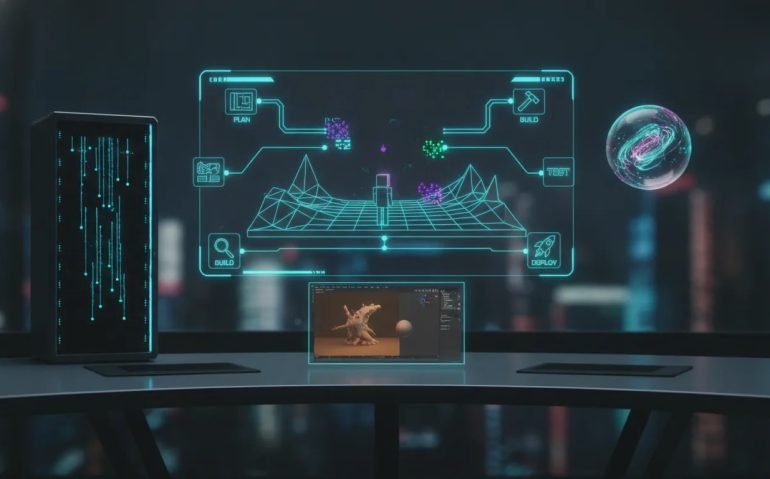
ChatGPT-6 Astra is being positioned as far more than a tool for basic automation, simple websites, or quick app ideas. When paired with Astra Mode on the Abacus AI Supercomputer, it can be used to plan, build, test, refine, and deploy ambitious browser-based experiences, including 3D games, Blender scenes, full apps, servers, and always-on AI agents.
That is the genuinely exciting part. The potential is not simply that an AI can write a few lines of code. The potential is that you can describe a fully formed product, establish a quality bar, approve creative direction, and have the system work through the production process step by step.
Games make the result easy to see, but the bigger lesson applies to practically any digital project. If a system can create a playable dark fantasy action game, a Formula-style racing experience, or a multiplayer arena game structure, think about what it can do for a SaaS tool, interactive website, visualization, storefront, automation, or custom application.
What Astra Mode on Abacus AI Supercomputer Is Designed to Do
Astra Mode combines ChatGPT-6 Astra with Fable 5.1 inside the Abacus AI Supercomputer environment. The idea is to bring creative generation, reasoning, coding, rendering, testing, and cloud deployment into one workflow.
ChatGPT-6 Astra is used throughout the creative and production process. It can help generate 3D playable experiences, rigged Blender scenes, rendered assets, and visual concepts directly from a detailed prompt. Fable 5.1 handles deeper coding and reasoning tasks for applications, servers, and always-on agents.
Blender is available in the environment as well, which means the system can model, render, and iterate on 3D assets without requiring a separate local setup. Rather than producing a concept that only exists as a temporary demo, projects can be hosted in the cloud, kept live around the clock, and made available for others to use.
That cloud-first element matters. A game, app, or tool is more valuable when it is accessible, shareable, and ready to become a real product rather than just an experiment sitting on a computer.
The Core Capabilities
- 3D game creation: Build browser-based playable games with environments, characters, controls, gameplay systems, and interfaces.
- Blender-ready creation: Generate and iterate on 3D models, scenes, and rendered assets with Blender available in the workflow.
- Full-stack app development: Create websites, SaaS products, apps, backend services, and servers.
- Always-on AI agents: Develop agent-based systems designed to remain active in the cloud.
- Testing and iteration: Run checks, identify gaps, refine issues, and report what remains unfinished before deployment.
- Cloud deployment: Keep projects live 24/7 and make them available for interaction, sharing, or monetization.
The Real Unlock: Stop Prompting for a Prototype
The quality of the request changes the quality of the build. If you ask for a basic demo, the system has permission to give you something basic. If you want a premium product, you need to state that clearly and define the experience you expect.
This is where detailed prompts and negative constraints become extremely powerful. A good prompt does not merely name the project. It specifies the intended quality, key systems, atmosphere, gameplay expectations, and the things that are not acceptable.
For example, a dark fantasy project was framed as a full-scale premium browser-based third-person 3D action game called Eye of the Fallen God. It was explicitly not supposed to be a prototype, grey-box proof of concept, simplified approximation, or technical demo.
That distinction immediately raises the standard. The request can include the kind of experience desired, from combat responsiveness and cinematic presentation to visual direction and world design.
Why Negative Prompts Matter
One of the most useful ideas here is the negative prompt. In practical terms, it is a quality gate. It tells the system what it should not knowingly deliver.
For the dark fantasy game, the constraints included avoiding robotic movement, weak combat, placeholder artwork, broken camera behaviour, and an obviously downgraded version of the original concept. The instruction was simple: if the result does not meet those requirements, keep building and fixing it.
This changes the workflow from “generate something and call it done” to “evaluate the work against an agreed standard.” That is the difference between casual vibe coding and a more deliberate production process.
Prompting principle: Describe the outcome you want, name the systems that make it valuable, define the quality bar, and be direct about what must not ship.
Use Case One: A Dark Fantasy 3D Action Game
The first major example was a browser-based third-person dark fantasy action game. The project included a large-scale entrance, a monumental reveal, arena design, a rigged character presentation, responsive controls, combat mechanics, special abilities, and enemy encounters.
What makes the workflow compelling is that it does not stop at asset generation. The system can break the work into production stages:
- Inspect approved concepts, production assets, and available tooling.
- Build the world, including the entrance, reveal, arena, and character presentation.
- Implement controls, combat, abilities, and encounters.
- Test gameplay, capture visuals and motion, then iterate on remaining issues.
- Commit the project and surface the results only when it is suitable for review.
The build included maps, audio, character movement, visual assets, and gameplay systems. It also reported the checks it performed. In this case, 28 tests were run before the project was presented for review.
Even better, the system did not pretend every detail was perfect. It identified remaining gaps such as minor foot sliding on sharp turns, visual quality below the approved concept in some areas, software rendering stutter, and GPU performance that still needed verification. The premium quality gate had not fully passed.
That kind of honest reporting is important. A useful AI development workflow should not hide unfinished work. It should tell you precisely what works, what needs attention, and what should be improved next.
Use Case Two: A Premium 3D Formula Racing Experience
The next example pushed the concept in a different direction: a premium browser-based 3D Formula racing game on a fictional circuit through the Alps.
Again, the prompt did not ask for a small Three.js racing demo. It asked for a big-budget-feeling experience where the driving physics, environment, speed, cinematic camera work, and overall sensation of racing were the showcase.
That framing led to a more complete product vision. The resulting experience included a cockpit view, sound controls, selectable maps, gear information, speed indicators, and map position data. These are exactly the small interactive details that make an experience feel closer to a real game rather than a static scene.
There was also a clear opportunity for further refinement. The graphics could be made more realistic, particularly if the goal is a more photorealistic racing simulation. But for a single detailed prompt and a first build, the result demonstrates the level of complexity that is now possible.
The broader takeaway is not that everyone needs to create a racing game. The takeaway is that complex interactive systems can begin with a clear description. The same approach can be applied to:
- A SaaS product with a polished front end and functional backend.
- An interactive product landing page with 3D elements.
- A virtual model of a home or architectural concept.
- A browser-based training tool or simulation.
- A custom app with payments and cloud access.
Use Case Three: A 5v5 Mobile-Inspired Arena Game
The most ambitious example was a polished browser-based 3D game inspired by the depth, scale, responsiveness, and visual quality associated with League of Legends.
The request called for a 5v5 experience with AI-controlled minion waves, jungle monsters, bushes and vision mechanics, recalls, respawning, gold, XP progression, an item shop, and a central-base objective. That is not a small feature list. It is a full set of interconnected game systems.
The planned build process included original textured champions and environmental assets, data-driven combat, navigation, bots, objectives, progression systems, match rules, champion selection, a heads-up display, controls, audio, browser interaction testing, screenshots for quality inspection, and issue fixing.
The completed game experience allowed character selection from multiple champions, each with different spells and options. It included map objectives, enemy towers, attack interactions, XP progression, purchasable items, and visible timers for incoming waves.
That is why this use case stands out. It illustrates that a well-structured prompt can ask for systems, not just visuals. It can request gameplay loops, economic progression, combat rules, interface design, and quality checks as part of one cohesive build.

Why Automated Testing and Self-Checking Are So Important
Anyone who has tried to build an app or website through iterative prompts knows the frustrating cycle. Something is created. You test it. You find an issue. You request a fix. You test it again. Another issue appears. Then the cycle repeats.
Testing is not the glamorous part of building, but it is one of the most important parts. A polished result depends on the ability to inspect functionality, identify failures, make fixes, and verify the fixes without losing track of the original vision.
Astra Mode is compelling because it is designed to handle that loop within the workflow. The system can inspect mechanics and browser interactions, capture screenshots for quality review, surface gaps, and continue improving the work rather than simply claiming success at the first sign of output.
That is a major shift in how to think about AI development tools. The goal is not just generating code. The goal is creating a system that can help carry a project through development, testing, iteration, and deployment.
From One Prompt to a Live Product
Another major advantage of using the Abacus AI Supercomputer environment is that projects can live in the cloud. A game or app can remain available 24/7 instead of being limited to a local machine or an isolated test session.
That opens up practical possibilities. A browser-based game can be shared. A web app can be used by customers. An AI agent can remain active. A product can be connected to payment flows and become something people can access commercially.
The point is not that every first-generation build is instantly ready for a massive launch. The point is that the road from concept to working, cloud-hosted product is becoming dramatically shorter.
A Better Way to Frame Your Next Idea
Instead of asking, “Can AI make this?” start with a more useful question: “What would the finished version need to do for it to be valuable?”
Then structure your request around that answer:
- Name the product: Give the project a clear identity and purpose.
- Describe the experience: Explain how it should feel and what makes it compelling.
- List essential features: Identify the systems that cannot be missing.
- Set visual and functional standards: Define what “premium” means for your project.
- Add negative constraints: Be explicit about weak, broken, placeholder, or simplified outcomes that are unacceptable.
- Ask for testing and gap reporting: Require the system to disclose what remains unfinished.
- Plan for cloud delivery: Think beyond the demo and consider how people will access the finished project.
ChatGPT-6 Astra Use Cases Go Far Beyond Games
Games are incredible demonstrations because they combine code, visuals, interaction, physics, controls, audio, interfaces, and testing. But the opportunity is much broader.
ChatGPT-6 Astra and Astra Mode can be approached as a creative and technical production environment. If you have an idea for a website, app, 3D object, automation, trading server, online service, or always-on agent, the starting point is no longer necessarily a blank code editor.
The starting point can be a strong specification of what you want built.
That does not mean standards disappear. In fact, standards become more important. The people who get the best results will be the ones who can articulate a clear vision, identify what matters, set constraints, inspect the output, and keep refining until the work is genuinely useful.
Build the Idea You Have Been Sitting On
The biggest message is simple: ambitious projects are becoming more accessible. You do not need to begin as an expert game developer, web developer, 3D artist, or app engineer to bring an idea to life. You need a clear objective, a detailed prompt, a high standard, and a workflow that can keep improving the result.
Whether you want to create a browser game, a SaaS platform, an interactive website, a 3D home concept, or an always-on AI agent, Astra Mode on Abacus AI Supercomputer is built around turning those concepts into working cloud-based projects.
Think bigger with the prompt. Do not settle for the prototype if what you really want is a product.
Explore Astra Mode on Abacus AI Supercomputer and start outlining the project you want to build.
Categories: Artificial Intelligence, AI Development, Game Development, SaaS, Automation
Tags: ChatGPT-6 Astra, Astra Mode, Abacus AI, AI game development, 3D games, Blender, AI app builder, cloud deployment
Frequently Asked Questions
What is ChatGPT-6 Astra used for?
ChatGPT-6 Astra is presented as a model for creating complex digital projects, including 3D games, Blender scenes, websites, apps, automations, servers, and always-on AI agents.
What does Astra Mode add to the workflow?
Astra Mode on Abacus AI Supercomputer combines ChatGPT-6 Astra with Fable 5.1, Blender-ready capabilities, testing, iteration, and cloud hosting for end-to-end project development.
Can Astra Mode create a playable 3D game?
Yes. The examples include a third-person dark fantasy action game, a 3D Formula racing game, and a 5v5 mobile-inspired arena game with gameplay systems, interfaces, and browser-based interaction.
Why should I use negative prompts for AI development?
Negative prompts help define unacceptable results, such as placeholder art, weak gameplay, broken cameras, robotic movement, or simplified prototypes. They act as a quality boundary for the build.
Can projects built with Astra Mode be hosted online?
Projects created through the Abacus AI Supercomputer environment are designed to live in the cloud, making them available 24/7 for sharing, interaction, and potential monetization.