
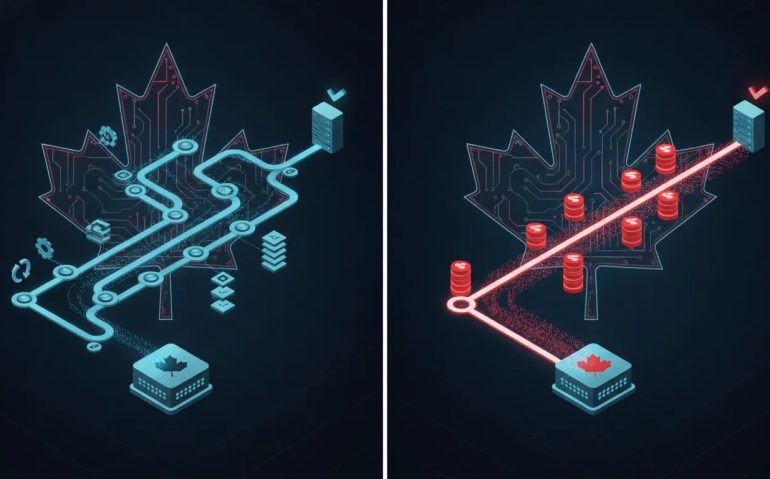
Canadian tech leaders are entering a new era of AI economics. The key question is no longer simply which large language model has the strongest benchmark score or the lowest published API rate. The real question is how much useful work an organization can buy with a fixed AI budget, within an acceptable timeframe, and at a quality level that can safely support production systems.
That distinction comes down to tokens. In practical terms, not every AI token delivers the same value. One model may be inexpensive per million tokens but require far more tokens, more time, or more corrective work to reach the same outcome as a higher-priced competitor. For Canadian tech companies building software, automating workflows, or equipping internal teams with AI tools, this is a critical operational issue.
The most capable AI users are increasingly moving beyond basic prompt engineering. They are designing model portfolios, assigning different AI systems to planning, execution, and review, then measuring cost by completed outcome rather than by a price list. This approach can reduce spending while improving quality, speed, and reliability.
Why Tokens Have Become a Canadian Tech Leadership Issue
AI adoption is accelerating across Canadian tech, from startups in the GTA to established enterprises modernizing internal operations. Yet AI spending can become unpredictable when organizations treat models as interchangeable utilities. A team may select a lower-cost model, assume it will reduce expenses, and later discover that it produces longer outputs, requires repeated prompting, misses requirements, or consumes valuable engineering time.
That is why token strategy matters. It affects:
- Software delivery costs: AI-generated code can require large volumes of output tokens.
- Engineering velocity: Slower model responses can introduce friction into development workflows.
- Quality assurance: Different models make different types of mistakes and detect different categories of defects.
- Vendor strategy: Closed and open source models create distinct pricing, control, and infrastructure tradeoffs.
- Business technology ROI: The cheapest token is not necessarily the lowest-cost path to a completed business task.
For Canadian tech decision-makers, the implication is direct: AI procurement and AI architecture should be assessed through the lens of completed work, not unit price alone.
What Is an AI Token?
A token is a basic unit of text processed by a large language model. It can resemble a word, part of a word, punctuation, or another chunk of text. Models such as ChatGPT and Claude do not process language as humans do. They operate by predicting the next token based on the sequence that came before it.
A short sentence such as “The cow jumped over the moon” may be divided into separate tokens that closely resemble individual words. But this is not always the case. A longer word can be split into multiple pieces. For example, a word such as “programmatic” may be segmented into “program” and “matic.”
This token-based structure matters because model providers commonly charge for two categories:
- Input tokens: The information sent to the model, such as prompts, source documents, codebases, requirements, and previous conversation context.
- Output tokens: The information generated by the model, such as analysis, plans, code, reports, recommendations, or revisions.
Output tokens often cost considerably more than input tokens. That pricing dynamic becomes especially important in software engineering, where a model may need to generate hundreds or thousands of lines of code. Canadian tech teams that use high-cost models for every stage of development may therefore pay premium rates for work that a lower-cost model could complete effectively once a strong plan is already in place.
Not All AI Tokens Deliver the Same Intelligence
The central concept is intelligence density: the amount of useful reasoning and completed work delivered by each token. A model may have a higher listed token price but require fewer tokens to understand a problem, develop a sound approach, and produce a correct answer. Another model may be cheaper per token but need twice as much generated text to reach the same result.
This shifts the analysis from price per token to cost per completed task.
Consider the model pricing examples used in the source material. GPT 5.6 Sol is described as costing US$5 per million input tokens and US$30 per million output tokens. Kimi K3 is described as costing US$3 per million input tokens and US$15 per million output tokens. At first glance, Kimi appears to cost roughly half as much.
However, benchmark-based task cost comparisons suggest that Kimi K3 may consume roughly twice as many tokens to reason through and solve certain tasks. If one model requires one million relevant output tokens for a result and another requires two million, a lower price per token can lead to nearly identical overall cost.
In the example provided, a task requiring one million tokens from GPT 5.6 at a US$30 output rate would cost US$30. If Kimi K3 required two million output tokens for the same task at US$15 per million, its final cost would also be US$30.
This is the kind of calculation Canadian tech organizations must make before standardizing on a model. Unit economics are only meaningful when they are connected to real workload outcomes.
Benchmark Scores Are Useful but Incomplete
Models are frequently compared through coding and terminal-oriented benchmarks, including DeepSweep, FrontierSweep, Kimi CodeBench, and TerminalBench. These tests can show that several models are highly competitive on specified technical tasks. But benchmark parity does not guarantee equivalent business value.
A benchmark score may not fully capture:
- How many tokens a model uses before reaching a correct answer.
- How rapidly it returns useful output.
- How well it follows a software team’s existing conventions.
- Whether it detects implementation risks beyond the immediate task.
- How much manual validation or revision the result requires.
Artificial Analysis task-cost figures cited in the material illustrate the gap between published rates and actual workload cost. Kimi K3 was estimated at approximately US$0.95 per completed task, while GPT 5.6 Sol was approximately US$1.04. Despite significantly different published per-token rates, the outcome-based costs were close. Claude Fable 5 was estimated at US$2.75 per completed task in the same comparison.
For Canadian tech teams, this reinforces a simple discipline: measure AI systems against the organization’s actual work. A model that looks expensive on a pricing page can be efficient in production. A bargain-priced model can become costly if it needs more retries, more tokens, or more human intervention.
Speed Is Part of the AI Cost Equation
Token price and token consumption are not the only variables. Speed has real economic value. If one model can complete a coding task in 30 minutes while another takes an hour, the slower option may reduce developer productivity even if its direct API bill is lower.
This matters in Canadian tech environments where engineering resources are limited and delivery timelines are tight. A delay in resolving a defect, implementing a product requirement, or reviewing a pull request can create downstream bottlenecks across product, QA, security, and customer-facing teams.
Organizations should therefore evaluate AI performance across three dimensions:
- Quality: Does the model produce correct, complete, and maintainable work?
- Cost: What is the total token and operational cost to complete the work?
- Speed: How long does it take to obtain a usable result?
A model should not be called economical merely because it has a lower token rate. It must be economical after accounting for total output volume, latency, review effort, and task completion rates.
Different AI Models Fail in Different Ways
Large language models are not interchangeable. They approach software problems differently, generate code differently, and demonstrate different blind spots. This creates a major opportunity for Canadian tech teams: instead of relying on one AI system as planner, developer, and reviewer, organizations can use model diversity as a quality-control mechanism.
Evidence presented through Greptile’s model-review findings indicates that a model can identify more bugs in another model’s code than the original author can identify in its own output. In one example, when Claude authored a pull request and GPT 5.5 reviewed it, GPT 5.5 identified more bugs than Claude identified through self-review.
This is unsurprising from a governance perspective. Self-review often reproduces the assumptions made during initial creation. A separate model has a different reasoning pattern, different tendencies, and potentially a different interpretation of the specification.
The findings also suggest that error clusters can differ by model. Claude may be more prone to missing behavior in certain situations, while Codex may be more likely to miss semantic intent in others. Neither pattern means a model is universally weak. It means the strongest workflow may involve deliberate cross-checking.
AI Code Review Should Be a Separate Stage
For Canadian tech organizations using AI-generated code, code review cannot be treated as an optional afterthought. A strong workflow separates authorship from validation. The reviewer should compare the implementation against the original requirements, inspect edge cases, identify defects, and assess whether the code fits the broader codebase.
Tools such as Greptile are designed around this operational need by applying AI to code review. The broader lesson is more important than any individual platform: organizations should build a formal review layer into AI-assisted software delivery.
A robust AI review process should examine:
- Whether the feature meets the agreed specification.
- Whether expected behavior is missing.
- Whether the implementation misunderstands the intended semantics.
- Whether new code introduces bugs, regressions, or inconsistent patterns.
- Whether the implementation is understandable and maintainable for human engineering teams.
Canadian tech leaders should treat cross-model review as a practical control. It can improve quality without requiring the most expensive model to generate every line of code.
The Three-Model Strategy: Plan, Execute, Review
The most effective approach described is a staged workflow that assigns each model to the work it performs best. Rather than using one expensive frontier model for every task, the workflow uses premium intelligence where reasoning is hardest and lower-cost speed where production volume is highest.
Stage 1: Use a Frontier Model for Planning
The planning phase requires high-level reasoning. The model must inspect the codebase, understand the requested feature, identify dependencies, recognize potential implementation risks, and create a detailed specification or plan.
This is the stage where a powerful frontier model such as Claude Fable can justify its higher cost. The goal is not to generate a large code output. It is to build a reliable blueprint that can guide the implementation phase.
Planning is input-heavy. The model may need to read substantial portions of a codebase or extensive documentation, but it produces a relatively concise design, requirement set, or implementation plan. Because output volume remains low, the cost impact of choosing a more capable planner can be manageable.
Stage 2: Use a Fast, Lower-Cost Model for Execution
Once a clear plan exists, the execution stage becomes more straightforward. A lower-cost but capable code-generation model, such as Grok 4.5 or Cursor’s Composer model in the examples provided, can translate the plan into code.
This is where cost discipline has the greatest impact. Code generation is often output-heavy, and output tokens are commonly the most expensive part of a model provider’s pricing structure. Using a premium model for every generated file, function, test, and revision can quickly inflate AI spend.
The execution model does not need to rediscover the solution from first principles. It receives a structured plan and applies it. Canadian tech teams can use this division of labour to reserve premium reasoning models for genuinely complex thinking while directing high-volume production work to faster and more economical systems.
Stage 3: Use Another Frontier Model for Final Review
After implementation, a separate frontier model can review the output against the original plan. This reviewer should ask whether the implementation is correct, whether important requirements were omitted, and whether bugs or unintended consequences are present.
The review stage is again relatively input-heavy. The model reads the specification and the generated code, then returns a smaller set of findings, corrections, or approval notes. It does not need to create the same volume of output as the implementation model.
Using a different frontier model for review adds an extra advantage: it reduces the likelihood that one model’s blind spots will persist through planning, creation, and validation.
Why the Mixed-Model Workflow Can Deliver Better Economics
The example workflow uses one million input tokens and 100,000 output tokens for planning, a smaller amount of input and a larger amount of output for execution, and then another input-heavy review stage. The resulting cost comparison is striking.
- Claude Fable alone: approximately US$81 for the end-to-end workflow.
- GPT 5.6 alone: approximately US$46.50.
- A mixed-model workflow: approximately US$25.55.
The mixed approach was presented as delivering comparable results at a much lower price. It may also improve turnaround time because the high-volume execution phase can be assigned to a faster model rather than to a slower frontier system.
For Canadian tech firms, the strategic lesson is clear. AI model selection should occur at the task level, not just at the organization level. An enterprise may have a preferred primary model but still benefit from assigning different models to different stages of a workflow.
A Practical Framework for Canadian Tech Teams
Before building an AI workflow, organizations should classify their work by complexity, risk, volume, and required speed. This creates a more disciplined model-routing strategy.
Assign Premium Models to High-Reasoning Work
Frontier models are best suited to tasks where misunderstandings are expensive and deep contextual reasoning is necessary. These can include architecture planning, complex debugging, product requirement analysis, codebase exploration, security-sensitive reasoning, and final validation.
Assign Efficient Models to High-Volume Work
Lower-cost, faster models can be appropriate for repetitive and well-specified work. Examples include code scaffolding, test generation, formatting, routine documentation, implementation against a detailed plan, and first-pass transformations.
Measure Task Completion, Not Just Usage
Canadian tech leaders should track more than monthly token counts. The more meaningful operational metrics include:
- Cost per completed task.
- Time to usable output.
- Number of retries required.
- Defects found during review.
- Human editing time after AI generation.
- Success rate against documented requirements.
These measures convert AI experimentation into business technology management. They allow IT and engineering leaders to identify which models create value, which tasks should be automated, and where human oversight remains essential.
Open Source Versus Closed Source: The AI Pricing Battle
The token economy is also shaped by a larger market contest between closed source frontier labs and open source models. Closed systems from major providers can offer highly capable models, but their owners control access and pricing. Their business model depends substantially on selling tokens at a margin.
Open source models introduce a different dynamic. If an organization can download, run, inspect, and optimize a model, more providers can serve it. Hyperscalers, data centres, and other infrastructure operators can compete to deliver inference at lower prices.
Kimi is presented as a prominent competitive open source alternative. Although it may use more tokens for certain tasks, its availability enables broader optimization and price competition. When multiple providers can serve the same underlying model, customers gain more choice.
This could be particularly consequential for Canadian tech. Canadian organizations may benefit from more deployment options, greater flexibility in model hosting, and lower inference costs as open source competition strengthens. The practical outcome is not simply cheaper AI. It is potentially more strategic control over where and how AI workloads are operated.
Where Value Moves When Token Prices Fall
Lower token prices do not eliminate value from the AI ecosystem. They shift it across the stack.
- Chip providers benefit because lower inference prices can drive higher overall token usage, increasing demand for compute capacity.
- Hyperscalers and data centres benefit because more usage requires more infrastructure to serve AI workloads.
- Application developers benefit because lower AI costs can make products more capable, accessible, and economically viable.
- Canadian tech buyers benefit because they can use more AI capability within the same budget.
Conversely, if closed source frontier providers maintain a significant quality advantage, they may continue to charge premium prices for the highest-density reasoning tokens. In that scenario, organizations may need to pay more for the best performance while using alternative models selectively for cost-sensitive workloads.
The Strategic Takeaway: Build an AI Portfolio, Not a Single-Model Dependency
Canadian tech organizations should avoid framing AI selection as a one-time contest to identify the single best model. The better question is which combination of models produces the strongest results for each workload.
A mature AI operating model may use a top-tier system to design an approach, a fast and affordable system to execute repetitive production work, and an independent high-capability system to validate the result. This strategy recognizes that intelligence density, output price, latency, and error patterns vary substantially across models.
The organizations that develop this capability early can gain a meaningful advantage. They can control AI costs more effectively, move faster on software delivery, improve output quality, and avoid becoming locked into a single provider’s assumptions or pricing structure.
The future of Canadian tech will not be defined solely by access to AI. It will be shaped by the ability to route AI work intelligently. The businesses that understand token economics today will be better positioned to scale their use of AI tomorrow.
Frequently Asked Questions
What does “not all tokens are equal” mean in AI?
It means that tokens from different AI models can produce different amounts of useful work. A lower-cost model may require more tokens, more time, or more retries to complete the same task as a premium model. The most meaningful measure is cost per completed outcome, not simply cost per million tokens.
Why are output tokens especially important for Canadian tech teams?
Output tokens are frequently more expensive than input tokens and are heavily used during code generation, document production, and detailed analysis. Since implementation work can generate significant output volume, Canadian tech teams can often reduce spending by using cost-efficient models for execution after a stronger model has created a detailed plan.
What is a mixed-model AI workflow?
A mixed-model workflow assigns different AI models to different stages of work. A frontier model may handle complex planning, a lower-cost model may execute the implementation, and another frontier model may conduct final review. This approach aims to balance quality, speed, and cost.
Why should a different AI model review AI-generated code?
Different models have different reasoning patterns and error tendencies. A model reviewing its own work may repeat the assumptions that created an error. Cross-model review can identify missing behaviour, semantic misunderstandings, and implementation bugs that the original generating model did not catch.
How does open source AI affect token prices?
Open source models can be served by multiple infrastructure providers, creating more competition around inference pricing. This may lower token costs and give organizations more deployment flexibility. Closed source models can still command a premium if they maintain superior performance or intelligence density.
What should Canadian tech leaders measure when evaluating AI models?
Key measures include cost per completed task, response time, output quality, retry rates, human correction effort, defect rates, and success against documented requirements. These operational metrics are more useful than published per-token prices alone.
Canadian Tech’s Next AI Advantage
The AI market is moving rapidly, but the core discipline is already clear. Organizations should buy outcomes, not merely tokens. They should use the highest-capability models where reasoning matters most, deploy faster and cheaper systems for high-volume execution, and use independent review to protect quality.
For Canadian tech leaders, this is more than an optimization exercise. It is an emerging operating model for AI-enabled business. As open source alternatives, frontier systems, hyperscalers, and application providers compete for market share, the ability to manage model choice at a granular level will become a major source of advantage.
Canadian tech organizations that treat tokens as a strategic resource can turn AI from an unpredictable expense into a measurable engine for speed, software quality, and business innovation. The urgent question is whether each organization has built the measurement, governance, and multi-model workflow required to capture that value.