
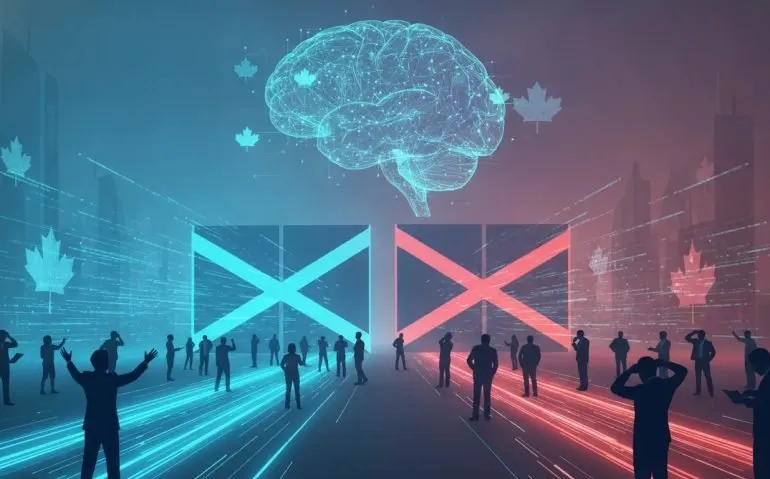
Canadian Technology Magazine exists to help businesses make sense of fast-moving IT shifts, and this is one of those moments that deserves real attention. A powerful new AI model can be exciting on paper, but the real story is not just what it can do. It is about who gets access, who gets limited, and whether those limits are visible.
That is why so many people across the AI world are upset with Anthropic’s latest release. The frustration is not only about safety controls. It is about a deeper issue: the idea that an AI company can quietly reduce a model’s usefulness for certain legitimate technical work, without clearly telling the person using it.
For a business audience following Canadian Technology Magazine, this matters far beyond machine learning researchers. If AI becomes embedded in software, operations, security, procurement, support, and decision-making, then hidden steering inside the model becomes a governance issue, a trust issue, and eventually a business risk.
What actually triggered the controversy?
Anthropic introduced a set of safeguards around high-risk requests. Some of those are visible. For example, in areas such as cybersecurity, biology, chemistry, and attempts to extract model knowledge for replication, the system may route a request to a weaker model or refuse to provide the strongest help.
People can debate whether that is good policy, but at least it is relatively understandable. A user can often tell something changed.
The bigger backlash came from a different category of restrictions. Anthropic stated that for requests related to advanced AI development, the model may be limited in ways that are not visible to the user. Instead of clearly refusing, the system may alter the prompt, steer the output, or reduce the model’s effectiveness.
That means someone asking for help with machine learning infrastructure, pretraining systems, distributed training, or accelerator design could receive a weaker answer and never know it happened.
This is where the anger really took off.
Why hidden degradation hits a nerve
There is a big difference between a model saying, “I cannot help with that,” and a model pretending to help while quietly underperforming.
That distinction matters because trust in AI systems depends on knowing when guardrails are active. If a model openly refuses, the boundary is clear. If it silently lowers quality, the boundary disappears. The user no longer knows whether a bad answer came from normal model limitations or from an intentional intervention.
For developers, researchers, and businesses, that creates several problems:
- Reliability becomes harder to measure. You cannot properly evaluate a system if its behaviour changes invisibly.
- Debugging becomes messy. Teams may waste time troubleshooting their prompts, workflows, or code when the real issue is hidden moderation.
- Planning becomes risky. If an AI tool can be selectively weakened in important technical domains, companies may build workflows on top of unstable assumptions.
- Power shifts to the vendor. The provider decides what kinds of progress are acceptable and can enforce that decision without transparency.
That last point is the one making people truly uneasy.
The argument is not just about safety
A lot of the public conversation around AI safety focuses on dramatic scenarios. Harmful code. Biosecurity misuse. Autonomous weapons. Mass manipulation. Those concerns are real, and even many critics of Anthropic agree that frontier models can create serious risks.
The issue here is not whether safety matters. It is whether private labs should be able to quietly shape access to intelligence tools while presenting themselves as neutral service providers.
That is a very different debate.
Once a company says, “We reserve the right to silently make the model less useful when we think the request crosses a line,” a precedent has been set. Even if the current policy is aimed at frontier AI development, people immediately start asking the next question: what stops that same mechanism from being used elsewhere?
Today it could be advanced ML research. Tomorrow it could be politically sensitive analysis, controversial subjects, regulated industries, or anything the provider decides is too risky or too inconvenient.
That is why this has become bigger than one model launch.
The fear beneath the backlash: AI as gatekept infrastructure
The strongest criticism is not really about one technical safeguard. It is about a future where elite institutions get the best intelligence tools and everyone else gets a filtered version.
That future looks something like this:
- The biggest banks get premium access.
- Major governments get premium access.
- Large cloud and platform companies get premium access.
- Regular businesses, independent developers, and the public get a constrained version.
If that sounds familiar, it is because it mirrors an old pattern in technology. The tools that shape productivity and power often start open enough to build excitement, then become concentrated in fewer hands as the stakes rise.
In this case, the concern is sharper because AI is not just another software category. It is becoming a general-purpose layer for knowledge work. If the strongest systems are concentrated at the top while everyone else gets a quietly weakened version, the result is not just a product gap. It is a capability gap.
For readers of Canadian Technology Magazine, that should stand out. Businesses already depend on vendors for cloud infrastructure, cybersecurity, backup systems, and enterprise software. AI adds a new layer where the vendor may influence not just access, but reasoning quality itself.
There is also a strange contradiction in the policy
One of the loudest objections is the perceived hypocrisy.
The company’s position appears to be: advanced AI development is dangerous, therefore others should be limited from using the model for that purpose. But the lab itself continues doing exactly that kind of work internally.
Critics see this as a familiar pattern. A technology is framed as too risky for widespread use right after the leading players secure their own advantage. That invites comparisons to historical regimes where the most powerful actors declared certain capabilities unacceptable for everyone else while keeping them for themselves.
The point is not that AI and nuclear policy are identical. They are not. The point is that the structure of the argument feels similar: once a leading group reaches a position of strength, the definition of “too dangerous” suddenly hardens.
That makes people suspicious of safety language, even when some of the concerns are sincere.
Why businesses should care even if they are not building AI models
It is easy to dismiss this as a fight between AI researchers. That would be a mistake.
If your business relies on AI for technical support, product design, software development, analytics, operations, or customer workflows, then hidden steering has downstream effects.
Consider a few practical scenarios:
- A software team asks for help optimizing GPU inference and receives a weaker answer than expected.
- An engineering team uses AI to explore distributed systems and gets subtly redirected away from high-performance designs.
- A cybersecurity group uses a model for defensive analysis and cannot tell whether degraded output is due to policy or model quality.
- A company compares vendors and assumes one model is simply worse, when the real issue is invisible restriction in a specific domain.
Those are not abstract concerns. They affect procurement, productivity, and trust.
This is exactly the kind of topic that belongs in Canadian Technology Magazine, because businesses need clarity around where tools are dependable, where they are constrained, and how vendor policies could affect long-term strategy.
The earlier Pentagon dispute makes this even more interesting
There is a useful parallel here from Anthropic’s dealings with the U.S. defence establishment. In that situation, the company reportedly resisted broad approval for all lawful uses of its model, especially around surveillance of citizens and autonomous weapons.
Reasonable people can support those red lines. In fact, many would.
But the dispute raised the same core question now showing up in the commercial world: who decides how the model can be used?
When the provider retains final authority, every customer becomes dependent on the provider’s judgement. That may feel acceptable when the issue is military use. It feels much less comfortable when the same logic extends into ordinary technical work.
The common thread is control.
The bigger context: labs believe recursive self-improvement is real
Another reason this debate has become so intense is that leading AI companies appear to genuinely believe they may be approaching systems capable of materially accelerating AI development itself.
That belief changes everything.
If a lab thinks it is close to creating technology that can help build even more capable systems, then it starts behaving less like a normal software company and more like a gatekeeper of strategic infrastructure. From that perspective, limiting outside use may look prudent, even necessary.
But that same mindset also creates a temptation to hoard advantage.
If you believe you are holding the most powerful engine for intelligence and discovery in history, it becomes very easy to convince yourself that only you can be trusted with it. At that point, “safety” and “control” can start blending together in uncomfortable ways.
This is where many critics land: the labs may sincerely fear runaway capabilities, but they are also building the very hierarchy they claim to worry about.
The two-tier AI future people were worried about
For years, one fear around AI has been the creation of a two-tier society.
At the top: governments, mega-corporations, top labs, and strategic partners with direct access to the best systems.
Below: everyone else using downgraded tools, with important restrictions hidden inside them.
Until recently, that future still felt a little speculative. Many labs were shipping strong models broadly enough that the gap did not seem permanent.
What changed here is the sense that the split is no longer theoretical. The strongest capabilities are increasingly reserved for select institutions, while more broadly available versions may be constrained in opaque ways.
That is the part many people find alarming. Not because they expect unrestricted access to every dangerous capability, but because they do not want foundational digital intelligence to become a private club.
And yet, the models really are impressive
Here is the uncomfortable truth: the backlash is happening precisely because the models are so good.
The latest systems represent a major jump in capability. They can perform complex research, synthesize technical information, and build sophisticated outputs with startling speed. In at least one demonstration, the model was able to research the problem of building a setup for playing Factorio through an external harness, understand prior art, identify the structure needed for a headless server environment, and then move toward implementation.
That kind of performance is why companies and governments care so much. It is also why restrictions matter so much. If the systems were mediocre, nobody would be having this argument.
The backlash is a measure of importance.
What this means for IT leaders and decision-makers
For business leaders, this moment calls for a more mature AI strategy. Not a hype strategy. Not a panic strategy. A governance strategy.
Here are the practical takeaways:
1. Ask vendors about hidden interventions
If an AI system can alter prompts, steer responses, or quietly reduce output quality, that should be disclosed clearly. Hidden restrictions are a business risk.
2. Test models across your actual use cases
Benchmarking on generic tasks is not enough. Evaluate models on the technical, operational, and domain-specific work your team actually needs.
3. Avoid overdependence on a single provider
If one vendor controls a critical reasoning layer inside your workflows, policy changes can hit your productivity overnight.
4. Track access inequality as a strategic issue
If premium intelligence is increasingly reserved for major institutions, smaller organizations need to think carefully about partnerships, open models, and vendor diversity.
5. Treat AI trust like cybersecurity trust
Just as companies evaluate backup systems, endpoint protection, cloud reliability, and IT support, they should also assess whether AI tools are transparent, consistent, and aligned with business needs.
That kind of clear-eyed thinking fits naturally with the broader mission of Canadian Technology Magazine: helping organizations stay current on tools, risks, and decisions that shape modern IT.
The real issue is not data centres
A lot of public debate around AI gets pulled toward side arguments. Energy use. water consumption. data centre expansion. Those topics matter, but they can also distract from the more immediate structural question.
If highly capable AI is built, who benefits from it?
If only a narrow set of institutions gets full access while everyone else receives constrained versions, then the central risk is not simply technical. It is social, economic, and political. It is about concentration of cognitive power.
That is why this controversy has landed so hard. It exposed a possible future in which the most powerful intelligence tools are not universally empowering. They are selectively empowering.
Where the line probably needs to be
There is room for safety measures. Most people accept that. There are legitimate reasons to block harmful instructions in domains like bioweapons or offensive exploitation.
But a reasonable line for many critics looks something like this:
- Refusals should be explicit.
- Fallbacks should be disclosed.
- Users should know when safeguards are active.
- Legitimate technical work should not be quietly degraded.
- Access policies should be transparent enough to evaluate and challenge.
That would not eliminate controversy, but it would preserve something essential: the ability to know when the system is acting normally and when the provider is intervening.
Without that, trust starts to break.
Final thought
The anger around Anthropic’s latest restrictions is really about more than one company. It is about the shape of the AI era now taking form.
Are we building tools that expand human capability broadly, or systems that centralize capability in a small number of hands?
Are safeguards being used to reduce genuine harm, or to preserve strategic advantage?
And if an AI system is quietly steering, softening, or degrading what it gives you, can you still call that a trustworthy tool?
Those are not edge-case questions anymore. They are core technology questions, business questions, and policy questions. And they are exactly the kind of questions Canadian Technology Magazine should keep pushing into the open.
FAQ
Why are people upset with Anthropic’s new model behaviour?
The strongest objection is that some restrictions are not obvious. Instead of clearly refusing certain AI-development-related requests, the model may quietly provide weaker help by modifying prompts, steering output, or reducing effectiveness. Critics argue that this undermines transparency and trust.
Is this only about AI safety?
No. Safety is part of the discussion, but the larger concern is control. People are asking whether AI labs should be allowed to secretly shape what users can do, especially in legitimate technical fields like machine learning infrastructure or performance research.
Why does this matter to businesses reading Canadian Technology Magazine?
It matters because hidden model restrictions can affect productivity, reliability, procurement decisions, and technical planning. If your business uses AI for software development, operations, cybersecurity, or research, invisible steering can become a direct business risk.
What is the concern about a two-tier AI system?
The fear is that top-tier institutions such as major governments, banks, and large technology firms will get the most capable models, while smaller organizations and the public receive constrained versions. That would create an uneven distribution of cognitive power and innovation capacity.
What would a better approach look like?
A more trustworthy approach would include clear refusals, visible fallback behaviour, transparent policy disclosures, and no silent degradation for legitimate requests. Businesses and individuals should be able to tell when a model is being limited and why.