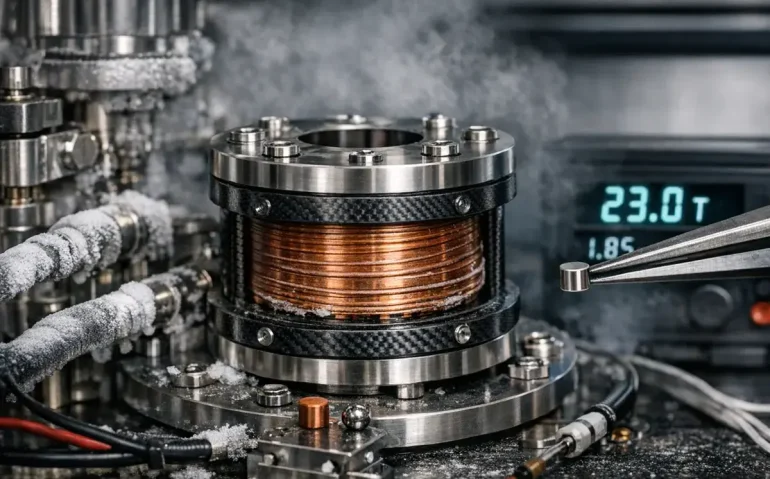
For decades, the world’s most powerful magnets have been room-sized behemoths that guzzle electricity and demand elaborate cooling systems. A new palm-sized design, however, has overturned that paradigm, offering laboratory-grade magnetic strength in a device small enough to fit on a workbench—and cheap enough for widespread adoption.
Why Size Traditionally Equals Strength
Conventional high-field magnets rely on bulk copper coils or superconducting wire cooled with liquid helium. To prevent overheating and to accommodate large current loops, engineers usually scale the magnet up. Bigger coils mean:
- Higher current capacity
- Better heat dissipation
- Room for heavy cryogenic plumbing
Unfortunately, this also means soaring costs—often millions of dollars to build and tens of thousands per year to operate.
The Breakthrough Design
The new miniature magnet uses a layered, high-temperature superconductor (HTS) tape wound tightly around a compact core. Key innovations include:
1. No-Insulation Windings
By eliminating electrical insulation between turns, current can flow around local defects, preventing burn-outs and allowing tighter packing.
2. Advanced Cryocoolers
Instead of baths of liquid helium, a refrigerator-sized cryocooler keeps the magnet at around 20 K. This reduces operating costs by roughly 90 %.
3. Reinforced Structural Shell
A carbon-fiber composite shell absorbs the immense Lorentz forces that build up at high field strengths—previously a limiting factor at small scales.
Performance Numbers That Matter
During independent testing, the device generated a 23-tesla central field—on par with many university research magnets—while drawing less than 2 kW of power. For comparison:
- Typical benchtop electromagnets: 1–2 tesla
- Whole-body MRI systems: 1.5–3 tesla
- Large-scale research magnets: 20+ tesla, but house-sized
Immediate Applications
Access to strong fields without the overhead of a full magnet facility opens new doors in:
- Materials science – probing quantum effects and phase transitions in a standard lab
- Magnetic resonance – developing portable, high-resolution NMR and MRI instruments
- Energy tech – compact fusion prototypes and advanced motor testing
- Education – allowing universities and even some high schools to teach high-field experiments safely
Cost and Accessibility
The prototype’s bill of materials comes in under US $80,000—an order of magnitude cheaper than legacy superconducting systems—while annual running costs drop to a few thousand dollars, mostly electricity for the cryocooler.
Challenges Still Ahead
Despite its promise, several hurdles remain:
- Quench protection – rapid energy dumps in fault scenarios must be managed to avoid damaging the HTS tape.
- Field homogeneity – for precision spectroscopy, uniformity better than 1 ppm is needed; current prototypes are at tens of ppm.
- Manufacturing scale-up – producing kilometers of defect-free HTS tape at low cost is still a developing industry.
Looking Forward
Engineers expect the next generation to push beyond 30 tesla, while further shrinking the footprint and integrating smart quench-detection electronics. If successful, the miniature high-field magnet could democratize access to extreme magnetic environments, much as desktop lasers revolutionized optics research three decades ago.
The age of the pocket-sized powerhouse has begun—proving that, at least in magnetics, bigger is no longer the only route to stronger.