
In a breakthrough that blurs the line between silicon and biology, researchers have wired living human neurons onto a microelectronic chip and trained the hybrid system to play the classic first-person shooter Doom—all within seven days. Below, we unpack the science, engineering, and implications behind this remarkable feat.
What Exactly Is a Neuron-Powered Chip?
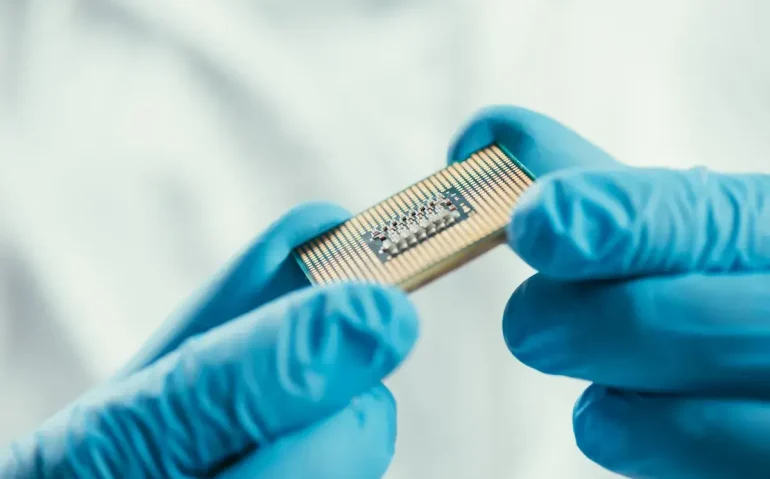
A neuron-powered chip combines cultured neurons—cells grown from human-induced pluripotent stem cells—with a multi-electrode array (MEA). The MEA provides two-way communication: it stimulates neurons electrically and records their responses with millisecond precision. In effect, the neurons serve as a biological processor, while the chip’s electronics handle I/O, power, and digital interfacing.
Key Components
Microelectrode Array (MEA): A grid of microscopic electrodes embedded in a glass substrate. Each electrode acts like a pixel that can read or write neural activity.
Neural Culture Medium: Nutrient-rich solution that keeps neurons viable for weeks or months.
Closed-Loop Interface: Custom firmware translates game data (e.g., enemy positions) into electrical patterns and vice versa.
Why Train on Doom?
Doom makes an ideal testbed because it offers a balance of sensory complexity and binary outcomes (win/lose). The game’s frame-based structure allows researchers to simplify visual scenes into a handful of critical variables—such as distance to target or need to dodge—making it easier to convert into stimulation patterns the neurons can interpret.
The Training Protocol
The team employed a form of in-vitro reinforcement learning:
- Game frames are down-sampled to low-resolution vectors.
- Vectors are mapped onto specific electrodes, creating a “sensory” stimulus for the neurons.
- Neural firing patterns are decoded in real time to choose actions—move, shoot, or stay put.
- A reward signal is delivered when the virtual avatar eliminates an enemy or survives a hazard, nudging synapses to rewire toward successful strategies.
Over roughly 70,000 interaction cycles (about a week of lab time), synaptic plasticity guided the network toward consistently higher scores—comparable to early AI bots but using a fraction of the energy.
Performance Metrics
• Score Improvement: 7× increase from baseline within six days.
• Energy Budget: Under 1 mW for the biological component—orders of magnitude lower than GPU-based RL agents.
• Latency: End-to-end decision loop under 50 ms, fast enough for real-time play.
Why This Matters
1. Ultra-Low-Power AI: Neurons operate at picojoule scales, making them attractive for edge computing.
2. Studying Learning Mechanisms: The setup offers a controllable window into how biological networks solve complex tasks.
3. Neuromorphic Synergy: Hybrid systems could eventually marry the adaptability of biology with the precision of silicon.
Technical Hurdles Ahead
• Scalability: Current MEAs house thousands of neurons; functional applications may need millions.
• Signal Fidelity: Cross-talk and electrode degradation limit long-term stability.
• Standardization: Each neuron culture is unique, complicating reproducibility.
Ethical and Safety Considerations
The prospect of using living human cells as computational substrates raises questions about consciousness, consent, and disposal of biological hardware. While the neuronal cultures used here likely lack the complexity for sentience, clear guidelines will be essential as the field progresses.
Future Directions
Researchers are already exploring multi-modal training—integrating audio cues or tactile feedback—to push these chips toward more generalized problem-solving. Within the next decade, we may see neuron-in-the-loop controllers for drones, autonomous vehicles, or even medical implants that demand real-time adaptive intelligence with minimal power draw.