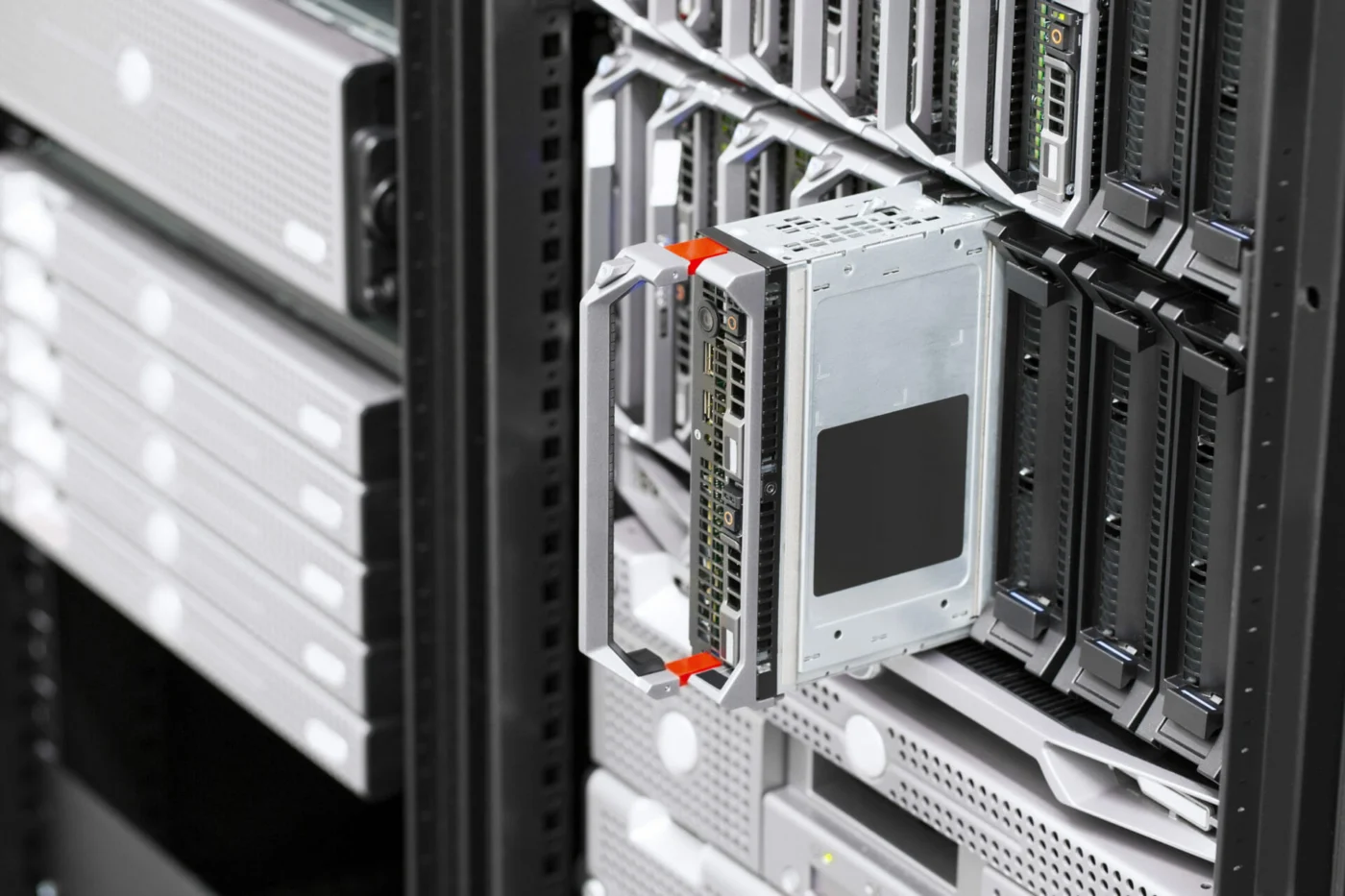
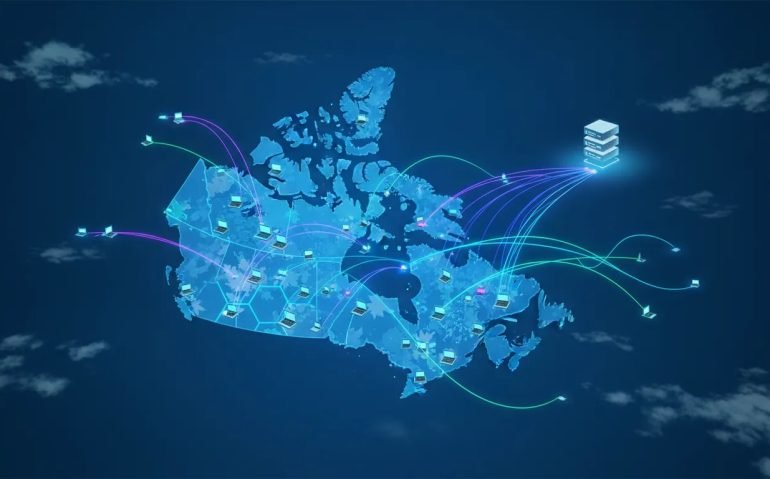
Canadian tech is confronting a defining AI infrastructure question: should the future of computing remain concentrated in enormous, power hungry data centres, or can it be distributed across the powerful computers already sitting in homes and offices? Darkbloom, an early-stage peer-to-peer AI inference network, presents a provocative answer. It aims to let owners of capable Macs contribute unused computing capacity to an open network, while customers access AI models at lower cost.
The concept is simple but potentially disruptive. Instead of relying exclusively on hyperscale facilities packed with GPUs, a distributed network can combine thousands or even millions of smaller machines. Each node may contribute only part of the total capacity, but the aggregate can become meaningful. For Canadian tech leaders assessing the next wave of AI infrastructure, that model deserves close attention.
Darkbloom is not a replacement for every enterprise data centre workload. It is also very early, with changing requirements and operational uncertainty. Yet its approach highlights a major shift underway in AI: compute is becoming more decentralized, open-weight models are becoming more useful, and idle hardware is increasingly viewed as an economic resource.
A New Model for AI Infrastructure
Traditional AI infrastructure is built around centralized data centres. These are large facilities that contain vast fleets of accelerators, networking equipment, cooling systems, and storage. Their scale can support demanding model training and high-volume inference, but they also create well-known concerns around energy consumption, local infrastructure, community acceptance, and the concentration of technological power.
Darkbloom advances a different architecture. A person installs the provider software on an eligible Mac, connects an account for payouts, and allows the computer to serve requests for supported AI models when capacity is available. Rather than one company owning every server in one or several large facilities, the network sources inference from many independently operated machines.
This is best understood as a distributed data centre, although the physical reality is much more fragmented. The hardware could reside in homes, small businesses, studios, agencies, or technology teams with capable machines that are otherwise underused. The idea is comparable, in broad terms, to distributed solar generation: individual contributions may be modest, but a network can aggregate them into a larger resource.
For Canadian tech, this concept is compelling because Canada’s AI ambitions are inseparable from access to affordable compute. Domestic firms, research groups, and startups all compete for infrastructure in a market where capacity is valuable and centralized providers remain dominant. Distributed inference offers one potential route to broaden participation, particularly for workloads that can operate on smaller, open-weight models.
What Darkbloom Is Actually Providing
Darkbloom focuses on inference rather than model training. Inference is the process of running a trained AI model to produce an answer, generate text, classify information, or complete another task. It is the recurring activity that occurs when an application sends a prompt to an AI system and receives an output.
The network serves open source or open-weight models, including models identified as Qwen 3.6, Gemma 4, and GPT-OSS. These models are designed to be more accessible than the largest proprietary systems and can be operated on sufficiently capable hardware. By connecting many machines, Darkbloom can offer users access to models without requiring each person to own a high-end computer.
The service is available through OpenRouter, a platform that provides access to multiple AI model providers. Darkbloom has positioned its offerings as significantly less expensive than some alternatives on that marketplace, with pricing described as roughly 50% lower. The network had reportedly processed 4.5 billion tokens within approximately its first week, an early indication that lower-cost distributed inference can attract real demand.
That does not mean price alone determines value. Canadian tech buyers should evaluate model quality, speed, availability, privacy, operational support, and commercial terms alongside per-token costs. Still, the underlying proposition is powerful: a network of independently owned machines may be able to serve useful AI workloads at a competitive price.
Why Smaller Models Matter
The centralized AI race has often focused public attention on ever-larger models that require immense clusters of specialized hardware. But many practical business tasks do not necessarily demand the biggest available model. Summarization, extraction, classification, routing, drafting, internal knowledge support, and structured generation can often be handled by smaller systems.
That is where distributed networks may have their strongest early opportunity. If a model can run effectively on a Mac with enough memory, that machine can become a productive node rather than an idle asset. Canadian tech organizations that already own Apple Silicon devices may see a different value proposition from their existing hardware, though eligibility, performance, and security requirements remain critical.
- Model accessibility: Open-weight models can be deployed beyond a single proprietary cloud provider.
- Distributed capacity: Many independently run nodes can contribute to aggregate inference throughput.
- Potential cost competition: Lower infrastructure and utilization economics may reduce model-serving costs.
- Hardware reuse: Existing computers can potentially generate revenue rather than remain underutilized.
- Reduced concentration: Compute capacity is not entirely controlled by a small group of hyperscale operators.
Peer-to-Peer AI Changes the Ownership Equation
The most important idea behind Darkbloom is not the modest monthly revenue estimate for an individual computer owner. It is the transition from centralized cloud consumption to peer-to-peer AI. In this model, someone needing inference can connect to capacity contributed by another person, rather than relying only on a major platform’s infrastructure.
For Canadian tech, this represents an intriguing alternative to the familiar cloud model. Businesses have spent years moving workloads into centralized environments because cloud platforms simplify deployment, scalability, and operations. AI has extended that pattern, with large model providers becoming a critical layer of the business technology stack.
Peer-to-peer inference introduces another possibility. Capacity can be owned and supplied by a geographically dispersed group of participants. An individual node operator supplies hardware, electricity, and availability. A customer consumes model output. The platform coordinates the network and payment flow.
In theory, this creates a more direct economic relationship between compute supply and demand. It also makes the value of idle hardware more visible. A powerful Mac that sits unused for much of the day may be capable of handling requests from the network, provided the owner accepts the operational and electricity trade-offs.
The potential strategic benefit is decentralization. Concentrated AI infrastructure can create dependence on a limited number of providers, facilities, and policies. Distributed networks built around open models may give organizations more options. They can also encourage a broader community of operators to participate in the AI economy.
Distributed compute does not eliminate the need for major data centres, but it could reshape which AI workloads must depend on them.
Privacy Is the Central Technical Challenge
Sending an AI prompt to someone else’s computer introduces an immediate and serious concern: how can the owner of that machine be prevented from reading the prompt or the resulting output? This is the foundational trust problem for peer-to-peer inference.
Darkbloom’s technical approach is designed around removing software pathways through which inference data could be observed on the host machine. The inference engine runs in a single hardened Swift process, with no subprocesses, local server, or inter-process communication. It uses MLX Swift LM, Apple’s inference technology for Apple Silicon GPUs.
The intended result is that the machine owner may provide the processing capability without gaining visibility into the content being processed. In a peer-to-peer model, this protection is not a feature that can be treated as optional. It is essential to whether businesses and individuals will trust the network with meaningful workloads.
Canadian tech decision-makers should nevertheless approach any new distributed platform with appropriate diligence. A published white paper, publicly available software, and an inspectable codebase all improve transparency, but they do not remove the need for internal security assessment. Organizations handling confidential client records, regulated data, trade secrets, or sensitive employee information should determine whether a service’s architecture, contracts, risk controls, and data practices meet their requirements before use.
Questions Enterprises Should Ask Before Using Distributed Inference
- What information is processed, retained, or logged by the network and its participating nodes?
- How does the architecture prevent node operators from accessing prompts and outputs?
- What hardware and software permissions does provider software require?
- What is the process for reporting vulnerabilities and responding to incidents?
- How are service availability, performance, and model changes communicated?
- Which workloads are suitable for open-weight models, and which should remain within controlled environments?
- How do billing, payment, and revenue-sharing terms change as the network develops?
These questions apply broadly across Canadian tech, not merely to Darkbloom. Novel infrastructure can create genuine opportunity, but it also requires governance that is proportional to the business value and the data involved.
How Providers Join the Network
Darkbloom currently uses a command-line interface for provider onboarding, with a Mac application planned. The setup process requires a Darkbloom account and software installed on the Mac. Once installed, the device is enrolled through macOS Device Management settings under Darkbloom Provider Enrollment.
The system then tests hardware performance to determine whether the machine can meet the network’s standard. One reported test used GPT-OSS 20B and achieved 78 tokens per second. Token throughput is a practical performance measure for language-model inference. Higher throughput generally means a machine can generate responses more quickly and handle requests more effectively.
Hardware verification follows the initial benchmark. Darkbloom raised its minimum memory requirement to 48 GB of RAM, a change attributed to demand and the need to establish a quality threshold. That requirement limits participation, but it also signals that the network is prioritizing predictable performance over unrestricted enrollment.
Many higher-specification Mac mini, Mac Studio, and Mac laptop configurations can meet this threshold. Still, an eligible device is not automatically an ideal provider node. Operators should consider whether the computer is needed for core work, whether sustained AI activity affects device availability, and whether the local power costs support the expected revenue.
Revenue Expectations Require Caution
An earnings estimator cited a Mac Studio with an M5 Ultra and 96 GB of memory as capable of producing approximately US$37 per month. This is not a guaranteed outcome. Actual earnings depend on demand, uptime, hardware performance, supported models, pricing, and evolving network rules.
The stated premise is that revenue can be earned from a machine that would otherwise be sitting idle. Electricity is an incremental cost, and Apple computers are widely valued for energy efficiency. Yet energy pricing varies by location, device use, and workload. Canadian tech operators should calculate the economics based on their own power rates, expected utilization, and hardware depreciation rather than assuming any published estimate will apply.
Payouts are handled through a connected Stripe account. Stripe acts as the payment intermediary, meaning the provider connects a bank account to Stripe rather than directly to Darkbloom. The practical implication is that the platform can send earnings, although each participant should independently understand the account terms and risks before linking financial information.
Transparency Is Promising, but Early-Stage Risk Remains
New AI platforms often attract immediate skepticism, especially when they request software installation, device enrollment, and financial account setup. That skepticism is rational. Distributed compute networks must earn trust not only through ambitious technical claims but through clear documentation, auditable code, careful permissions, and reliable operating practices.
Darkbloom’s software is publicly readable, enabling independent inspection and auditing. A review of the codebase referenced in the source material did not identify hidden malware, cryptocurrency mining functions, or credential theft, and described mobile device management and device access concerns as low. However, an external code review or automated review is not the same as a comprehensive security guarantee.
One important commercial issue is revenue sharing. At the current stage described, node operators receive 100% of revenue earned. That arrangement can be changed in the future. This is a useful reminder that the economics of emerging platforms are fluid. Early incentives may be structured to stimulate supply, but mature networks frequently adjust fees, eligibility standards, payout models, and service terms.
Canadian tech leaders should therefore distinguish between the durability of the distributed-compute concept and the uncertainty of any single implementation. Darkbloom may evolve rapidly. Its requirements may change. Its product experience may contain rough edges. Network demand may fluctuate. None of those realities diminish the significance of the broader model, but they do argue for measured pilots instead of uncritical adoption.
What This Could Mean for Canadian Businesses
Canada’s technology economy includes global AI research centres, a growing startup ecosystem, established enterprises modernizing their operations, and thousands of small and mid-sized firms seeking practical automation. Across that landscape, affordable inference matters. The ability to use capable models without committing every workload to premium centralized services could influence how companies design AI products and internal tools.
For a startup in Toronto, Waterloo, Montréal, Vancouver, Calgary, or another Canadian innovation hub, a lower-cost inference option may support experimentation. For an IT team, it may create another sourcing option for non-sensitive workloads. For a business operating powerful Apple hardware, provider participation may offer a way to explore the economics of unused compute.
At the same time, Canadian tech organizations should resist treating decentralization as a universal solution. Major centralized providers retain substantial advantages in reliability, support, scale, managed services, and access to frontier proprietary models. Training advanced models also remains fundamentally different from serving smaller models through a distributed network.
The more realistic near-term scenario is a hybrid AI infrastructure environment. Businesses may use:
- Local AI for work that must remain on-device or inside controlled systems.
- Distributed inference for appropriate open-model tasks where price and decentralization are attractive.
- Centralized cloud AI for premium models, high-availability requirements, and workloads needing established enterprise controls.
This mix gives Canadian tech teams greater flexibility. It can also force more disciplined architectural decisions. Instead of sending every prompt to the same provider by default, organizations can assess the sensitivity, cost, quality requirements, latency needs, and strategic value of each use case.
Open-Weight Models Are the Foundation
Darkbloom’s model depends on open source and open-weight AI. These models make it possible for participants to run capable systems outside the infrastructure of the companies that created the largest proprietary platforms. Without accessible model weights, a distributed provider network would have far less flexibility to operate independently.
This is why open models matter beyond developer experimentation. They can change the economics and governance of AI deployment. When models can run on diverse hardware, infrastructure ownership becomes more distributed. More organizations can experiment with deployment patterns. More communities can build services around inference rather than being limited to a small number of closed ecosystems.
For Canadian tech, the strategic lesson is clear. Open models can expand the range of choices available to builders and buyers. They can support local deployment, distributed deployment, and alternative provider networks. Their presence does not automatically solve questions of model quality, safety, or governance, but it prevents infrastructure decisions from becoming entirely synonymous with a handful of global vendors.
The Future Is Not Fully Centralized or Fully Distributed
Darkbloom represents an early and ambitious test of an idea that could become far more important: unused consumer and business hardware can be organized into meaningful AI capacity. The network’s appeal rests on three interlocking promises: lower-cost inference, broader ownership of compute, and a less centralized path for open models.
There are still substantial questions around security, long-term economics, reliability, eligibility, and scale. The platform itself remains at an early stage. A reported earnings estimate should not be mistaken for a business case, and public code should not eliminate normal security scrutiny. These are not reasons to dismiss the model. They are reasons to evaluate it with the seriousness that new AI infrastructure deserves.
Canadian tech has an opportunity to engage with this shift early. As demand for AI grows, the companies that understand where compute comes from, who controls it, and how it is priced will be better positioned to make durable technology decisions. Distributed inference may not eliminate data centres, but it could make the AI economy more open, more competitive, and more accessible.
The central question is no longer whether AI compute will expand. It is whether Canadian tech organizations are prepared to build, buy, and govern that compute through more than one centralized model.
Frequently Asked Questions About Canadian Tech and Darkbloom
What is Darkbloom?
Darkbloom is an early-stage distributed AI inference network. It enables eligible Mac owners to contribute unused computing capacity to serve supported open-weight AI models and receive payment for that capacity.
How does Darkbloom relate to Canadian tech?
Canadian tech businesses and professionals can view distributed inference as an emerging alternative to relying entirely on centralized AI infrastructure. It may create additional options for affordable AI experimentation, open-model deployment, and the use of underutilized hardware.
What hardware does a Darkbloom provider need?
The reported minimum requirement is 48 GB of RAM on a Mac. The platform also performs hardware verification and performance testing before a device can serve requests.
Can a node owner read AI prompts processed on their computer?
Darkbloom’s stated architecture is designed to prevent node owners from observing prompts or outputs. It uses a hardened single Swift process with no subprocesses, local server, or inter-process communication. Organizations should still perform appropriate security due diligence before processing sensitive information.
How much can a Darkbloom provider earn?
Earnings are variable. One estimate for a Mac Studio with an M5 Ultra and 96 GB of memory was about US$37 per month. Actual results depend on demand, uptime, performance, energy costs, pricing, and changes to the platform’s policies.
Is distributed AI inference a replacement for cloud data centres?
Not in every use case. Distributed inference may be useful for certain open-model workloads, while centralized cloud platforms remain important for large-scale operations, premium proprietary models, managed services, and high-availability enterprise requirements.