AI never sleeps, and this week has been absolutely exhausting. Frontier language models, local open-weight systems, real-time video editing, voice cloning, robotics, accessibility tools and personal memory platforms all landed at once.
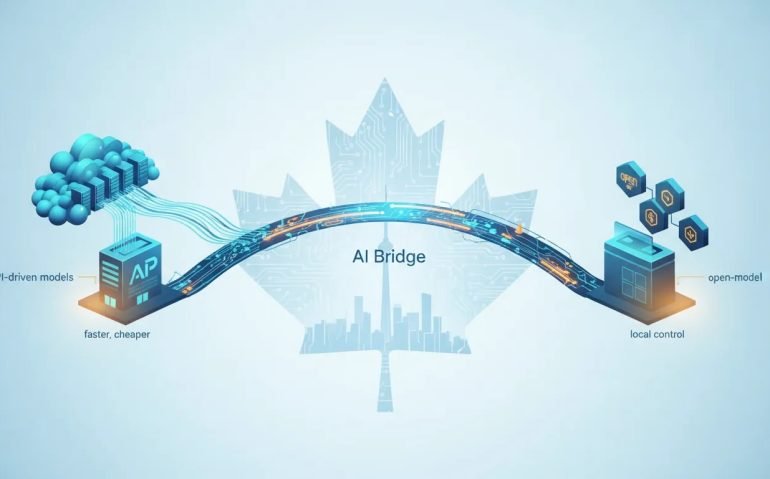
For Canadian businesses, this is not just another flood of product announcements. The big story is that powerful AI capabilities are moving in two directions at the same time. Massive frontier models are becoming faster and less expensive through APIs, while shockingly capable open models are becoming realistic to run locally on business-grade and even consumer hardware.
That means organizations across the GTA, across Canada and globally now have more choices: build with low-cost cloud intelligence, deploy local models where data control matters, or combine specialized tools in an AI stack that is actually fit for the job.
AI news intro
The headline releases are enormous: DeepSeek V4 Pro, Grok 4.6, GLM 5.3, Qwen 3.8 Max and Gemini 3.7 Flash. But the real disruption goes far beyond chatbots. Open-source video, audio and speech systems are rapidly closing the gap with closed commercial tools, while smaller models are making offline AI far more practical.
The business implication is simple. AI procurement can no longer be a one-model decision. The best choice for a cybersecurity workflow, a customer-support process, a local document pipeline, a marketing video and a real-time incident response may be completely different.
The winners will be organizations that match the model to the workload, cost target, latency requirement and privacy constraint.
JoyAI video edit
JoyAI Video Edit is a new open-source video editor that changes existing video through natural-language instructions. It can restyle clothing and environments, remove selected people or objects, fill the resulting background and make highly targeted visual changes such as recolouring animals or changing accessories.
What makes it particularly compelling is speed. The system supports an interactive editing experience with approximately one-second latency in its real-time interface. That is a major shift from the slow, render-heavy workflows traditionally associated with generative video.
Technically, JoyAI Video Edit is a 16-billion-parameter multimodal diffusion transformer. It can produce 720p output at more than 30 frames per second and uses an autoregressive diffusion approach that processes video in chunks. Its editing quality is presented as competitive with systems such as Bernini R and the closed Kling 3 Omni, while operating much faster.
The weights are available under the permissive Apache 2 licence, including commercial use. The practical caveat is infrastructure: the model is roughly 32.5 GB, so local deployment requires a high-end GPU. For Canadian creative agencies, in-house marketing teams and production studios, that may still be an attractive trade-off where iterative control and ownership of the workflow matter.
Scope
Tencent’s Scope targets a stubborn weakness in AI video generation: reliable camera movement. Rather than asking a model to infer a cinematic movement from a sentence alone, Scope takes an input image and a camera path, then generates video intended to follow that trajectory consistently.
It supports paths such as pullback-and-rise, push sweeps, S-curve reveals, crane-up movements and dolly-ins. This is useful because camera direction is not merely a visual flourish. It determines how a story is framed, what product details are revealed and where an audience’s attention goes.
Scope is based on Wan 2.2 and DiffSynth Studio, and its code is released under Apache 2. For teams producing product concepts, architectural visualizations or branded content, this framework offers more direct creative control than hoping an ordinary prompt produces the right shot.
Deepseek V4 0813
DeepSeek V4 Pro 0813 is a massive 1.7-trillion-parameter mixture-of-experts model. Its standout addition is DSparse speculative decoding, intended to improve inference efficiency. The model performs competitively across knowledge and agentic coding evaluations, including benchmarks for complex tasks and software engineering.
On independent intelligence comparisons, DeepSeek V4 is positioned slightly below leading open alternatives such as Kimi K3 and alongside GLM 5.2, while still trailing the leading closed models such as GPT and Grok 4.6. But raw intelligence is only half the story.
Its cost is the huge deal. At roughly six cents per task in the cited comparison, DeepSeek V4 sits in an exceptional intelligence-to-cost position. For businesses with substantial AI workloads, especially coding agents and knowledge work automation, that economics could matter far more than a few points on a leaderboard.
The full raw model is about 893 GB, so this is not a straightforward local deployment. Multiple accelerators are required. Yet open availability means the community can create quantized and compressed variants, including likely GGUF releases, that reduce memory demands over time.
Deepseek harness
DeepSeek also released DeepSeek Harness, its own framework for orchestrating agentic work. A harness is the operational layer around a model. Claude Code is a harness for Claude, and Codex fills a comparable role for GPT.
Previously, teams using DeepSeek commonly relied on third-party frameworks such as Hermes or OpenClaw. A vendor-built harness should, in principle, offer tighter integration with the vendor’s own model behaviours and tool-use patterns.
It is currently in developer preview and may introduce compatibility-breaking changes. That makes it better suited to technical teams willing to experiment than to organizations expecting a stable production standard today. Still, it is an important sign that DeepSeek is building a more complete agent ecosystem rather than supplying only a base model.
Grok 4.6
xAI’s Grok 4.6 is a serious frontier contender. It reaches the level of leading GPT and Claude offerings on the Artificial Analysis Intelligence Index and performs strongly on GDPVal, an evaluation aimed at professional work with real economic value.
It is especially notable in agentic software engineering. Grok 4.6 outperforms some frontier peers on DeepSweep and performs strongly on other coding-oriented tests. It is trained through a broad mix of agentic reinforcement-learning tasks involving knowledge work, general coding, kernel optimization and web development.
The model appears designed for turning vague ideas into functioning first versions of interactive or visual projects. It also performs more self-checking on extended tasks, inspecting its work as it proceeds. For business leaders, this is the kind of capability that makes AI less of a writing assistant and more of an active project collaborator.
Grok 4.6 is closed and paid, but it is available through Cursor, Grok Build, API access and other providers. Its pricing is competitive with Kimi K3 and lower than GPT 5.6, while its speed is also stronger than many competing frontier systems.
Qwen 3.8 max
Alibaba followed through on its promise to open-source Qwen 3.8 Max. This is a 2.4-trillion-parameter mixture-of-experts model, although only 95 billion parameters are active during use. That active-parameter design is a key part of why massive models can be more efficient than their headline size implies.
Across agentic coding, general capability and knowledge benchmarks, Qwen 3.8 Max approaches and sometimes matches leading closed frontier models. It sits close to Kimi K3 and edges near Claude and GPT 5.6 in the cited comparisons, while outperforming DeepSeek V4 on one referenced leaderboard.
It is freely downloadable for organizations with the infrastructure, or usable via API for those that do not. The practical local deployment challenge is enormous: the full system is approximately 4.8 TB. This is a datacentre-scale model, not an office-PC model. Still, Alibaba’s decision to release it openly is a major statement about how quickly high-end AI is becoming accessible outside closed vendor ecosystems.
MiDasheng
Xiaomi’s MiDasheng LM Gen is a flexible audio-scene generator. It can produce speech, music, sound effects and environmental ambience together in a single output. Think vehicle descriptions with a running engine in the background, instrumental music under a speaker or emotionally delivered dialogue in multiple languages.
It is not positioned as the best dedicated music generator, but its strength is composition across audio modalities. That makes it useful for prototyping advertisements, product demos, game scenes, training materials and multimedia concepts where isolated sound effects are not enough.
The entire package is under 12 GB, making it realistic to use on a mid-range GPU. For teams looking to bring audio experimentation in-house, that small footprint is extremely attractive.
Genspark Secondbrain
Genspark SecondBrain is a personal memory platform built around a compact wearable recorder called SecondBrain Note. The device is about the size of a credit card, attaches to a phone or fits in a wallet, and offers a 35-hour battery, a four-microphone array with bone conduction and 64 GB of local storage.
A long press begins recording, while a tap bookmarks an important moment. The software then connects with tools such as email, calendar, Notion, Google Workspace and HubSpot, with permission, to create a personal context layer.
Instead of leaving recordings in a forgotten archive, the system organizes information around people, companies, projects and knowledge. It can generate meeting summaries, retrieve bookmarks, search conversations over long periods and track how ideas evolve. Genspark’s Super Agent can then use that context to draft emails, create proposals and build documents.
For executives and client-facing professionals, the pitch is powerful: less manual note taking and more durable organizational memory. The operational question is equally important: companies should ensure their recording practices, consent processes and data governance align with their legal, privacy and internal-policy obligations.
LTX 2.5 vs Minimax
LTX 2.5 is one of the fastest open video models available, with native audio support, multi-shot generation, broad style handling and improved prompt comprehension. It also remains compatible with previous LTX 2 LoRAs, which is excellent news for teams that have already invested in customization.
But speed is not the whole story. In direct comparisons with MiniMax H3 across difficult prompts, MiniMax delivered better overall quality in most cases.
- Fight scene: MiniMax was more coherent, while LTX 2.5 produced strange motion and inconsistent action.
- Subtle emotional expression: Both struggled, but MiniMax was more realistic and closer to the intended emotional progression.
- Continuous zoom from Earth into a person’s phone: MiniMax handled the transitions more convincingly.
- Complex camera movement: LTX 2.5 performed better, including a visible orbital camera motion that MiniMax did not fully achieve.
- Anime dialogue: MiniMax preserved faces and scene consistency far more effectively.
- Text rendering: MiniMax was the clear winner, while LTX made spelling mistakes and produced less convincing text.
- Pythagorean theorem explanation: MiniMax came closer to explaining the concept and wrote the correct equation.
The conclusion is straightforward. MiniMax H3 offers higher quality for most demanding creative work. LTX 2.5 offers a major speed advantage, generating similar videos in roughly half the time. Its INT8 version is only 22 GB and has ComfyUI support, making it an accessible option for rapid iteration.
Sign language to text
Google DeepMind’s sign-language-to-text model is one of the most meaningful releases of the week. It enables Deaf and hard-of-hearing people to sign into a phone camera and receive text output, including during live conversations through Live Transcribe.
The system was trained on more than 100,000 hours of data spanning over 50 sign languages. It launches with American Sign Language support through Gboard and Live Transcribe on Pixel 11, with additional languages and devices planned.
This is not merely a technical benchmark achievement. It represents a more accessible interface for communication. Canadian organizations thinking seriously about inclusive digital services should pay attention to tools like this as AI moves from novelty to practical accessibility infrastructure.
GPT Ultrafast
OpenAI has previewed an Ultrafast mode for GPT-5.6 Sol that can generate up to 750 output tokens per second, approximately 14 times the standard speed. This is powered through OpenAI’s partnership with Cerebras.
That level of inference speed matters for incident response, security operations, financial research, quantitative trading, real-time customer service and voice applications. In the referenced comparison, typical leading models operate around 60 output tokens per second, GLM 5.2 reaches 111, and Gemini 3.7 Flash reaches 340. GPT Ultrafast is more than double Gemini’s already impressive output speed.
Access remains limited to a private preview group, with broader availability expected as capacity expands. For enterprises, the important shift is clear: latency is increasingly a strategic differentiator, not a minor technical specification.
Qwen 3.8 27B
Qwen 3.8 27B may be one of the most exciting releases for local AI users. The 27-billion-parameter category is exceptionally popular because it can run on high-end personal hardware while delivering serious capability. Qwen 3.6 27B reportedly exceeded seven million downloads, and the newer 3.8 version raises the bar again.
Qwen 3.8 27B is a dense multimodal model with native image and video understanding, strong agentic coding and knowledge-work performance, and support for a context window of up to one million tokens. Across many cited benchmarks, it even exceeds Opus 4.6 Max.
The full model is 56 GB, while an FP8 version is around 30 GB. Quantized GGUF options reduce the size dramatically, with a Q2 version as small as 9 GB. That is the insane part: highly capable AI can now fit within the constraints of lower-to-mid-range GPU hardware.
For Canadian firms handling sensitive internal documents, local deployment can be strategically valuable. It can support greater control over where information is processed, provided implementation is handled responsibly.
GLM 5.3
ZAI’s GLM 5.3 is an absolute beast, especially for agentic coding, long-horizon tasks and cybersecurity. It substantially improves on GLM 5.2 across Terminal Bench, DeepSweep, Agent’s Last Exam, GDPVal, Automation Bench and Humanity’s Last Exam.
The remarkable point is that ZAI did not build an entirely new architecture or simply scale parameter count. It took GLM 5.2 and post-trained it harder with more environments, more diverse tasks and more compute. The result is major performance gains.
Cybersecurity is where GLM 5.3 stands out most. It performs at or near the top on CyberGym, ExploitBench and ExploitGym, surpassing several leading closed models in the cited results. ZAI reports that it has already identified thousands of vulnerabilities across hundreds of open-source projects.
That dual-use capability demands caution. The same model skills that help identify and fix vulnerabilities can also support harmful activity. ZAI is conducting added safety testing before releasing the weights publicly. In the meantime, GLM 5.3 is available through the Z Code plan for use in coding agents.
Gemini 3.7 Flash
Google’s Gemini 3.7 Flash is designed for speed rather than outright frontier dominance. Against other smaller or Flash-class models, it performs extremely well in coding, web development and PDF understanding, with a particular strength in multimodal work.
Gemini can process text, images, video, audio and documents. It can create projects such as a 3D game from generated assets, an interactive parallax website or a website built from information inside a PDF. That breadth makes it especially useful for organizations working with messy real-world business inputs rather than text alone.
At 340 output tokens per second, Gemini 3.7 Flash is exceptionally fast. The trade-off is cost. It is priced higher than some competing small models, including GPT 5.6 Luna Max in the cited comparison. Businesses choosing Gemini are therefore paying for speed and multimodal capability.
It is available through Google’s Anti-Gravity coding platform, AI Studio, Android Studio and, for eligible Pro and Ultra subscribers, the Gemini app in supported countries.
Minimax Music 3
MiniMax Music 3 is positioned as the best open-source music generator currently available. It can produce polished songs from prompts that specify genre, tempo, key, instrumentation and overall mood, while also accepting structured lyrics and labels such as intro, verse, chorus, bridge and outro.
Accessibility is the huge advantage. The full model is only 9.8 GB, and an INT8 version is just 2.5 GB. That means local music generation is no longer reserved for expensive workstation setups.
For creative teams, this opens up rapid audio prototyping. The output can help explore concepts, create placeholders or build original musical assets, subject to each organization’s own quality standards and rights-management practices.
Index TTS 2.5
Index TTS 2.5 is a state-of-the-art open text-to-speech system capable of cloning a voice from only a few seconds of reference audio. It can reproduce the vocal character closely while generating entirely new speech.
The model handles emotion and multiple languages, enabling uses such as expressive narration and dubbing a scene from one language into another while preserving a consistent voice identity. The full package is approximately 5.5 GB, making it suitable for many consumer devices.
For Canadian media, training and customer experience teams, multilingual voice generation is potentially transformative. But voice cloning also carries serious consent and impersonation risks. Responsible use requires clear permission from the original speaker and careful safeguards around identity, disclosure and misuse.
Magi 2
Magi 2 is another open-source video generator, but it sits at the opposite end of the spectrum from LTX 2.5. It is huge: a 114-billion-parameter mixture-of-experts model, with six billion active parameters during generation and native audio support.
It currently supports 10-second clips and includes a refiner component capable of output up to 1080p. The infrastructure requirements are the problem. At around 228 GB, it cannot realistically run on typical consumer hardware. The recommended setup calls for eight NVIDIA Hopper GPUs.
Its open release is commendable, particularly for researchers interested in its architecture. For most businesses, however, Magi 2 is more a signal of where open video AI is headed than a practical local tool today.
Cactus Needle
Cactus Needle 2 shows the opposite philosophy: make AI tiny enough to run almost anywhere. It contains only 45 million parameters, is packaged in a 14 MB binary and uses about 28 MB of RAM. No GPU VRAM is required.
It will not replace a frontier reasoning system, and it is not meant to. Needle 2 is suited to device control, tool calls and document information extraction. It is not suited to complex, long-horizon agentic reasoning.
Its speed is exceptional: roughly 500 tokens per second on a Raspberry Pi 5, up to 1,500 on VR devices and around 700 on inexpensive phones. For embedded systems, retail devices, industrial workflows and offline applications, this kind of lightweight model could be far more useful than an oversized general-purpose model.
WorldClaw
Tencent Hunyuan’s WorldClaw aims to generate complete open 3D worlds from text descriptions rather than isolated objects. It can create settings such as snowy villages and desert battlefields, including terrain, materials, depth information, normal information and individual assets.
The system uses multiple agents to plan layout and materials, generate assets sequentially from coarse to fine, then inspect and refine the final world for physical consistency. This is a major step beyond simply generating an attractive image.
Potential downstream use cases include video game production, virtual environments and immersive design. A GitHub repository is available, though there is no stated confirmation that the full system will be open-sourced.
Dyna 2
Dyna 2 tackles one of robotics’ hardest problems: training robots without endlessly collecting robot-specific data. Its approach is refreshingly direct. Learn from humans first.
The world-action model was trained on more than one million hours of first-person human video, representing roughly 170 years of continuous experience. The data includes everyday tasks such as folding clothes, cooking, cleaning and assembling objects.
Dyna 2 learns how the world changes when humans interact with it, then transfers that knowledge to robots with only a relatively small amount of robot data. Researchers found a scaling relationship: as human training data increased, performance improved on unfamiliar robot data.
This could be a major unlock for robotics. Rather than treating every machine and task as a separate data-collection challenge, the field may increasingly use broad human experience as a foundation for robotic competence.
Nemotron Lightning
NVIDIA released NeMoTron 3.5 Lightning, a 30-billion-parameter mixture-of-experts model with a one-million-token context window, alongside NeMo Switchyard, an open-source model router.
NeMoTron Lightning is not the most intelligent model in its size class. It trails Qwen 3.6 in the cited comparison, though it is competitive with Qwen 3.5 and Gemma 4. Its defining strength is speed, delivering roughly double the throughput of Qwen 3.6 and even exceeding Gemini 3.6 Flash in the referenced data.
Switchyard acts as traffic control for AI workloads. It can route difficult jobs to a stronger agent and simple jobs to a faster, smaller model. NVIDIA reports that pairing Switchyard with Opus 4.8 and other systems completed more tasks than using Opus alone while costing around three times less.
This is a crucial enterprise idea. The future of AI deployment may not be one winning model. It may be intelligent routing across several models, continuously balancing quality, cost and latency.
MatrAIx
MatrAIx is an ambitious attempt to simulate the global human population using 8.3 billion persona agents. The project describes 1,290 persona attributes and more than 1,000 applications.
The concept is to let simulated people with different backgrounds, preferences and behaviours interact with apps, shopping experiences, surveys or chatbots. Product teams could then receive feedback, scores and behavioural data without recruiting massive groups of real participants.
It is a fascinating possibility for product testing and research, but the biggest question is unavoidable: how closely do simulated preferences and behaviours match actual people? The answer is not clear yet. Synthetic users can be useful as one input to product development, but they should not be mistaken for a substitute for real customer research without strong validation.
Muse Glimmer
Meta’s Muse Glimmer is an open-source, 30-billion-parameter dense model released under Apache 2. Meta compares it with Gemma 4 and Qwen 3.6, highlighting results that suggest solid performance.
However, independent leaderboard comparisons provide a more restrained picture. Muse Glimmer can outperform Gemma 4 in some areas, but it does not surpass Qwen 3.6 overall, despite Qwen using fewer parameters. With Qwen 3.8 27B now arriving, Muse Glimmer looks relatively underwhelming.
The full model is around 60 GB, and compressed GGUF variants are also available. It remains a viable option for teams who want to evaluate another open model under a permissive licence, but the current local-AI market is incredibly competitive. Strong benchmarks and transparent independent evaluation matter more than polished vendor charts.
The bottom line: this week’s releases confirm that AI is accelerating across every layer of the stack. Frontier models are becoming more capable and economical. Open models are becoming more deployable. Video, voice, music, robotics and accessibility are advancing at the same time. Canadian business leaders need to move beyond asking whether AI matters and start asking where it can create measurable value, safely and at the right cost.
Which of these AI tools could make the biggest difference in your organization: local Qwen models, ultrafast inference, agent routing, generative video or an AI-powered institutional memory?
FAQ
What is the most practical open model for local AI deployment?
Qwen 3.8 27B is one of the strongest practical options because it combines high benchmark performance, multimodal capability and quantized versions that can fit on relatively modest GPU hardware.
Why does AI inference speed matter for businesses?
Speed matters for time-sensitive workloads such as cybersecurity incidents, customer service, voice systems, financial analysis and agentic workflows. GPT Ultrafast and Gemini 3.7 Flash demonstrate how latency is becoming a major competitive factor.
Which open video model offers the best quality?
In the described comparisons, MiniMax H3 produced better results than LTX 2.5 in most quality tests, including coherent motion, character consistency, text rendering and complex scene continuity. LTX 2.5 remains valuable for its exceptional generation speed.
What is an AI model harness?
A harness is the framework that orchestrates an AI model’s agentic behaviour, tools and workflows. DeepSeek Harness is DeepSeek’s own developer-preview framework for running DeepSeek models as agents.
What should organizations consider before using voice-cloning AI?
Organizations should obtain clear consent from the voice owner, establish safeguards against impersonation, disclose synthetic audio where appropriate and ensure the use complies with internal governance and privacy requirements.