
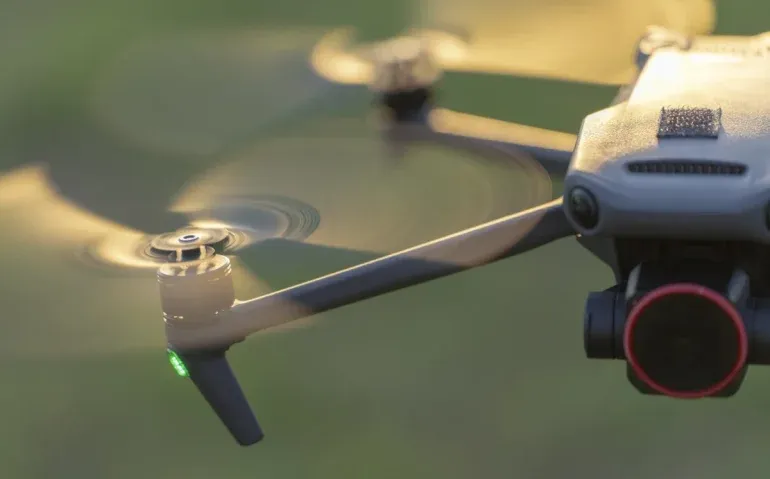
Imagine a flying robot that hides in plain sight—not by shrinking, darkening, or blending into the background, but by spinning so quickly that the human eye can no longer resolve its outline. Researchers have demonstrated a prototype drone that rotates roughly 25 times every second, creating a translucent blur in mid-air. Below, we explore the science that makes this possible, the engineering hurdles still to overcome, and the broader implications of a platform that is hard to see yet impossible to ignore.
1. Why Spin at All?
Traditional stealth concepts focus on reducing radar, infrared, or acoustic signatures. By contrast, the spinning-blur approach aims to defeat visual detection—specifically, the rapid object-tracking ability of the human eye. At about 25 Hz (25 revolutions per second), the craft’s surface details smear into an almost transparent disk. For an observer, that turns a distinct silhouette into a fleeting shadow, buying precious seconds before recognition.
1.1 Human Visual Limits
• The human eye typically resolves flicker at up to 60–75 Hz but has far poorer spatial resolution for rapidly rotating objects.
• Motion blur increases with angular velocity; above ~15 Hz, fine edges vanish.
• Peripheral vision, which detects motion best, is paradoxically more susceptible to blur, further camouflaging the drone.
2. Engineering Anatomy of a Spinning Drone
Building a craft that holds position while rotating introduces unique design constraints:
• Rotor Arrangement: Instead of four static arms like a quadcopter, the entire airframe—or an outer ring—spins around a central hub.
• Control Electronics: Onboard sensors (IMUs, magnetometers) must correct for Coriolis forces and rapidly changing reference frames.
• Power & Data Transfer: Slip rings or wireless power links carry electricity to spinning motors, while optical or RF links transmit telemetry.
• Structural Integrity: Centrifugal stresses grow with the square of angular speed; carbon-fiber composites are common to keep mass low without sacrificing strength.
3. The Elephant in the Sky: Acoustic Signature
No matter how effectively the craft blurs visually, the noise it produces remains conspicuous. Rapid rotation churns air violently, and blade-tip speeds approach the transonic regime, generating:
• Broadband “whooshing” from vortex shedding
• Harmonic tones from blade passage frequency (25 Hz × blade count)
• Potential micro-pressure waves that propagate farther in quiet environments
Engineers are experimenting with serrated trailing edges, variable-pitch blades, and active noise-cancellation, but true acoustic stealth is still elusive.
4. Potential Applications
• Military reconnaissance: Delay visual detection during short overflights or peeks above cover.
• Wildlife monitoring: Approach skittish animals without presenting a clear shape (though sound remains an issue).
• Search-and-rescue beacons: High-visibility lighting can be embedded in the blur to create attention-grabbing halos when desired.
5. Ethical and Regulatory Considerations
As with all stealth technologies, dual-use concerns loom large. Regulators will need to gauge:
• Air-traffic safety—unseen drones pose collision risks.
• Privacy—harder-to-spot drones complicate visual monitoring and enforcement.
• Noise pollution—audible but invisible craft may heighten public annoyance.
6. Future Research Directions
• Multi-modal stealth: Combining visual blur with radar-absorbing materials.
• Adaptive spin: Variable-RPM systems that spin only when detection risk is high, conserving energy and reducing wear.
• Psychoacoustic masking: Emitting counter-phase or frequency-shifted sounds to shroud the drone’s acoustic footprint.
The spinning-blur drone is a compelling reminder that stealth is not solely the domain of exotic coatings or complex geometries. Sometimes, defeating detection is as simple—and as complex—as becoming a blur. Yet until engineers conquer the sound it makes, the craft may remain more of a curiosity than an invisible spy.