Quantum computing has long felt like the exclusive domain of national laboratories and well-funded tech giants. That perception is changing. Barcelona-based start-up Qilimanjaro has released a do-it-yourself kit that brings a small, gate-based quantum processor to the workbench of researchers, educators, and ambitious hobbyists. Below is an in-depth look at what the kit offers, what skills you need to assemble it, and how it might reshape hands-on quantum exploration.
What Makes a Quantum Computer Different?
Classical computers store information in bits, which take on values of 0 or 1. Quantum computers use qubits, which leverage superposition and entanglement to exist in multiple states simultaneously. This property allows certain problems—factorization, unstructured search, quantum chemistry simulations—to be solved in dramatically fewer steps.
However, qubits are fragile. They must be carefully isolated from noise, precisely controlled, and read out with high fidelity. Until now, maintaining these conditions has required multimillion-dollar dilution refrigerators and specialized microwave electronics. Qilimanjaro’s kit tackles this barrier by packaging a small number of superconducting qubits and control hardware into a form factor suitable for a standard laboratory or advanced makerspace.
Inside the Qilimanjaro DIY Quantum Kit
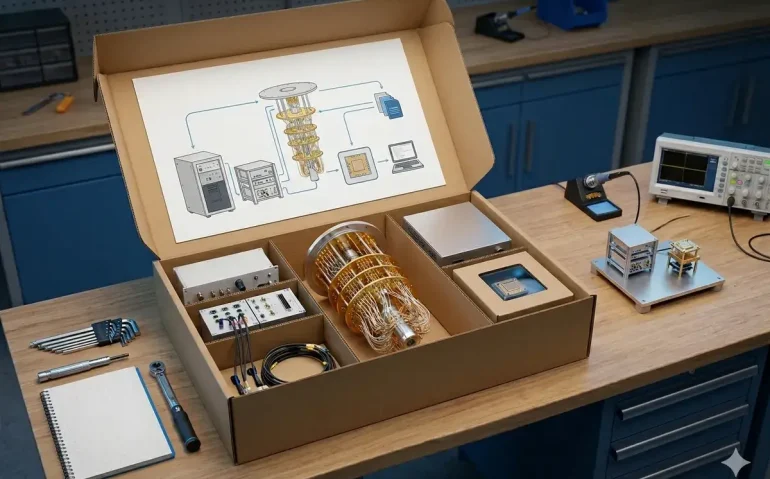
The kit arrives in a rugged shipping crate with labeled foam compartments. A typical configuration (dubbed the “Qili-6”) contains:
- A six-qubit superconducting processor mounted on a compact cryostat insert
- Miniature pulse-modulation electronics capable of generating microwave control signals
- A closed-cycle cryocooler that reaches 10–15 mK without liquid helium
- High-bandwidth coaxial cabling with low-temperature attenuators and filters
- A PCIe control card that plugs into a conventional desktop PC
- Qilimanjaro’s open-source software stack, including a Python SDK and Jupyter-based tutorials
- Safety interlocks, thermal sensors, and step-by-step assembly documentation
Optional expansions add qubit-count upgrades, an AI-assisted pulse optimizer, and a calibration toolkit.
Required Skills and Tools
The company advertises the kit as “graduate-student friendly,” but certain competencies are assumed:
- Intermediate electronics and soldering skills
- Familiarity with basic cryogenic safety procedures
- Comfort with Linux, Python, and command-line environments
- Understanding of linear algebra and complex numbers (for quantum gate design)
Common lab tools—oscilloscope, multimeter, torque wrench, and an antistatic mat—are also required. While the manual is comprehensive, Qilimanjaro recommends working in teams of two or more to minimize errors during the delicate wiring stage.
Step-by-Step Assembly Overview
1. Cryostat Preparation
Users mount the pulse lines and DC bias leads on the 3-stage cryocooler. Proper heat-sinking at each temperature stage (50 K, 4 K, 15 mK) is critical to prevent thermal loading.
2. Processor Installation
The six-qubit chip is clamped to the cold plate with indium gaskets to ensure thermal conductivity while protecting the delicate aluminum Josephson junctions.
3. Wiring and Filtering
Coax lines are routed through low-pass and eccosorb filters. Attenuators down-convert room-temperature noise before signals reach the qubits.
4. Electronics Integration
The control card synchronizes arbitrary waveform generators and digitizers. Calibration scripts validate pulse shaping, Rabi oscillations, and T1/T2 coherence times.
5. Software Configuration
After installing the QiliSDK, users can write quantum circuits in a QuantumCircuit Python class and push them to the hardware with a single command:
from qili.sdk import QiliBackend
qc = QuantumCircuit(6)
qc.h(0); qc.cx(0,1)
backend = QiliBackend()
backend.run(qc)
Software Stack and Programming Environment
The SDK exposes two abstraction layers:
- High-level API: Similar to Qiskit or Cirq, letting users define circuits with familiar gate sets.
- Pulse-level API: For advanced users who need custom microwave envelopes, enabling experiments in optimal control, dynamic decoupling, and error mitigation.
The software ships with visualization tools—Bloch spheres, fidelity curves, and heatmaps—to help diagnose decoherence sources.
Potential Applications and Experiments
With six qubits, you will not crack modern encryption, but you can perform meaningful research:
- Implement the Variational Quantum Eigensolver (VQE) on small molecular Hamiltonians
- Test quantum error-correcting codes such as the three-qubit bit-flip and phase-flip codes
- Explore quantum machine-learning kernels for classification tasks on toy datasets
- Investigate quantum chaos and entanglement growth in random circuits
Pricing and Availability
The base Qili-6 kit lists at €49 900, a fraction of traditional turnkey cryogenic systems that easily exceed half a million euros. Academic discounts and multi-unit bundles bring the cost lower. Lead time is currently 8–12 weeks due to supply-chain constraints on superconducting chip fabrication.
Caveats and Future Outlook
Despite the approachable price tag, keep in mind:
- Maintenance: Cryocoolers require periodic vacuum pump servicing and helium re-pressurization.
- Limited qubit count: Algorithms with non-trivial error-correction overhead remain out of reach.
- Evolving standards: As quantum hardware matures, today’s microwave control protocols may rapidly change.
Qilimanjaro plans to release a 12-qubit upgrade in mid-2025 and is collaborating with European universities to build a user community that shares calibration data and open-source improvements.
The Qilimanjaro DIY quantum computer kit lowers the barrier to hands-on experimentation with real qubits. Whether you are a graduate student validating theoretical work, an educator enriching laboratory courses, or an industry engineer prototyping quantum algorithms, the kit offers a rare blend of affordability and depth. Just be prepared to wield both a torque wrench and some linear-algebra chops: quantum tinkering remains as challenging as it is exciting.