The Royal Netherlands Air Force is pioneering a neuro-adaptive training system that harnesses pilots’ brainwaves to make virtual-reality (VR) flight simulations more demanding in real time. Below, we explore how this cutting-edge approach works, why it matters, and what hurdles still lie ahead.
The Core Idea: Turning Brain Activity into a Difficulty Dial
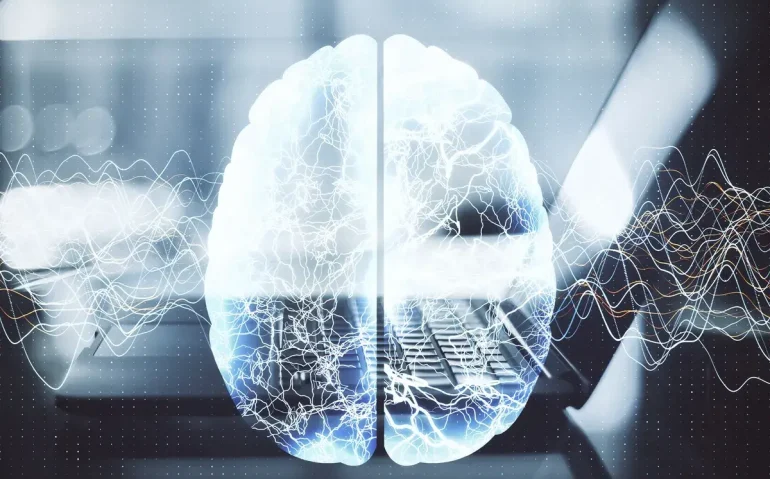
Traditional flight simulators rely on preset scenarios or manual instructor input to raise or lower difficulty. The Dutch programme replaces that static model with a closed feedback loop: an electroencephalography (EEG) headset measures a trainee’s neural signals, an AI model interprets those signals as a workload score, and the VR environment instantly intensifies or relaxes its challenges. In effect, the pilot’s own brain acts as the throttle for the simulation’s complexity.
How the Technology Works
1. EEG Data Capture
Lightweight, aviation-grade EEG sensors are embedded in the pilot’s helmet liner. These sensors pick up oscillatory patterns—alpha, beta, and theta waves—associated with concentration, stress, and fatigue. Because cockpits are noisy and full of motion, the headset incorporates active noise cancellation and dry electrodes that stay stable without conductive gel.
2. Real-Time Signal Processing
Raw EEG data is streamed to an onboard processor that filters out artefacts (e.g. eye blinks, muscle tension) in milliseconds. Feature extraction algorithms convert the cleaned waveform into numerical vectors representing mental workload indicators.
3. AI Workload Estimation
A supervised learning model—trained on thousands of labelled EEG segments from novice to expert pilots—maps those vectors to a workload index on a 0-100 scale. If the score creeps above a predefined threshold indicating cognitive overload, the simulator eases off; if it sinks too low, the scenario becomes tougher.
4. Dynamic Scenario Adjustment
The VR engine changes variables such as weather severity, instrument failures, or enemy aggressiveness. Because updates are incremental and continuous, trainees rarely notice a discrete shift; instead, the experience feels naturally progressive, mirroring the ebb and flow of a real sortie.
Why Adaptive Difficulty Matters
• Efficient Skill Acquisition: Keeping pilots in the “optimal challenge zone” (neither bored nor overwhelmed) accelerates mastery of complex manoeuvres.
• Objective Performance Metrics: EEG-derived workload scores complement traditional metrics like reaction time and precision, giving instructors a multidimensional view of competence.
• Reduced Instructor Load: Automation allows a single human coach to oversee more trainees simultaneously, a crucial benefit amid pilot shortages.
Scientific Foundations
The project builds on two decades of adaptive automation research. Studies at NATO’s HFM (Human Factors and Medicine) panels show that EEG-based workload measures correlate strongly (r ≈ 0.8) with subjective NASA-TLX questionnaires. The Dutch team fine-tuned these findings for fast-jet profiles, where eye-tracking and heart-rate variability alone proved insufficient due to high G-forces and constrained head movement.
Challenges and Ethical Considerations
Data Privacy: Brain signals are uniquely identifiable; rigorous anonymisation and encryption protocols are essential.
False Positives: Mood, caffeine intake, or lack of sleep can skew EEG readings, potentially causing the simulator to misjudge difficulty. Redundant biosensors (e.g. galvanic skin response) are being tested to cross-validate workload.
Psychological Impact: Continual escalation could induce training stress injuries; programmes must embed recovery phases and allow manual override.
Certification: Any system that influences flight curriculum must meet military aviation standards (STANAG 4568) before widespread deployment.
The Road Ahead
Pilots in the F-35 transitional syllabus will begin large-scale trials next year. Future iterations aim to:
• Integrate haptic feedback suits for somatic realism.
• Feed the same AI model into live aircraft HUDs, dynamically filtering information during high-stress manoeuvres.
• Share de-identified workload datasets across NATO allies to standardise neuro-adaptive training protocols.
Key Takeaway
By merging brain-computer interfaces with adaptive AI, the Dutch Air Force is transforming flight training into a living, self-tuning system. If successful, this approach could redefine how militaries—and eventually civilian aviation schools—prepare aviators for the mental rigours of modern air combat.