


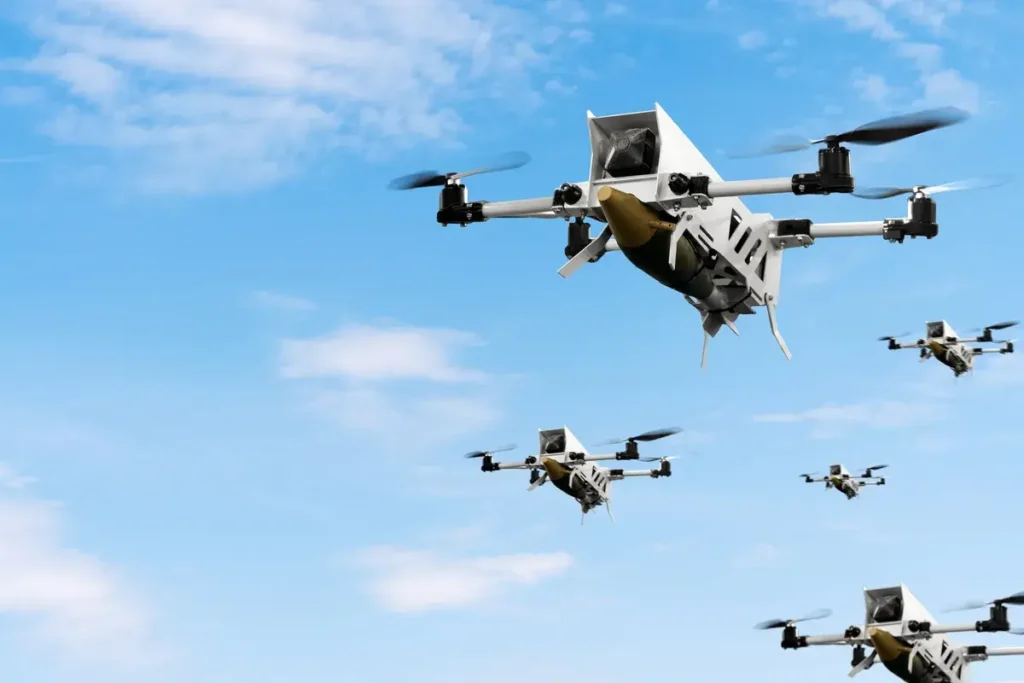
In an era dominated by hypersonic missiles, autonomous swarms, and fifth-generation stealth jets, the re-appearance of a slow, inexpensive Iranian-designed drone on the modern battlefield seems counter-intuitive. Yet by 2026 the United States has found strategic value in repurposing exactly such a platform—turning a $50,000 unmanned aircraft against its country of origin. Understanding why requires a look beyond price tags into doctrine, logistics, and the complex chessboard of Gulf security.
The Drone in Question: A Brief Technical Profile
The airframe most frequently cited is an evolution of the Shahed-131/136 lineage. Built around a molded-fiberglass delta wing, it carries:
- Commercial off-the-shelf (COTS) GPS/INS navigation modules
- A small piston or rotary engine using ordinary gasoline
- Warhead payloads between 30–50 kg, swappable for ISR sensor kits
- Range approaching 1,000 km at cruise speeds of 150–200 km/h
Key point: virtually every sub-component—from servos to microcontrollers—exists in open markets, allowing rapid assembly and equally rapid reverse engineering.
Why the U.S. Would Field an Iranian Design
1. Exploiting an Established Supply Chain
After years of sanctions evasion Iran’s procurement web is well practiced at sourcing COTS parts. By tapping the same grey-market channels, U.S. special programs can acquire spare parts anonymously, build airframes in-theater, and maintain plausible deniability during covert actions.
2. Cost-Per-Shot Economics
Patriot interceptors cost roughly $3–4 million each. Forcing Iran to fire one at a $50,000 drone produces a 60:1 cost exchange ratio favoring Washington. In drawn-out escalations, bleeding an adversary’s magazine can be more decisive than destroying hardware outright.
3. Tactical Utility as Decoys and Saturation Assets
Even “primitive” drones complicate radar pictures. When launched in waves, they:
- Soak up surface-to-air missile (SAM) capacity
- Distract operators while high-end stealth or cruise missiles slip through
- Trigger enemy radars, revealing emitter locations for follow-up strikes
4. Low Emissions, Low Signature
Ironically, a noisy two-stroke engine can be stealthier than a jet turbine in the electromagnetic spectrum. Minimal RF emissions make the drone difficult to locate via passive sensors until it is visually acquired—often too late.
Reverse Engineering: Turning Threat into Asset
Captured examples gave U.S. engineers a shortcut to rapidly deploy “friendly clones.” Components were swapped for U.S. equivalents, firmware rewritten, and datalinks hardened with frequency-hopping protocols. Because airframe geometry stayed the same, Iran’s existing radar filters often still classify them as domestically built traffic, delaying engagement decisions.
Psychological and Political Payoffs
Using an enemy’s own invention against them creates narrative leverage:
- Domestic messaging: Showcases U.S. ingenuity and frugality, countering perceptions that Washington only fights with gold-plated weapons.
- International signaling: Implies that any technology proliferated by Iran can—and will—be turned inward when escalation crosses red lines.
Limitations and Countermeasures
The drone’s wooden propeller and slow speed also make it a target for low-cost counter-UAS tools—shotgun-style flechette rounds, microwave guns, even WWI-style barrage balloons. Iran has begun:
- Layering short-range AAA with radar proximity fuzes
- Deploying passive acoustic arrays along likely ingress corridors
- Integrating AI image recognition on EO/IR towers to reduce human reaction time
These adaptations illustrate the cat-and-mouse cycle that cheap drones excel at perpetuating.
Strategic Takeaways for 2026 and Beyond
1. Affordability is a weapon. In an age of trillion-dollar defense budgets, a platform’s effectiveness is increasingly judged on the enemy resources it drains rather than the sophistication it flaunts.
2. Open marketplaces undermine export controls. So long as COTS electronics are globally available, states and non-state actors alike can iterate faster than control regimes can enforce.
3. Doctrine must evolve. Militaries that fail to adapt to low-end threats risk strategic paralysis: allocating exquisite air-defense assets to $50,000 targets imposes unsustainable opportunity costs.
Conclusion
The U.S. adoption of a cheap Iranian drone encapsulates a broader shift in twenty-first-century conflict. High-end systems still matter, but the ability to field—and exploit—rudimentary technology at scale can prove just as decisive. As long as asymmetric economics favor the attacker, expect the skies over the Gulf and beyond to remain crowded with unlikely, low-tech intruders.