


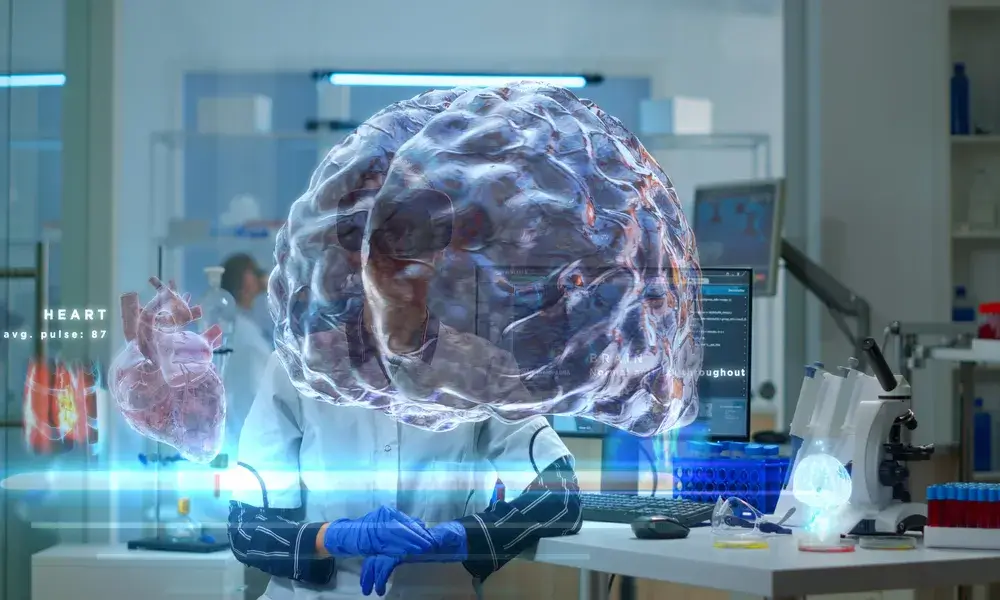
Over the past decade, advances in high-performance computing (HPC) have propelled neuroscience into a new era.
Today’s top-tier supercomputers—machines capable of performing quadrillions of calculations per second—can run software that
mimics the electrical activity of billions of interconnected neurons. While we remain far from achieving a true “digital human,” these
large-scale brain simulations are already reshaping how researchers probe cognition, disease, and even the nature of consciousness.
How We Reached the Billion-Neuron Milestone
Early neural simulations in the 1990s were limited to hundreds of neurons due to memory and CPU constraints.
Three technological currents converged to change that trajectory:
- Exascale Hardware: Modern systems such as Frontier, Fugaku, and LUMI provide more than an exaflop (1018 operations per second), offering unprecedented compute density and high-bandwidth memory.
- Neuromorphic Inspiration: Specialized chips like Intel’s Loihi and IBM’s TrueNorth have influenced software toolkits that more efficiently map spiking neural networks onto conventional GPUs and CPUs.
- Algorithmic Optimizations: Sparse data structures and event-driven simulators such as NEST, SpiNNaker, and Brian2 reduce computational overhead when neurons are idle, making billion-neuron runs feasible.
What a “Whole-Brain Simulation” Really Means
It is important to clarify that a current billion-neuron model is not a full recreation of the human brain, which contains roughly 86 billion neurons and an estimated 100 trillion synapses.
Instead, researchers typically build mesoscale models in which each simulated unit can represent thousands of biological neurons.
These abstractions sacrifice cellular detail for speed, but they still capture large-scale dynamics such as oscillations, global synchronization, and signal propagation between cortical regions.
Scientific Payoffs
Large-scale simulations already offer several breakthroughs:
- Testing Theories of Consciousness: Competing hypotheses—such as Integrated Information Theory and Global Workspace Theory—predict different patterns of network-level activity. Simulations let researchers toggle parameters impossible to manipulate in living brains.
- Drug Discovery for Neurological Disorders: Virtual brains provide a sandbox in which to model how molecular changes ripple up to behavior, accelerating preclinical testing for epilepsy, Alzheimer’s, and depression.
- Decoding Brain Rhythms: By reproducing alpha, beta, and gamma oscillations in silico, scientists can explore how frequency bands coordinate perception and memory formation.
Technical and Biological Hurdles
Despite rapid progress, several critical challenges remain:
- Data Fidelity: High-resolution brain atlases guide network wiring, but we still lack complete connectomes for most species, let alone humans.
- Energy Consumption: A full 86-billion-neuron simulation could draw tens of megawatts—orders of magnitude above the ~20 W consumed by the biological brain.
- Plasticity and Learning: Incorporating realistic synaptic plasticity (LTP, LTD) dramatically increases computational load and memory requirements.
- Validation: Bench-marking virtual circuits against real neural recordings (EEG, fMRI, single-unit data) remains labor-intensive and controversial.
Ethical and Philosophical Questions
As simulations grow more detailed, they raise profound questions:
- Machine Consciousness: If a model exhibits human-like patterns of firing, does it possess subjective experience? The debate straddles neuroscience, philosophy, and computer science.
- Data Privacy: Personal connectome data could theoretically be used to build individualized brain models, making anonymization vitally important.
- Dual-Use Concerns: Insights derived from brain simulations might aid neuro-enhancement or, conversely, neuro-manipulation.
Future Directions
The field is moving toward multi-scale integration, where ion-channel kinetics, dendritic morphology, and large-scale network topology coexist in a single framework. Key initiatives include:
- The EU’s EBRAINS Platform: Successor to the Human Brain Project, offering cloud access to HPC clusters and shared datasets.
- U.S. BRAIN Initiative: Funding projects that couple petascale computing with next-gen neuroimaging and optogenetics.
- Hybrid Analog-Digital Systems: Combining neuromorphic cores for spiking dynamics with classical CPUs for large-scale logistics to lower energy footprints.
Simulating the human brain on a supercomputer is no longer a distant dream but an evolving reality accelerating year by year.
While technical, ethical, and biological obstacles persist, the synergy between neuroscience and HPC promises insights that were previously unattainable.
By decoding the computational logic of our own minds, we are not merely building better computers—we are charting the future of understanding what it means to be human.