


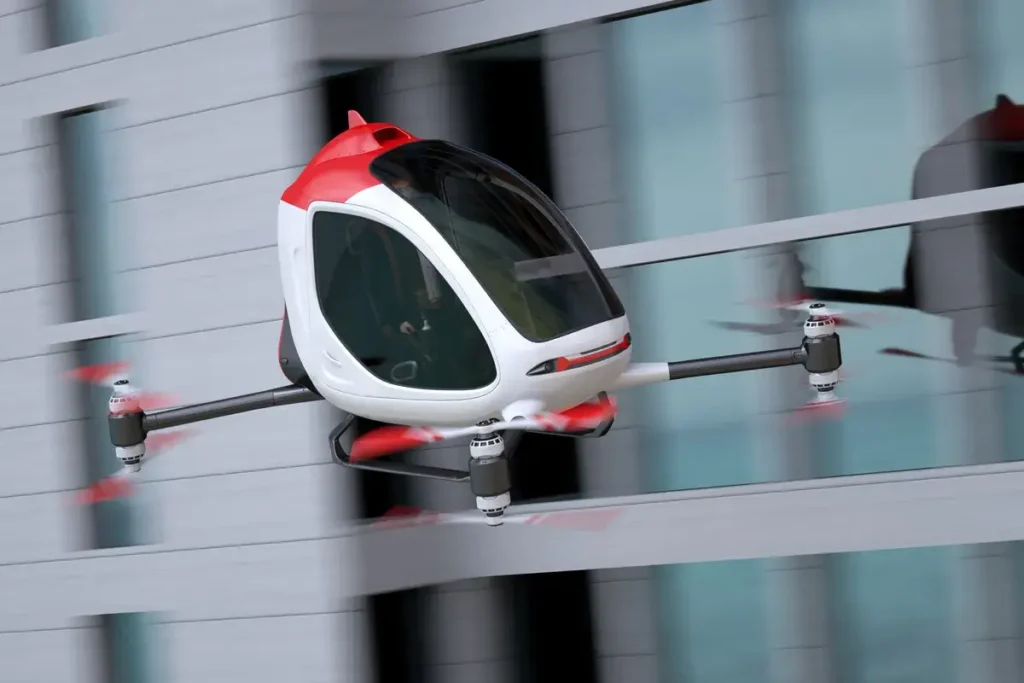
Uncrewed aerial vehicles capable of lifting a person are edging closer to reality.
While no civil aviation authority has yet certified drones for routine passenger flights,
prototypes are already being tested in war zones for emergency medical evacuation—and criminal networks are eyeing the same technology for covert transport.
Below is a deeper look at the technical, regulatory, and ethical landscape that may soon allow the first human passengers to fly without a pilot on board.
The Current Regulatory Landscape
Civil regulators such as the U.S. Federal Aviation Administration (FAA) and the
European Union Aviation Safety Agency (EASA) treat any aircraft designed to carry humans—crewed or uncrewed—as a category requiring the strictest
air-worthiness certification. As of today:
- No nation has issued full type certification for an uncrewed aircraft intended to carry a person.
- Experimental certificates have been granted for testing purposes only, usually under controlled conditions and without fare-paying passengers.
- Military forces operate under separate rules, giving defense ministries more latitude to experiment with higher-risk concepts such as robotic casualty evacuation.
Battlefield Evacuation: A High-Stakes Use-Case
Removing wounded soldiers from the line of fire within the golden hour can be the difference between life and death.
Human-lifting drones—or Robotic MEDEVAC platforms—promise several tactical advantages:
- Reduced danger to aircrews: No pilot means no personnel risked when flying into hostile zones.
- Smaller target profile: eVTOL drones are typically smaller and quieter than traditional helicopters, complicating enemy targeting.
- Rapid point-to-point lift: Vertical take-off allows casualty pickup from trenches, rooftops, or narrow streets without a landing strip.
Prototypes under evaluation include the U.S. Army’s Joint Tactical Autonomous Aerial Resupply System (JTAARS),
Israel’s Cormorant CityHawk, and Australia’s adaptation of large quad-rotors for casualty extraction. Field trials have demonstrated flights carrying 100–200 kg payloads over several kilometers, enough for a fully equipped soldier or a stretcher patient plus minimal medical gear.
Medical Challenges
Evacuation drones must integrate life-support equipment, vibration isolation, and real-time biomonitoring.
Military medics emphasize the need for autonomous routing that considers not just shortest distance but also
g-force limits, air pressure variations, and onboard telemedicine links so physicians can monitor the patient while the drone is airborne.
Technical and Safety Hurdles
Carrying any human payload introduces a cascade of engineering challenges:
- Redundancy: Multiple motors, flight computers, and power sources are mandatory to survive single-point failures.
- Energy density: Batteries still impose weight and range limits; hybrid or hydrogen fuel-cell systems are being explored.
- Sense-and-avoid: The drone must detect and avoid everything from power lines to incoming artillery in real time.
- Crash survivability: Capsules or crumple structures are needed to protect occupants during hard landings.
Criminal Applications: Smuggling 2.0
Organized crime has already embraced small drones to move narcotics over borders and prison walls.
Scaling up to human-sized payloads could enable:
- Rapid border crossing: Short hops bypassing terrestrial checkpoints, especially across rivers or rugged terrain.
- Remote drop zones: GPS-guided deliveries into secluded clearings, minimizing interception risk.
- Extraction of high-value targets: A “getaway drone” could lift a fugitive from an urban rooftop before police can cordon the area.
Law-enforcement agencies worry that autonomous flight profiles and encrypted command links will make interdiction harder than with crewed aircraft.
Counter-drone technologies—radar, RF jammers, and directed-energy weapons—are being upgraded to handle heavier, faster, and higher-flying threats.
Ethical and Legal Crossroads
The dual-use nature of passenger drones raises thorny questions:
- International humanitarian law: Is a robotic MEDEVAC platform a protected medical vehicle or a legitimate target if it can also carry supplies or weapons?
- Data privacy: Onboard cameras and sensors collect sensitive imagery—who owns and secures that data?
- Accountability: In an accident, liability could span manufacturers, software developers, remote operators, and military commanders.
- Equity of access: Will humanitarian corridors adopt the technology, or will early benefits flow mainly to wealthy militaries and illicit actors?
The Road to Certified Passenger Drones
Even as militaries fast-track experimental flights, civilian certification remains a multi-year process.
Urban air-mobility startups such as Joby Aviation, Volocopter, and EHang
target 2025–2028 for commercial operations, but those plans rely on piloted or remotely supervised flights under controlled airspace corridors.
Fully autonomous, unsupervised human transport will require:
- Mature detect-and-avoid standards coordinated globally.
- Demonstrated safety levels equivalent to or better than current airliners (≈1 fatal accident per 10 million flight hours).
- Public acceptance proven through transparent incident reporting and community engagement.
In the meantime, war zones may become the proving ground—and criminal enterprises the opportunistic adopters—of the world’s first true passenger drones.
Whether society can harness the life-saving potential while curbing the darker uses will shape aviation’s next disruptive chapter.